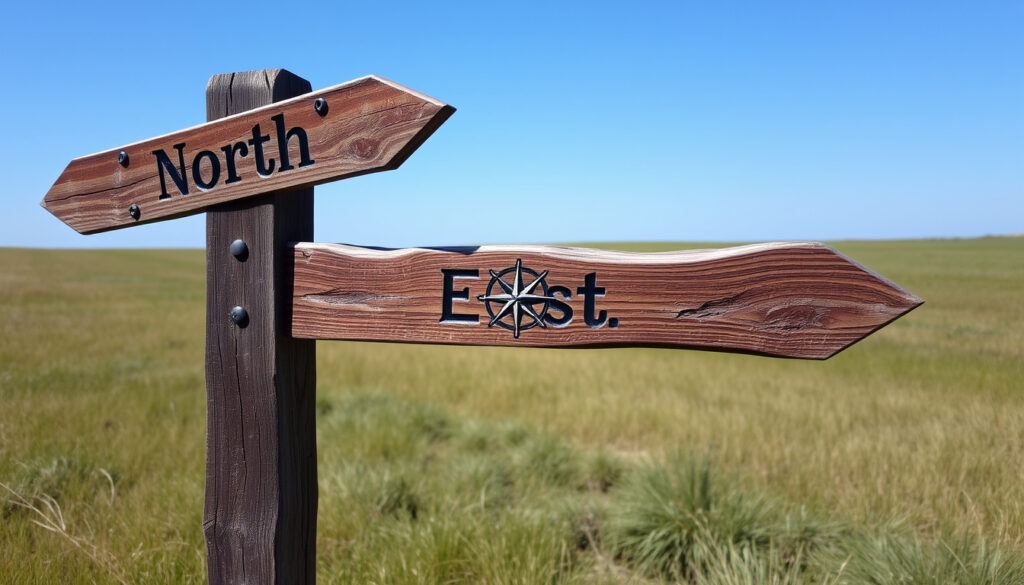
North South East West: How to Find Cardinal Directions
Ever found yourself lost and wondered which way is north? Knowing your cardinal directions—north, south, east, and west—is more than a school lesson; it’s a practical skill that can help you navigate the world around you.
Cardinal directions: 4 ·
Compass points: 360° ·
Sun rises in: east ·
Sun sets in: west ·
Magnetic north deviation: varies by location
Quick snapshot
- The sun rises in the east and sets in the west (Reference.com)
- The North Star (Polaris) marks north in the Northern Hemisphere (Wikipedia)
- A compass needle aligns with Earth’s magnetic field (Math Is Fun)
- Exact magnetic declination changes over time (Outdoor Life)
- The exact origin of direction names is debated by linguists (Outdoor Life)
- Ancient civilizations used celestial navigation for trade and exploration (Wikipedia)
- Use the methods in this guide to orient yourself anywhere—no tools required
The table below organizes the essential numbers behind cardinal directions.
| Label | Value |
|---|---|
| Number of cardinal directions | 4 |
| Compass degrees in a circle | 360 |
| Source of cardinal direction names | Old English and Germanic roots |
| Magnetic north vs true north difference | Declination angle varies by location |
How do I know which is north, south, east, west?
There are three reliable ways to identify the cardinal directions: using a compass, using the sun, or using Google Maps. Each method works in different situations, so knowing all three gives you a backup when one isn’t available.
Using a compass
- A compass needle points toward magnetic north. The red end of the needle typically indicates north (Math Is Fun (educational resource)).
- Once you know north, you can deduce south (opposite), east (right), and west (left) when facing north.
- Compasses work because Earth has a magnetic field that aligns the needle (Outdoor Life (survival skills guide)).
Using the sun
- The sun rises in the east and sets in the west. This is a general rule, though exact sunrise and sunset points shift by latitude and season (Reference.com (science reference)).
- At the equinoxes, the sun rises due east and sets due west (EarthSky (astronomy site)).
- In the morning, if you face the rising sun, you are facing east; north is to your left.
Using Google Maps
- Open Google Maps and look for the compass icon in the top-right corner. Tapping it reorients the map so north is up (YouTube (Google Maps tutorial)).
- In “north-up” mode, the top of the screen is north, bottom is south, right is east, left is west.
- Calibrating your phone’s compass improves accuracy. Google Maps will prompt you to rotate your phone in a figure-eight pattern if needed.
The implication: mastering the sun method gives you orientation in seconds, but digital tools offer precise degree readings when accuracy matters.
A beginner who learns the sun method can orient themselves in seconds without any device. But for precise navigation, a compass or Google Maps gives you exact degrees, not just general directions.
How to Find North, South, East & West Without a Compass
When you don’t have a compass, nature provides clues. The sun, stars, and even your wristwatch can help you figure out which way is north, south, east, or west.
Using the sun and shadows
- The shadow-stick method: Place a stick vertically in sunlight and mark the tip of its shadow. Wait 15–20 minutes, then mark the new shadow tip. The line between the two marks runs east-west. The first mark points west, the second points east (wikiHow (practical guide)).
- Standing on the east-west line with the first mark on your left and the second on your right means you are facing north in the Northern Hemisphere (wikiHow).
- The sun moves east to west at about 15 degrees per hour, so you can estimate direction by the sun’s position relative to the time of day (Outdoor Life (survival skills guide)).
Using the stars (North Star)
- In the Northern Hemisphere, locate the Big Dipper constellation. The two stars at the end of the bowl point toward Polaris, the North Star, which is almost directly above the North Pole (Wikipedia (direction determination)).
- Once you find north, you can turn around to face south, east (right), and west (left).
- This method works only on clear nights in the Northern Hemisphere. In the Southern Hemisphere, use the Southern Cross to find south.
Using a wristwatch
- In the Northern Hemisphere, point the hour hand of an analog watch toward the sun. The midpoint between the hour hand and 12 o’clock marks north-south line. South is halfway between the hour hand and 12, north is opposite (Geography Realm (geography education)).
- In the Southern Hemisphere, the method is reversed: point the 12 o’clock mark toward the sun, and the midpoint to the hour hand gives north-south.
- Digital watches require you to visualize the face. Some survival guides suggest drawing a clock face on paper.
Never look directly at the sun when using body-based direction checks. The sun’s rays can damage your eyes even in twilight (Geography Realm (safety note)).
How do I check my direction?
You can check your direction using a compass, a smartphone, or even landmarks. Each method gives you a quick answer, but reliability varies.
Checking direction with a compass
- Hold the compass flat in your palm. The needle (usually red) points to magnetic north. Rotate the bezel until the orienting arrow aligns with the needle, and read the direction at the index line (Math Is Fun (compass tutorial)).
- Remember that magnetic north differs from true north by a declination angle that varies by location. For most casual use, magnetic north is close enough.
Checking direction on a smartphone
- Most smartphones have a built-in magnetometer. Apps like Google Maps or a dedicated compass app use this sensor to show your heading (YouTube (smartphone compass tutorial)).
- Swipe down from the top of the screen to access the quick settings panel, then tap the compass icon if available.
- For best accuracy, calibrate your phone by moving it in a figure-eight pattern.
Checking direction using landmarks
- Familiar landmarks can give approximate direction. For example, if you know that a mountain range runs north-south, you can orient yourself relative to it.
- Sunrise and sunset are reliable indicators: if you see the sun setting ahead, you’re facing west.
- In urban areas, street grids often align with cardinal directions. Main streets may run north-south or east-west.
What this means: a quick check with a compass or phone is the most reliable, but landmarks and sun position serve as free backups.
Where is my compass in Google Maps?
Google Maps makes it easy to find north. The compass icon appears in the top-right corner of the screen, but you need to know how to use it correctly.
Accessing the compass icon
- Open Google Maps on your phone. The compass icon is located in the top-right corner, above the map layers button (YouTube (Google Maps compass guide)).
- If the icon is not visible, rotate the map with two fingers. The compass icon appears automatically when the map is not north-up.
- Tap the compass to reorient the map so north is up. The compass then shows a small arrow pointing north.
Enabling compass mode
- In Google Maps, the default orientation is “north-up” when you tap the compass. For a rotating map that follows your device’s heading, tap the “my location” button (the crosshair icon) twice. The map will rotate to match your direction, and a compass rose will appear.
- This mode is useful for walking directions because the map aligns with what you see in front of you.
Calibrating the compass
- If Google Maps shows a blue dot with a wide beam, your compass needs calibration. The app will prompt you to rotate your phone in a figure-eight pattern (YouTube (calibration instructions)).
- Calibration improves accuracy from roughly 30° to 5° of true heading.
- For best results, repeat calibration outdoors away from metal objects and power lines.
The pattern: Google Maps becomes a reliable direction finder only after calibration — without it, the blue dot’s wide beam signals uncertainty.
What are the 4 directions called?
The four cardinal directions—north, east, south, and west—are the foundation of global navigation. They are named from Old English and Germanic roots, and their order is fixed in the compass rose.
North
- North is 0° on a compass. It points toward the geographic North Pole.
- In the Northern Hemisphere, the North Star (Polaris) marks north.
- Abbreviated as N.
East
- East is 90° on a compass. It is the direction of sunrise.
- When facing north, east is on your right.
- Abbreviated as E.
South
- South is 180° on a compass. It is opposite north.
- At solar noon, the sun is highest in the sky and due south (in the Northern Hemisphere).
- Abbreviated as S.
West
- West is 270° on a compass. It is the direction of sunset.
- When facing north, west is on your left.
- Abbreviated as W.
The four cardinal directions are used as reference points for all navigation. Intercardinal directions (northeast, southeast, etc.) fill in between them. The order is traditionally listed as N, E, S, W, but the mnemonic “Never Eat Soggy Waffles” helps remember the clockwise sequence.
The implication: these four points create a 90° grid — once you know north, the other three follow by simple geometry.
The four cardinal directions form a 90° grid. Once you know north, the other three are always 90° apart: east is right, south is behind, west is left. This simplicity is why they’ve been used for millennia.
Clarity check
Confirmed facts
- The sun rises in the east and sets in the west (Reference.com)
- The North Star is approximately above the North Pole (Wikipedia)
- A compass needle aligns with Earth’s magnetic field (Math Is Fun)
What’s unclear
- Exact magnetic declination changes over time (Outdoor Life)
- The exact origin of direction names is debated (Wikipedia)
Perspectives from experts
“Cardinal directions are the four main points of a compass: north, south, east, and west. They are the foundation of all navigation.”
Wikipedia (encyclopedic reference)
“A compass is a device that shows direction using the Earth’s magnetic field. It’s one of the oldest navigation tools still in use today.”
Math Is Fun (educational resource)
For anyone who spends time outdoors, knowing how to find north without a compass isn’t just a party trick—it’s a safety skill that can prevent you from walking in circles. For parents teaching kids, the sun and shadow method is a hands-on science lesson. For travelers exploring new cities, Google Maps compass mode saves time. The choice is clear: learn at least one method, and you’ll never be lost.
Related reading: New Zealand North Island Map
youtube.com, suncompass.co.uk, youtube.com, facebook.com, thesunrisesandsets.com
Frequently asked questions
What is the difference between true north and magnetic north?
True north is the geographic North Pole, while magnetic north is the point where Earth’s magnetic field points downward. The angle between them is called declination, and it varies by location. In most map-and-compass work, you adjust for declination to get accurate bearings.
Why is east called east?
The word “east” comes from Old English “ēast”, which likely derives from a Proto-Indo-European root meaning “dawn” or “to shine.” It reflects the direction of the rising sun.
How do I teach cardinal directions to kids?
Start with the sun: “The sun rises in the east and sets in the west.” Use a simple mnemonic like “Never Eat Soggy Waffles” (N, E, S, W). Point to the actual directions when you’re outside. Practice with a compass or Google Maps.
Can I find north by looking at my watch?
Yes, with an analog watch. In the Northern Hemisphere, point the hour hand at the sun. Midway between the hour hand and 12 o’clock is south; north is opposite. In the Southern Hemisphere, point 12 at the sun instead.
What is the order of the four directions?
The standard order is north, east, south, west (clockwise). In some cultures, the order may vary; for example, East is often listed first in Asia because of the rising sun’s importance.
Are there more than four cardinal directions?
Yes, there are intercardinal directions (northeast, southeast, etc.) and secondary intercardinal directions (north-northeast, etc.). But the four cardinal directions are the primary reference points.
How do I calibrate Google Maps compass?
Open Google Maps and tap the blue dot. If the beam is wide, the app will prompt you to rotate your phone in a figure-eight pattern. Do this until the beam narrows to a thin circle. This improves heading accuracy.
More related posts
 AA Car Insurance Login: How to Access Your Account Online
 Single Mattress Size NZ: 92x188cm Dimensions Guide
 Manawatu Standard Obituaries: How to Find Recent Death Notices
 University of Waikato Address: Hamilton & Tauranga Campuses
 Manchester United F.C. vs Man City Stats: H2H, Results & Records
 Punjab Kings vs Chennai Super Kings Timeline: IPL Head-to-Head
 Best Joint Bank Account NZ 2025: ANZ, ASB, Kiwibank, Westpac
 Devon Road Sentry Hill Closure: Crash Details and Map
