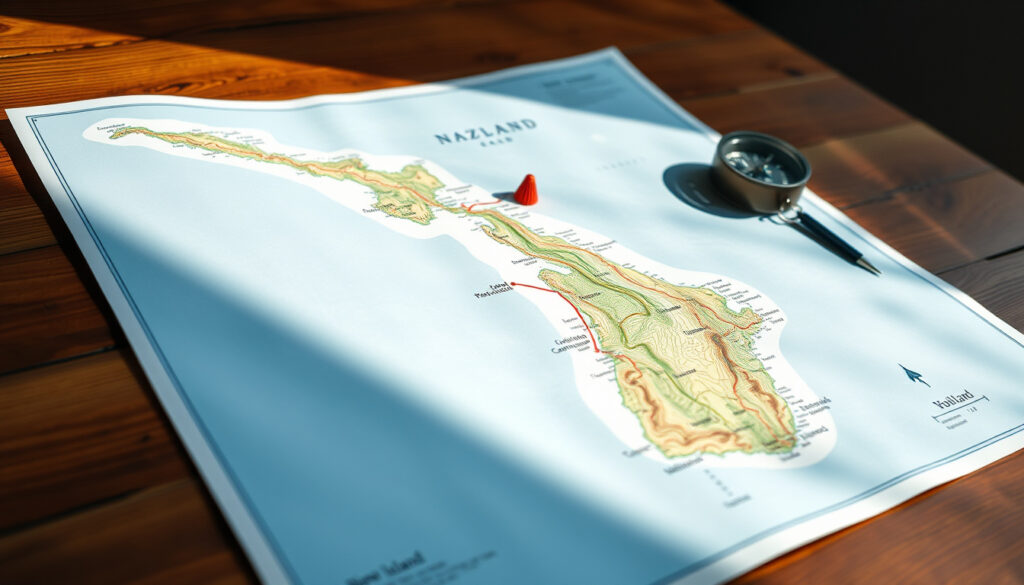
New Zealand North Island Map: Complete Travel Guide
Planning a trip around New Zealand’s North Island usually starts the same way: staring at a map and wondering how far everything really is. The distances between those dots on the page aren’t always obvious, and the best routes aren’t always marked.
North Island area: 113,729 km² ·
Population (approx.): 3.9 million ·
Major cities: Auckland, Wellington, Hamilton, Tauranga ·
Driving time around island: 10–14 days (non-stop) ·
Best time to visit: November–April
Quick snapshot
- Official NZ touring map available as free PDF from 100% Pure New Zealand (national tourism board)
- Auckland is the largest city with about 1.6 million residents (100% Pure New Zealand)
- Tongariro National Park is a major hiking and volcanic scenery stop (Well Traveled Backpack (travel guide))
- Exact driving time depends on route, stops, and traffic — the non-stop estimate is a baseline.
- Cost of a 7-day trip varies widely by accommodation and activity choices.
- Weather can be unpredictable, especially in mountain areas.
- Summer (Dec–Feb): peak season, warm weather, best for beaches.
- Autumn (Mar–May): fewer crowds, mild weather, great for hiking.
- Winter (Jun–Aug): ski season on Mount Ruapehu; lower prices but wetter coasts.
- Spring (Sep–Nov): blooming landscapes, moderate weather, good value.
- Download the free PDF touring map and start planning a 10–14 day loop.
- Book accommodation early for summer; aim for shoulder seasons for better value.
The official tourism board provides a free PDF touring map, while key planning resources offer detailed driving distances and cost estimates. Here’s a quick reference table with essential planning data.
| Planning resource | Details |
|---|---|
| Official tourism map PDF | 100% Pure New Zealand (national tourism board) provides a free touring map PDF |
| Google Maps link | google.com/maps/search/North%20Island%2C%20New%20Zealand |
| Road distances | Guest New Zealand lists detailed distances |
| Cost estimate (7 days) | NZ$1,500–$3,000 per person (mid-range) |
Is it worth going to the North Island of New Zealand?
The North Island is a compact region of volcanic peaks, geothermal springs, coastal forests, and vibrant cities. It’s absolutely worth a visit, especially if you value variety in a shorter travel window.
What are the top attractions on the North Island?
- Rotorua – geothermal wonders and Māori culture (Well Traveled Backpack (travel guide))
- Tongariro Alpine Crossing – one of the best day hikes in the country (Well Traveled Backpack)
- Bay of Islands – sailing, dolphins, and historic sites
- Waitomo Glowworm Caves – underground boat rides through glowing caves
- Hobbiton – the movie set from The Lord of the Rings (Petrina Darrah (travel blog))
How does the North Island compare to the South Island?
Many travelers say the South Island has more dramatic alpine scenery, but the North Island offers something the South doesn’t: active volcanoes, geothermal parks, and a warmer climate. The North Island is also home to the capital, Wellington, and the cultural hub of Rotorua. The trade-off is straightforward: the South Island impresses with scale, the North Island with variety.
What are the costs for a week trip?
A mid-range 7-day trip on the North Island typically costs between NZ$1,500 and NZ$3,000 per person — including accommodation, rental car, food, and some activities. This estimate comes from aggregated traveler data and assumes a mix of motels, cafes, and paid attractions. If you camp and cook your own meals, you can cut that closer to $1,000.
How long does it take to drive around the North Island of New Zealand?
The full scenic loop of the North Island is approximately 1,500–2,000 kilometres. Driving it non-stop would take roughly 16 hours (NZ Pocket Guide (travel planning resource)), but no one should do that. A proper road trip needs at least 10 days; 14 days is the sweet spot for a relaxed pace with side trips.
What is the recommended route for a North Island road trip?
A common 14-day loop starts and ends in Auckland, covering Waiheke, Coromandel, Hobbiton, Rotorua, Taupo, Tongariro, New Plymouth, Taranaki, Waitomo, Raglan, and back to Auckland (Petrina Darrah (travel blog)). An official 5–8 day itinerary from the tourism board covers Auckland, Coromandel, Napier, Bay of Plenty, Rotorua, and back to Auckland — about 380 km (100% Pure New Zealand).
How many kilometers is the full loop?
The full loop (including Northland and the Coromandel) is about 1,500–2,000 km. Auckland to Wellington alone is roughly 650 km, which takes about 8 hours of driving time (Never Ending Voyage (long-term travel guide)). The official tourism site provides a travel time and distance calculator for any route (100% Pure New Zealand).
What are the must-see stops along the way?
- Coromandel Peninsula – beaches and coastal forests (Never Ending Voyage)
- Lake Taupō – a central stop between Rotorua and Tongariro (Never Ending Voyage)
- Hawke’s Bay – wine region, included in longer itineraries (Never Ending Voyage)
- Wellington – the southernmost city on the North Island, capital and cultural hub (Minimalist Journeys (travel blog))
The drive from Auckland to Wellington can be done in a single long day, but you’ll miss the Coromandel, Rotorua, and Taupo. The real cost of speed is missing half the island.
What is the biggest city on the North Island of New Zealand?
Auckland is the largest city on the North Island and the main international gateway. It holds about 1.6 million residents, roughly a third of the country’s entire population.
What is the population of Auckland?
Auckland’s urban population is approximately 1.6 million (100% Pure New Zealand).
What are the other major cities on the North Island?
- Wellington – capital city, population ~215,000
- Hamilton – inland city, population ~180,000
- Tauranga – Bay of Plenty port city, population ~160,000
Which city is best for a base?
Auckland is the most practical base because it’s the arrival point and has the best transport connections. For exploring the central North Island, Rotorua or Taupo are better positioned. For the southern end, Wellington serves as an excellent hub for the lower North Island and the ferry connection to the South Island.
Which part of New Zealand is most beautiful?
Beauty is subjective, but the North Island’s scenery is undeniably diverse. 100% Pure New Zealand describes the North Island as a land of “island sanctuaries, busy cities, beaches, and scenic walks.” The standout regions are Tongariro National Park (volcanic peaks and emerald lakes), the Bay of Islands (blue water and islands), and the Coromandel Peninsula (golden beaches and native forest).
What are the most beautiful regions on the North Island?
- Tongariro National Park
- Bay of Islands
- Coromandel Peninsula
- Waitomo Caves
How does the North Island compare to the South Island in beauty?
Many travelers consider the South Island more dramatically beautiful (Milford Sound, Aoraki/Mount Cook). But the North Island has a different kind of beauty: active geothermal landscapes, black sand beaches, and accessible volcanic craters. It’s a question of what you’re after — the South Island delivers alpine grandeur; the North Island delivers variety and uniqueness.
What is the most beautiful town in New Zealand?
Queenstown (South Island) often wins this title, but on the North Island, Rotorua and Russell (Bay of Islands) are frequently cited as particularly beautiful towns. Rotorua is known for its lakefront and geothermal parks, while Russell offers historic charm right on the water.
The North Island’s beauty is more accessible — you can drive from a volcanic crater to a surf beach in the same morning. The South Island’s beauty demands more travel time between sights.
What is the best time to visit the North Island of New Zealand?
The North Island has four distinct seasons. The best weather runs from November to April, with warm temperatures and clear skies (100% Pure New Zealand). But the “best” time depends on what you want to do.
What is the weather like month by month?
- Summer (Dec–Feb): 20–30°C, sunny, peak tourist season
- Autumn (Mar–May): 15–25°C, fewer crowds, pleasant hiking
- Winter (Jun–Aug): 8–15°C, rainy in coastal areas, skiing on Mount Ruapehu
- Spring (Sep–Nov): 12–20°C, blooming gardens, moderate prices
When are the peak tourist seasons?
Peak season runs December through February. Shoulder seasons — November, March, and April — offer a good balance of decent weather and lower crowds. Winter (June–August) is low season except for ski areas.
Should I visit during summer or winter?
Choose summer if you want beaches, outdoor dining, and all attractions open. Choose winter if you’re here to ski on Mount Ruapehu or want lower accommodation prices. For most first-time visitors, summer (or late spring) is the safer bet.
Which part of New Zealand North Island is best for a road trip? (Pros/Cons)
Upsides
- Compact size — you can see a lot in a week
- Excellent roads and well-marked routes
- Diverse experiences: geothermal, beaches, caves, cities
- Free official touring map PDF available
- Warm weather for much of the year
Downsides
- Driving distances can be deceptive — 200 km takes 3 hours on winding roads
- Summer accommodation books out months in advance
- Weather can change rapidly, especially in mountain areas
- Some stretches (e.g., Desert Road) have limited facilities
- Not all regions are well-served by public transport
How to plan a North Island road trip in 7 steps
- Download the official map – Get the free PDF touring map from 100% Pure New Zealand.
- Decide your duration – Minimum 10 days for a comfortable loop; 14 days if you want side trips.
- Choose your route – The classic loop: Auckland → Coromandel → Rotorua → Taupo → Wellington → Waitomo → Auckland. Or a shorter 5–8 day version (100% Pure New Zealand).
- Book accommodation early – Especially if travelling December–February.
- Check driving times – Use the tourism board’s travel time calculator to avoid over-scheduling.
- Pack for all weather – The North Island can have four seasons in one day.
- Allow flexibility – Weather and road conditions may change your plan. Build in a spare day.
Timeline: When to go and what to expect
Summer gives you perfect beach weather but crowds and high prices. Spring gives you blooming landscapes and lower costs — at the risk of more rain.
| Period | What to expect |
|---|---|
| Summer (Dec–Feb) | Peak tourist season, warm weather, best for beaches and outdoor activities. |
| Autumn (Mar–May) | Pleasant temperatures, fewer crowds, excellent for hiking. |
| Winter (Jun–Aug) | Ski season on Mount Ruapehu; lower prices but wet in coastal areas. |
| Spring (Sep–Nov) | Blooming landscapes, moderate weather, good value travel. |
What we know and what remains unclear
Confirmed facts
- Auckland is the largest city and main international gateway (100% Pure New Zealand).
- North Island has a moderate climate with four distinct seasons (100% Pure New Zealand).
- Official NZ tourism map is free and downloadable (100% Pure New Zealand (national tourism board)).
- Tongariro National Park and Rotorua are top attractions consistently cited across guides (Well Traveled Backpack).
What’s unclear
- Exact driving time depends on route, stops, and traffic.
- Cost of a 7-day trip varies significantly by accommodation and activities.
- Weather can be unpredictable, especially in mountain areas.
- The best “most beautiful” region is subjective and varies by traveler.
“The North Island is a land of beaches, volcanoes, and vibrant cities.”
— 100% Pure New Zealand (national tourism board)
“The best time to visit is from November to April for warm weather and clear skies.”
— Intrepid Travel AU (adventure travel operator)
Summary
The North Island offers a dense, varied travel experience that rewards planning. With the free official touring map and a realistic understanding of driving times, you can build an itinerary that covers volcanoes, caves, beaches, and cities without rushing. For first-time visitors to New Zealand, the North Island is the natural starting point. For seasoned travellers, its geothermal and coastal diversity still holds surprises. The catch is simple: don’t try to see it all in a week. Give yourself ten days minimum, and treat the map as a guide, not a checklist.
For New Zealand-bound travellers, the choice is clear: pick the North Island if you want variety and accessibility in a warm climate, or save it for a second trip if you’re already set on the South Island’s grand landscapes.
welltraveledbackpack.com, travellingthewildside.com, inafarawayland.com, newzealand.com, getyourguide.com
Frequently asked questions
How much does a 7 day trip to New Zealand cost?
A mid-range 7-day trip to the North Island costs approximately NZ$1,500–$3,000 per person, including rental car, accommodation, food, and activities. Budget travellers can reduce this to around NZ$1,000 by camping and cooking.
What is the 4 second rule in NZ?
The 4-second rule is a driving guideline for wet or slippery roads: maintain at least a 4-second gap between your vehicle and the car ahead, instead of the standard 2-second gap. It’s recommended when driving on New Zealand’s winding or rain-prone roads.
What is the most eaten food in NZ?
New Zealand’s most iconic food is the classic meat pie — a handheld pastry filled with mince, steak, or cheese. Fish and chips, pavlova, and lamb are also national favourites. On the North Island, Māori hangi (meat and vegetables cooked underground) is a must-try cultural experience.
Where can I find a free New Zealand North Island map?
The best free North Island map is the official touring map PDF available from 100% Pure New Zealand. It includes detailed roads, distances, and points of interest. You can also use Google Maps for navigation.
What are the major towns on the North Island map?
Major towns and cities clearly marked on any North Island map include Auckland, Wellington, Hamilton, Tauranga, Rotorua, Napier, New Plymouth, Whangarei, Palmerston North, and Taupo. Smaller notable towns include Russell (Bay of Islands), Coromandel Town, and Raglan.
What is the best road trip route on the North Island?
The most popular road trip route is a loop from Auckland: Auckland → Coromandel → Rotorua → Taupo → Tongariro → Wellington → Waitomo → Auckland. For a shorter trip, the official 5–8 day “North Island Highlights” route is recommended (100% Pure New Zealand).
More related posts
 Sunday Ro e Kidman Urban: Age, Modeling, Family & Career
 Trade Me Rentals Wellington: Find Houses & Apartments for Rent
 The Life of a Showgirl: Taylor Swift’s Album Guide
 NZD to USD Forecast: Will the New Zealand Dollar Strengthen
 North South East West: How to Find Cardinal Directions
 Darts World Championship 2025: Littler Youngest Winner
 Manawatu Standard Obituaries: How to Find Recent Death Notices
 Nelson Suspicious House Fire: Latest Updates
