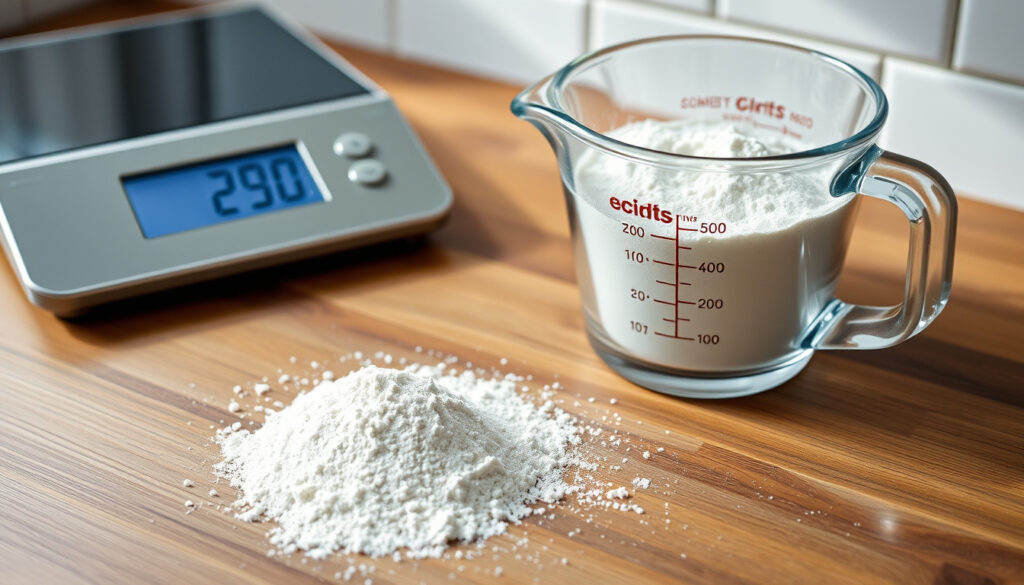
How Many Cups is 250g Flour? Accurate Conversion Guide
If you’ve ever stood in your kitchen staring at a recipe that calls for 250 grams of flour but only have measuring cups on hand, you know the feeling of uncertainty that follows. The truth is, the answer depends on the type of flour and how you measure it, and this guide breaks down exact conversions for all-purpose, bread, whole wheat, and more so you can bake with confidence.
1 cup all-purpose flour (US customary): 120–125 g · 250 g all-purpose flour (approx.): 2 cups · 1 cup bread flour: 127 g · 1 cup whole wheat flour: 130 g · 1 cup cake flour: 114 g
Quick snapshot
- 1 cup all-purpose flour = 120 g (King Arthur Flour standard). (The Calculator Site)
- 250g all-purpose flour ≈ 2 cups (using 125g/cup) (The Calculator Site).
- Exact conversions for gluten-free flours (almond, coconut) vary by brand.
- UK vs US cup sizes (240ml vs 250ml) change results.
- Baking measurement debates stay active as home bakers shift to digital scales.
- No single authoritative standard exists for cup volume.
- More bakers will adopt weight-based recipes as scale prices drop.
- Expect clearer labeling from flour brands on cup weight equivalents.
A quick look at the numbers reveals one clear pattern: no single conversion fits all flours. The table below shows how the same 250g weight translates into different cup amounts depending on the flour you choose.
| Flour type | 1 cup weight | 250g in cups |
|---|---|---|
| All-purpose flour | 120–125 g | ≈ 2.00 cups |
| Bread flour | 127 g | ≈ 1.97 cups |
| Whole wheat flour | 130 g | ≈ 1.92 cups |
| Cake flour | 114 g | ≈ 2.19 cups |
| Self-rising flour | 125 g | ≈ 2.00 cups |
| Rye flour | 102 g | ≈ 2.45 cups |
For a homemade alternative, see our guide on Self-Raising Flour Substitute.
The pattern: Denser flours (whole wheat, rye) pack more weight per cup, so 250g yields fewer cups. Lighter flours (cake, almond) give you more cups for the same weight. Choosing the wrong conversion can throw off your recipe by a full half-cup.
Is 250 grams of flour equal to 2 cups?
How many cups is 250g of all-purpose flour?
- Using the common U.S. conversion of 125g per cup, 250g all-purpose flour equals exactly 2 cups. This is the standard used by The Calculator Site and Baking Like a Chef.
- If you follow King Arthur Flour’s 120g-per-cup guideline, 250g becomes about 2.08 cups.
- Doves Farm lists 1 cup flour as 120g, putting 250g at roughly 2.1 cups.
How many cups is 250g of bread flour?
- Bread flour is slightly denser: 1 cup weighs about 127g. So 250g of bread flour equals approximately 1.97 cups.
- Baking Like a Chef confirms this value in its flour conversion chart.
Why do different flours yield different cup amounts?
Flour density changes with protein content, milling fineness, and moisture level. The Calculator Site explains that a cup measures volume while grams measure weight — the same cup can hold 120g of fluffy cake flour or 130g of dense whole wheat flour. That’s why your 250g can become 2 cups for all-purpose but only 1.92 cups for whole wheat. The implication: Always check which flour type your recipe assumes. Using a blanket conversion invites inconsistency.
How many grams are in 2 cups of flour?
Conversion for all-purpose flour
- 2 cups all-purpose flour = 240–250g, depending on the standard. Doves Farm says 240g; Anna Olson says 300g (using 150g/cup).
- The wide range shows why picking one source matters for consistency.
Conversion for whole wheat flour
- 2 cups whole wheat flour ≈ 260g (at 130g per cup).
Conversion for cake flour
- 2 cups cake flour ≈ 228g (at 114g per cup).
Why this matters: A recipe calling for 2 cups all-purpose flour could require anywhere from 240g to 300g of weight, a difference of 25% — enough to turn a fluffy cake into a dense brick.
What is the difference between 250ml and 250g in baking?
Volume vs weight in baking
Milliliters measure volume (space occupied), while grams measure weight (mass). For water, 250ml equals 250g because water’s density is 1g/ml. Flour, however, is much less dense — 250ml of flour weighs between 120 and 150g depending on the type and compaction.
Why weight measurements are more accurate
- A scale removes the guesswork of settling, scooping, and leveling.
- The Calculator Site warns that the “dip and sweep” method can force 15% more flour into a cup than the spoon-and-level method.
- Doves Farm notes that using the same cup for all ingredients helps keep proportions consistent, but weight remains the gold standard.
When to use mL vs g
Use milliliters for liquids (water, milk, oil) where density is close to water. Use grams for dry ingredients like flour, sugar, and oats to avoid compaction errors. Mixing mL and g for the same ingredient is fine — just know that 250ml of flour is not the same as 250g of flour. The trade-off: A scale costs money and takes storage space. For casual bakers, volume works with careful technique. For serious results, weight is non-negotiable.
How to measure 250g of flour accurately?
Using a kitchen scale
- Place your mixing bowl on the scale and press tare (zero).
- Spoon or pour flour gently into the bowl until the display reads 250g.
- Proceed with your recipe — no measuring cup needed.
Doves Farm recommends this method as the most reliable for consistent baking results.
Using the spoon-and-level method
- Fluff the flour in its container with a spoon (to break up compaction).
- Spoon the flour into your measuring cup, heaping it above the rim.
- Level off the top with the flat edge of a knife — no tapping or shaking.
- Repeat until you reach the desired number of cups (about 2 for all-purpose).
The Calculator Site assumes this spooned method for its conversion, warning that dipping the cup directly into the bag can add up to 15% extra flour.
How to convert volume to weight without a scale
If you have no scale but know the cup weight for your flour type, simply multiply cups by that weight. For all-purpose at 125g per cup, 250g equals 2 cups. Use the table below for other common amounts.
How many cups is 200g, 150g, and 100g of flour?
200g flour to cups
- All-purpose: 1.6 cups (200 ÷ 125).
- Whole wheat: 1.54 cups (200 ÷ 130).
- Cake flour: 1.75 cups (200 ÷ 114).
150g flour to cups
- All-purpose: 1.2 cups (150 ÷ 125).
- Bread flour: 1.18 cups (150 ÷ 127).
100g flour to cups
- All-purpose: 0.8 cups (100 ÷ 125).
- Cake flour: 0.88 cups (100 ÷ 114).
Baking Like a Chef provides similar ratios, though exact values shift slightly by source. What this means: For small amounts the difference is negligible, but 200g can be 1.6 or 1.75 cups depending on flour type — enough to matter in delicate doughs.
Home bakers who rely on cups alone face a 15–20% error margin when measuring flour. Switching to a digital scale for 250g eliminates this variance entirely. The upfront cost of $15–20 pays for itself in saved ingredients and consistent results.
Confirmed facts
- 1 cup all-purpose flour = 120g (King Arthur standard) and 125g (other common sources).
- 250g all-purpose flour = 2 cups when using 125g/cup (The Calculator Site).
- Weight measurements are more accurate than volume in baking (Doves Farm).
- Flour density varies by type — whole wheat and rye are denser; cake flour is lighter (Baking Like a Chef).
What’s unclear
- Exact conversion values for gluten-free flours (almond, coconut) lack standardization.
- Difference between US, UK, and Australian cup sizes (240ml vs 250ml vs 280ml) can alter results.
- Scooping technique (spooned vs dipped) is rarely specified in recipes.
“We recommend using a scale for the most accurate results. One cup of all-purpose flour weighs 120 grams.”
— King Arthur Flour (baking expert)
“Cups to grams conversion table: for accurate baking, always weigh ingredients.”
— Doves Farm (flour brand and hints guide)
For home bakers in the US or UK, the choice is clear: invest in a $15 kitchen scale and measure 250g of flour by weight. That single switch eliminates the uncertainty of spooning, dipping, and flour-type variation. Your favorite recipes will turn out the same every time — no more guessing whether today’s cup is 120g or 150g.
dovesfarm.co.uk, annaolson.ca, bakinglikeachef.com, youtube.com, facebook.com
For a broader perspective on weight-to-volume conversions, you might also find our 250 grams to cups conversion guide helpful for other common baking ingredients.
Frequently asked questions
How many cups is 250g of sugar?
Granulated sugar is denser than flour. 250g of granulated sugar equals about 1.25 cups (using 200g per cup).
How many cups is 250g of butter?
Butter has a density of about 227g per cup. 250g of butter equals roughly 1.1 cups.
Is it better to measure flour by weight or volume?
Weight is more accurate. Volume can vary by up to 20% depending on how the cup is filled. Most professional bakers use grams.
What is the best flour conversion chart?
Sources like The Calculator Site and Doves Farm offer reliable, well-maintained charts. Compare two or three to see the range.
Can I use the same conversion for self-raising flour?
Yes. Self-raising flour has similar density to all-purpose (about 125g per cup). 250g self-raising flour ≈ 2 cups. For a homemade substitute, see our Self-Raising Flour Substitute guide.
How many cups is 250g of almond flour?
Almond flour is lighter. 250g equals about 2.6 cups according to Baking Like a Chef.
Does the type of cup matter for conversion?
Absolutely. US customary cups are 240ml; UK metric cups are 250ml; Australian cups can be 250ml or 280ml. Always check which standard your recipe uses.
How do I convert grams to cups for other ingredients?
Find the ingredient’s density (grams per cup) and divide the weight by that number. Online calculators like the one at The Calculator Site can do this for you. You can also check our 12 Ounces to Grams guide for similar conversions.
More related posts
 ASB House Price Forecast Revised Down: Flat 2026 NZ Outlook
 Silver Ferns vs Australia – Constellation Cup 2024 Results
 Q Mastercard NZ Online: How to Use and Apply
 Tauranga Airport Flights Cancelled: Current Status
 Atmosphere Taylor Jenkins Reid – Synopsis, Characters, Reviews
 New York Times Crossword: Free, Answers & Today’s Puzzle
 25 AUD to NZD: Live Rates from 28.35-30.27 NZD Today
 Air New Zealand Boeing 787-9: The Best Seats for Every Cabin
