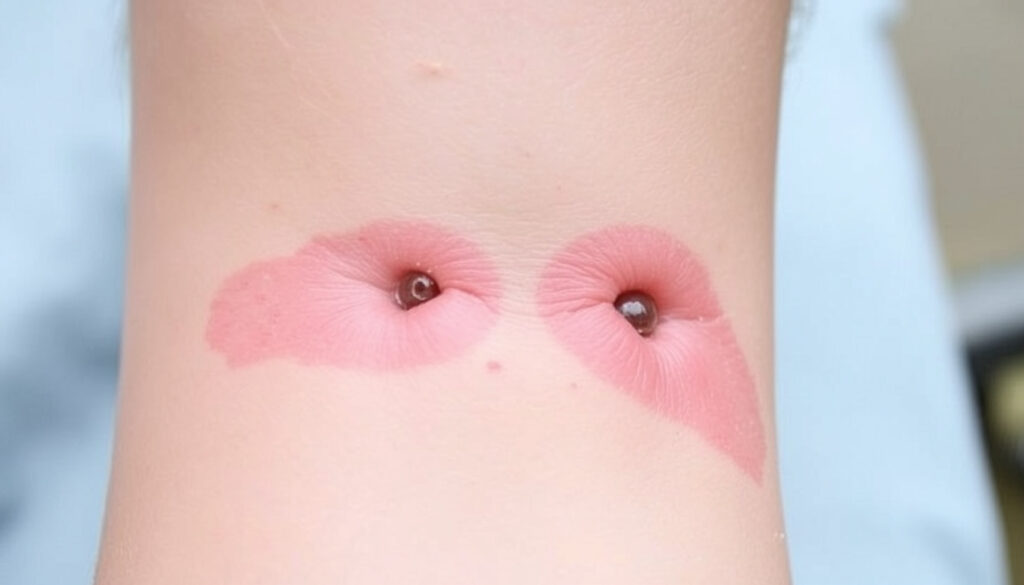
What Do White Tail Bites Look Like? Visual Guide & Symptoms
If you’ve woken up with a red, angry mark on your skin and your mind jumps to the white‑tail spider, you’re not alone. These slender spiders have earned a fierce reputation, but the real story of what their bites actually look like is much less dramatic — and much more evidence‑based.
Typical bite sensation: sharp sting or pin‑prick ·
Onset of visible symptoms: within 24 hours ·
Common visible signs: red mark, puncture marks, localized swelling ·
Severity range: mild to moderate pain/discomfort ·
Misconception: do not cause necrotic ulcers (confirmed by studies)
Quick snapshot
- Red mark or small puncture wound (Healthdirect (Australian government health service))
- Localized swelling and redness (University of the Sunshine Coast)
- Sometimes a small blister (Healthdirect)
- Sharp sting or pin‑prick at time of bite (myDr (medical editorial))
- Burning feeling at site (Healthdirect)
- Itchiness may develop (Healthdirect)
- Symptoms usually appear within 24 hours (Medical Journal of Australia (prospective study))
- Mild cases resolve in days (Healthdirect)
- Full healing can take 1‑2 weeks (Minibeast Wildlife)
- Clean with soap and water (CPR First Aid (first aid training provider))
- Apply cold compress (CPR First Aid)
- Over‑the‑counter pain relief if needed (Healthdirect)
Six facts, one takeaway: white‑tail bites are local affairs, not systemic emergencies.
The table below summarises the key evidence from clinical studies and health authorities.
| Label | Value |
|---|---|
| Common reaction | localized redness, swelling, mild pain (Healthdirect) |
| Time to symptoms | within 24 hours (Medical Journal of Australia) |
| Severity | mild to moderate in most cases (myDr) |
| Necrotic ulcers | not caused by white tail spider bites (studies confirm) (PubMed (indexed prospective study)) |
| Healing duration | few days to two weeks (Minibeast Wildlife) |
| First aid | clean, cold compress, monitor (CPR First Aid) |
The pattern is consistent: a localised reaction that looks more like a minor insect bite than a medical emergency.
What do white tail bites look like on a human?
Typical appearance: red mark, puncture points, localized swelling
- A white‑tail bite usually presents as a red mark with one or two visible puncture wounds. In a prospective study of 130 confirmed bites, the most common finding was a red mark with local swelling (Medical Journal of Australia (peer‑reviewed research)).
- The University of the Sunshine Coast describes “localised redness and swelling” as the typical response (UniSC (research‑led institution)).
- Blisters can sometimes form, but they are not a hallmark of white‑tail bites (Healthdirect (Australian government health service)).
The pattern is consistent: a localised reaction that looks more like a minor insect bite than a medical emergency.
Sensations: sharp sting or pin‑prick, sometimes unnoticed initially
- Many people report a sharp sting or pin‑prick at the moment of the bite. The myDr medical editorial notes that “the bite may cause an immediate sharp sting or burning sensation” (myDr (established medical reference)).
- Itchiness and a mild burning feeling often develop over the following hours (Healthdirect).
- Because the bite can be painless, some people don’t realise they’ve been bitten until redness or swelling appears later (MJA study).
The most common experience is a short‑lived pain followed by a red spot — nothing like the graphic necrosis that circulates online. For Australian and New Zealand readers, that’s an important reality check.
How do I know if I’ve been bitten by a white tail?
Immediate and delayed symptoms
- Within 24 hours, the bite area becomes red, swollen, and may feel tender. The Medical Journal of Australia’s prospective study found that the majority of confirmed bites produced only these local effects (MJA (prospective clinical evidence)).
- Healthdirect lists “pain, redness, swelling, itchiness, and occasionally a blister” as the typical symptom set (Healthdirect).
- Systemic symptoms like nausea or headache are rare — reported in around 10% of cases according to myDr (myDr).
What this means: if you have a spreading, ulcerating wound, a white‑tail is almost certainly not the cause — look for other explanations.
Distinguishing white tail bites from other insect bites
- Unlike mosquito bites that are intensely itchy from the start, white‑tail bites more often begin with a sharp sting and then become itchy later (Healthdirect).
- Mosquito bites typically have a raised white or pink welt; white‑tail bites usually show a distinct puncture point in the centre of a red patch (GoodRx (health information publisher)).
- Bacterial infections like MRSA can mimic spider bites, but they tend to enlarge quickly and may discharge pus – a sign that warrants medical review (GoodRx).
How long do white tail bites last?
Typical healing timeline
- Most mild bites heal within a few days. The redness and swelling usually peak around day 1‑3, then gradually subside (Healthdirect).
- Minibeast Wildlife notes that an itchy red sore can last up to two weeks (Minibeast Wildlife (entomology education)).
- The MJA study reported that even in moderate cases, the bite resolved without scarring in the vast majority of participants (MJA).
Factors influencing duration
- Individual variation matters: people with sensitive skin or who scratch the bite may experience a longer healing time (Healthdirect).
- Secondary infection, caused by scratching, can extend discomfort. That’s why first‑aid guidelines stress cleaning and not scratching (CPR First Aid).
The takeaway: for the vast majority, a white‑tail bite is a short‑lived irritation – not a long‑term medical problem.
What is the best thing for a white tail bite?
First aid steps: clean, cold compress, monitor
- Clean the bite area gently with soap and water to reduce infection risk (CPR First Aid).
- Apply a cold pack wrapped in a cloth for 10‑15 minutes at a time to ease swelling (CPR First Aid).
- Elevate the affected limb if possible (CPR First Aid).
- Monitor for signs of infection: increasing redness, warmth, pus, or fever. Over‑the‑counter pain relief (paracetamol, ibuprofen) can help if needed (Healthdirect).
When to seek medical attention
- If the bite area grows larger after 24 hours, or if you develop spreading redness, chills, or fever, see a doctor – these signs suggest a bacterial infection (Healthdirect).
- People with a history of severe allergic reactions should seek care promptly (RACGP (Australian clinical guidance)).
What is commonly mistaken for a spider bite?
Other skin conditions that mimic spider bites
- Many skin lesions are wrongly blamed on spiders. The Medical Journal of Australia’s study highlighted that people often attribute any red sore to a spider, yet fewer than 1 in 5 suspected spider bites are actually from a spider (MJA).
- Boils, ingrown hairs, and allergic contact dermatitis produce red, swollen spots that look identical to a spider bite (GoodRx).
How to differentiate from MRSA, boils, or insect bites
- MRSA infections typically enlarge rapidly, form a painful abscess, and do not have the central puncture marks that spider bites show (GoodRx).
- Boils are deeper, tender nodules that often come to a head; spider bites tend to be more superficial and flat (GoodRx).
- Insect bites (mosquito, flea, bee) produce immediate itching or pain, whereas spider bites often have a delayed onset (Healthdirect).
The pattern: when a “spider bite” doesn’t heal or gets worse, it’s time to stop blaming the spider and start suspecting infection.
Timeline of a white‑tail bite
- Immediately after bite: Sharp sting or pin‑prick; may be unnoticed (myDr)
- Within 24 hours: Redness, swelling, puncture marks appear (MJA)
- Days 1‑3: Local inflammation peaks; mild itching or burning (Healthdirect)
- Days 4‑7: Gradual resolution of swelling and redness (Healthdirect)
- 1‑2 weeks: Complete healing in most cases; no scarring typical (Minibeast Wildlife)
The implication: if symptoms persist beyond two weeks or worsen, the initial diagnosis should be reconsidered.
What we know – and what’s still unclear
Confirmed facts
What’s unclear
- Exact frequency of bites may be underreported because bites are often painless or unnoticed (Minibeast Wildlife)
- Individual allergic reactions can vary in severity – some people may develop more pronounced swelling (Healthdirect)
Expert perspectives
The bite of a white‑tail spider can cause an initial burning pain and localised redness that lasts a few days – but the idea that it regularly leads to flesh‑eating wounds is not supported by the evidence.
— First Aid Pro Australia (CPR First Aid (first aid training provider))
Visible puncture marks with localized redness and swelling are the expected findings after a confirmed white‑tail spider bite.
— University of the Sunshine Coast (UniSC (research‑led institution))
Studies confirm that white‑tail spider bites can cause pain and swelling, but they do not cause necrotic ulcers.
— Entomemeology (community discussion via Minibeast Wildlife)
Itchiness, burning, and swelling are common; nausea and headache are rare. Most people need only simple first aid.
— myDr medical editorial (myDr (established medical reference))
For anyone in Australia or New Zealand who finds a white‑tail in their home, the evidence is reassuring: the bite is a minor annoyance, not a medical crisis. If a wound does not match the visual signs described here – if it grows, ulcerates, or causes fever – the smart move is to see a doctor and stop blaming the spider. Alternatively, Signs of a Heart Attack: Symptoms & Early Warnings and Lemsip Cold and Flu: Does It Really Work? – Efficacy & Safety are other health‑related resources on this site that follow a similar evidence‑based approach.
For a detailed breakdown of symptoms and treatment, see our guide on white tail spider bite symptoms.
Frequently asked questions
What does a white tail spider bite look like at first?
It typically appears as a red mark with one or two small puncture holes, often with mild swelling. Sometimes a tiny blister forms. The bite may be barely noticeable for the first few hours (Healthdirect).
Can a white tail spider bite cause a blister?
Yes, a small blister can develop, but it is not a universal feature. Blisters are more common with other conditions mistaken for spider bites (Healthdirect).
How can I tell if a bite is from a white tail spider or another insect?
White‑tail bites usually start with a sharp sting, then become red and swollen within 24 hours. Mosquito bites itch immediately; flea bites cluster; MRSA infections enlarge rapidly with pus. No single feature is definitive – context matters (GoodRx).
Should I go to the doctor for a white tail spider bite?
Most bites don’t need medical care. See a doctor if the area becomes increasingly red, warm, painful, or you develop a fever – those are signs of infection (Healthdirect).
Do white tail spider bites itch?
Itchiness can develop after the initial sting, but it is usually mild. Scratching can lead to secondary infection (Healthdirect).
Are white tail spider bites dangerous?
Healthdirect states white‑tail spiders are not considered dangerous to humans. The evidence shows they do not cause necrotic ulcers – the danger has been greatly exaggerated (Healthdirect).
How do you treat a white tail spider bite at home?
Clean the area with soap and water, apply a cold compress, elevate the limb if swollen, and take over‑the‑counter pain relief if needed. Monitor for infection signs (CPR First Aid).
What should I do if I see a white tail spider in my house?
There is no need to panic. White‑tails are common in Australian and New Zealand homes. You can safely catch and release or use a simple spray. They are not aggressive (Minibeast Wildlife).
For Australian and New Zealand readers, the evidence is clear: a white‑tail bite is a minor local event, not a trip to the emergency room. The next time you see a red spot and wonder, check the visual signs – puncture marks, local swelling, no spreading necrosis – and you’ll know. If the wound doesn’t match that picture, your next move is a doctor, not a spider hunt.
More related posts
 Buy XRP in New Zealand: Step-by-Step Guide & Tax (2026)
 Adobe QR Code Generator: Free Forever? (2025 Review)
 Single Mattress Size NZ: 92x188cm Dimensions Guide
 New Zealand North Island Map: Complete Travel Guide
 Flights Christchurch to Brisbane: Compare Prices, Times & Airlines (2025)
 Full Moon May 2025: Flower Moon Date, Meaning and Effects
 Spark Mobile Top Up: How to Top Up Your Prepaid Phone (2025)
 Best Breville Coffee Machine NZ: Models Compared
