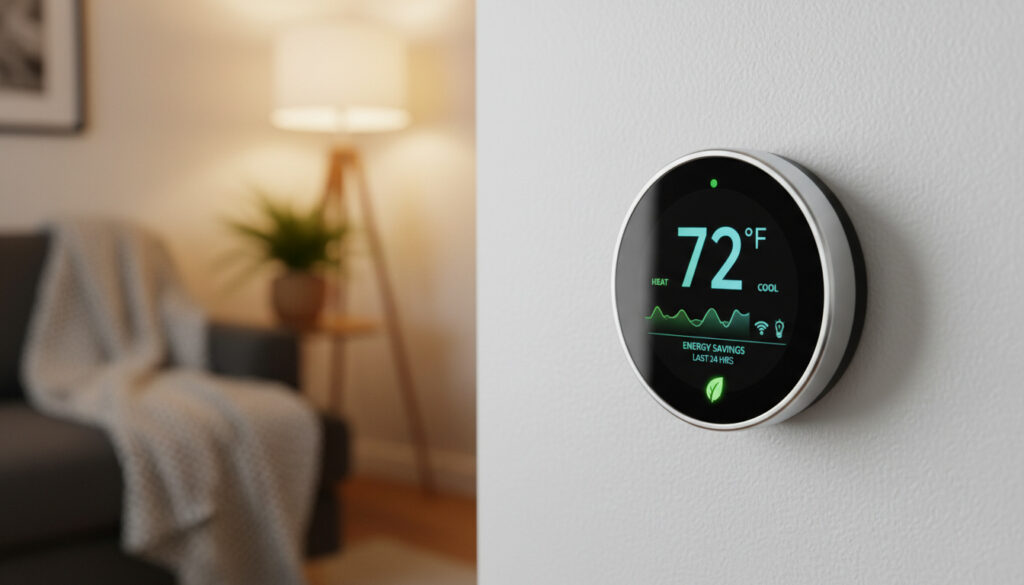
What Is a Smart Thermostat – How It Works and Saves Energy
A smart thermostat is a Wi-Fi-enabled device that connects to your home’s HVAC system, automatically adjusting heating and cooling based on user habits, sensors, schedules, and external data like weather or location, offering remote control via apps and integration with smart home ecosystems.
Unlike basic programmable thermostats, which require manual schedule setup often leading to misuse and no energy savings, smart models use algorithms, learning capabilities, and automation to optimize comfort and efficiency without user intervention. These devices eliminate the complexity that caused earlier programmable units to fail in real-world applications.
The technology represents a shift from reactive temperature control to predictive climate management. By processing data from motion sensors, humidity detectors, and geofencing capabilities, these systems maintain optimal conditions while reducing energy waste.
What Is a Smart Thermostat?
Wi-Fi-enabled HVAC controller with machine learning and sensor-based automation
Occupancy detection, remote app control, voice integration, energy reporting
Nest (Google), Ecobee, Carrier, Honeywell Home
10-20% reduction in heating and cooling costs annually
Core Capabilities
- Automatic adjustment based on occupancy detection and geofencing
- Remote climate control via smartphone applications from any location
- Learning algorithms that adapt to daily routines without manual programming
- Integration with major smart home ecosystems including Alexa, Google Assistant, and Apple HomeKit
- Real-time energy consumption monitoring and utility reporting
- Weather-responsive temperature optimization using cloud data
- Multi-zone capability with remote room sensors for balanced comfort
Technical Specifications
| Feature | Details |
|---|---|
| Wi-Fi Connectivity | 802.11b/g/n protocols for cloud communication and updates |
| App Control | Native iOS and Android applications with remote access |
| Learning AI | Pattern recognition algorithms for schedule optimization |
| Avg Cost | $130-250 per unit; sensors additional $50-100 |
| Sensors | Temperature, humidity, motion, ambient light, occupancy |
| Compatibility | Most 24V HVAC systems (furnaces, heat pumps, AC) |
| Voice Control | Amazon Alexa, Google Assistant, Apple Siri integration |
How Does a Smart Thermostat Work?
Smart thermostats operate through a continuous cycle of sensing, processing, and adjustment that requires minimal user intervention once configured.
Environmental Sensing and Data Collection
Built-in sensors detect temperature, humidity, occupancy, light, and motion; some include remote room sensors for multi-zone coverage. These sensors create a comprehensive picture of indoor conditions and resident activity patterns.
Processing and Learning Algorithms
Users set initial preferences via touchscreen, app, or voice; advanced models like Nest learn routines automatically or use geofencing (phone location) to detect home/away status. Wi-Fi links to cloud servers for data analysis, weather integration, pattern recognition, and algorithmic decisions on HVAC adjustments.
System Control and Feedback Loops
The device sends signals to HVAC systems for precise heating, cooling, or fan operation while integrating with broader smart home platforms. Apps provide remote access, energy reports, alerts, and optimizations like safety temperatures to prevent pipe freezing during extreme cold.
Stable Wi-Fi is essential for full functionality including remote access, weather data integration, and software updates. Without internet connectivity, most units revert to basic temperature control but lose learning capabilities and app-based features.
Key Benefits of Smart Thermostats
Verified Energy Reduction
Typical households achieve 10-20% reductions in heating and cooling bills, translating to $100-200 annually. Studies indicate that programmable thermostats often resulted in higher energy consumption than manual units due to user error, whereas smart thermostats eliminate this risk through automation.
Automated Comfort Management
Geofencing technology adjusts temperatures when residents leave or approach home, while motion sensors detect occupancy to eliminate energy waste in empty rooms. The system learns sleep schedules and wake times, pre-conditioning spaces for optimal comfort without manual intervention.
Advanced Safety and Monitoring
Beyond temperature control, these devices monitor HVAC system performance and provide alerts for extreme conditions that could damage plumbing or equipment. Remote monitoring capabilities allow homeowners to verify system operation while away, preventing costly freeze damage or equipment failures.
Smart Thermostat vs. Traditional or Programmable Thermostats
| Feature | Smart Thermostats | Programmable Thermostats |
|---|---|---|
| Scheduling | Auto-learns habits, geofencing, occupancy detection; adapts dynamically | Manual fixed schedules; often disabled or misprogrammed |
| Control | App/voice remote access from anywhere; multi-device sync | On-device only; no remote or learning capabilities |
| Energy Savings | 10-20% typical via optimization; tracks usage with insights | Potential savings if programmed correctly, but studies show higher consumption due to errors |
| Intelligence | Algorithms, weather data, room sensors for even comfort | Basic timers only; no environmental adaptation |
| Ease of Use | Intuitive apps eliminate programming hassle | Complex setup leads to non-use or incorrect configuration |
When evaluating USB A to USB C Adapter – Compatibility Limits and Best Picks, consumers examine connection standards carefully—a similar approach applies to verifying HVAC compatibility before selecting thermostat hardware.
Research indicates that programmable thermostats often result in higher energy consumption than manual units due to user error in setting schedules. Smart thermostats resolve this human factors problem through automated learning and occupancy detection.
High-voltage line-voltage boilers, millivolt systems without adapter kits, and certain zoned hydronic systems remain incompatible with standard smart thermostats. Always verify wiring configuration using manufacturer compatibility tools before purchase.
How Has Smart Thermostat Technology Evolved?
- : Nest Launch — Introduction of the first learning thermostat with Auto-Schedule and smartphone connectivity, establishing the category standard
- : Ecobee Smart Platform — Introduction of remote room sensors for multi-zone temperature management, addressing uneven heating in larger homes
- : Matter Standard Adoption — Development of unified connectivity protocol enabling cross-platform compatibility regardless of ecosystem, reducing vendor lock-in
What We Know vs. What Remains Uncertain
Established Information
- Compatible with most 24V HVAC systems including gas furnaces, heat pumps, and central air conditioning
- ENERGY STAR verification confirms 10-20% energy savings potential for certified models
- Requires C-wire (common wire) or compatible adapter for continuous power supply
- Geofencing and occupancy detection demonstrably reduce unnecessary heating and cooling cycles
Information That Remains Unclear
- Precise 2024/2025 pricing fluctuations due to market volatility and component availability
- Long-term reliability data beyond 5-10 year horizons for first-generation adopters
- Exact quantification of savings in extreme climate zones versus moderate regions
- Comprehensive privacy implications of cloud-based usage data storage across different manufacturers
The Smart Home Ecosystem Context
Smart thermostats function as climate command centers within interconnected residential environments. Their compatibility with Matter and Thread protocols represents a shift toward unified smart home standards, reducing ecosystem lock-in previously dominated by proprietary platforms.
The technology addresses a critical gap in residential energy management. While programmable thermostats offered theoretical efficiency gains, actual consumer behavior undermined their potential. Smart thermostats resolve this through automation, removing the burden of manual schedule management while providing granular energy consumption data previously unavailable to homeowners.
Integration capabilities extend beyond voice control, enabling automated responses to security system arming, window sensor triggers, and time-of-use utility pricing. This positions the thermostat as a central node in home automation rather than an isolated climate controller.
Expert Perspectives and Data Sources
Smart thermostats use algorithms, learning capabilities, and automation to optimize comfort and efficiency without user intervention.
Unlike basic programmable thermostats, which require manual schedule setup often leading to misuse and no energy savings, smart models adapt automatically.
— Crows Heating and Air
ENERGY STAR certified smart thermostats provide features that learn your schedule and can be controlled remotely, saving an average of 10-20% on heating and cooling costs.
— ENERGY STAR
Is a Smart Thermostat Right for Your Home?
For households seeking reduced energy expenditures without sacrificing comfort, smart thermostats offer a verified solution through automated climate management. The technology proves particularly valuable for busy families who lack time to optimize programmable schedules, multi-zone residences requiring balanced temperatures, and existing smart home enthusiasts seeking ecosystem integration. Before purchasing, verify HVAC compatibility and consider whether the 1-2 year return on investment aligns with your long-term residency plans. Compare Car Insurance Quotes – Best Sites to Save in 2025
Frequently Asked Questions
Do smart thermostats work without WiFi?
Most functions require WiFi for learning, remote access, and weather data. Without internet, they typically revert to basic manual temperature control.
What HVAC systems are compatible?
Most 24V systems including gas/electric furnaces, heat pumps, and AC units work with smart thermostats. High-voltage boilers and some zoned systems require specific adapters or remain incompatible.
How much do smart thermostats cost?
Units range from $130-250 with additional sensors costing $50-100. Professional installation adds $100-200 for complex systems.
Do smart thermostats require professional installation?
Basic installations take 30-60 minutes and are DIY-friendly. Heat pumps or homes without C-wires may require professional electrical work.
Can smart thermostats control humidity?
Advanced models monitor humidity levels and can trigger dehumidification systems, though specific capabilities vary by manufacturer and HVAC configuration.
How quickly do they learn my schedule?
Most learning thermostats establish baseline patterns within one week, with refinement continuing for approximately one month as algorithms process occupancy data.
More related posts
 SpinBet Promo Code Free Spins 2026: Claim Guide & Offers
 Man United vs Bournemouth – Preview, Predictions and Lineups
 Harold and the Purple Crayon 2024: Flop, Age Rating, Meaning
 Ben Roberts-Smith: Australia’s VC Hero Accused of War Crimes
 Nike Air Force 1 Black: Guide for Men, Women & Ireland
 Bed Bath and Beyond Rugs: Sizes, Sales, and Safavieh Guide
 Wednesday Season 2 Cast: Returns, New Faces & Full Lineup
 Man City vs Aston Villa: Head-to-Head & 2026 Preview
