USB A to USB C Adapter – Compatibility Limits and Best Picks
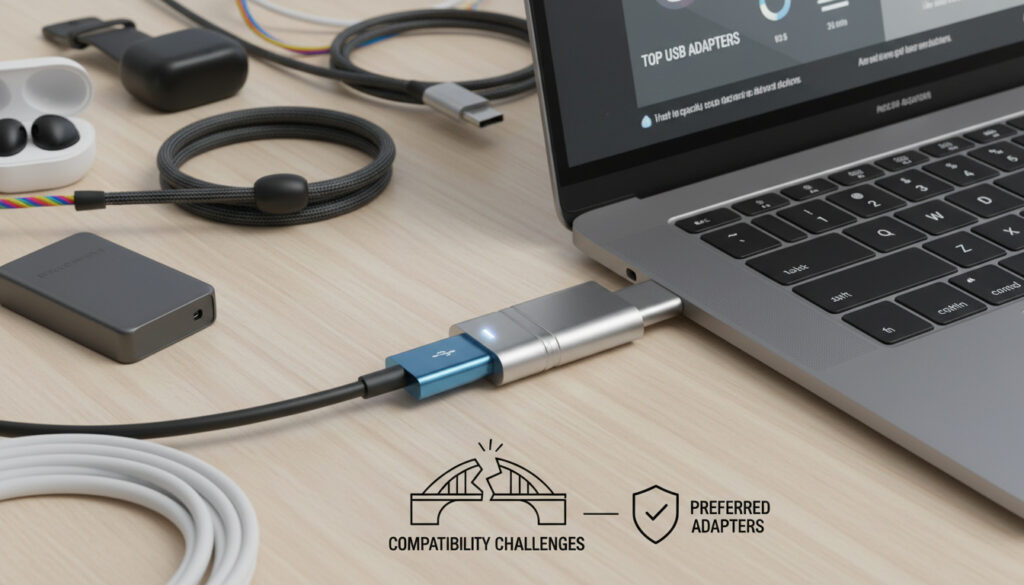
USB A to USB C adapters function as compact bridges between legacy USB-A ports—ubiquitous on computers, automotive outlets, and hotel charging stations manufactured over the past two decades—and modern USB-C devices that have dominated the smartphone and laptop markets since 2015. These passive connectors physically convert the rectangular USB-A interface to the oval USB-C standard, enabling users to charge contemporary hardware and transfer data without replacing existing cable infrastructure.
Despite their utility, these adapters encounter hard technical constraints that limit their performance. Technical documentation confirms that USB-A ports lack the internal wiring necessary for USB Power Delivery negotiation, restricting most adapters to basic charging speeds between 4.5 and 15 watts regardless of cable quality or device capability.
Understanding the precise capabilities and limitations of these transition accessories prevents consumer frustration when connecting new devices to older charging hardware.
What Is a USB A to USB C Adapter?
Converts physical USB-A ports (male or female) to USB-C compatibility for charging and data synchronization with modern devices.
Connecting USB-C smartphones to legacy computer ports, charging tablets via older wall adapters, and enabling OTG host mode on Android devices.
USB 2.0/3.0 data support, 5V/3A maximum power (15W), OTG functionality for peripheral connections.
Typically $5 to $20 USD depending on data speed ratings and safety certifications.
- Most adapters max out at USB 2.0 speeds (480Mbps) even when labeled for USB 3.0, constrained by the host port generation.
- USB-A connectors lack Configuration Channel (CC) pins required for Power Delivery negotiation, making true fast charging impossible.
- Maximum power output remains capped at 15 watts (5 volts, 3 amps), insufficient for modern laptop charging or smartphone rapid charging.
- Video output via DisplayPort Alternate Mode requires native USB-C ports; adapters cannot transmit video signals.
- Android devices require OTG-compatible adapters to function in host mode for connecting flash drives or peripherals.
- Physical wear occurs at the adapter junction, creating potential failure points not present in single-cable solutions.
- Safety certifications (UL, CE, ETL) indicate proper thermal protection and insulation standards.
| Specification | Details |
|---|---|
| Connector Type | USB-A Male to USB-C Female (most common) |
| Maximum Power Output | 15W (5V/3A) |
| Data Transfer Standards | USB 2.0 (480Mbps) / USB 3.0 (5Gbps) when specified |
| Power Delivery Support | Not supported |
| OTG Functionality | Yes (device dependent) |
| Video Output Capability | None |
| Typical Physical Length | 2–6 inches |
| Safety Certifications | UL, CE, ETL (varies by manufacturer) |
Do USB A to USB C Adapters Support Fast Charging?
Power Delivery (PD) Compatibility
True USB Power Delivery requires dedicated Configuration Channel pins and sophisticated power negotiation protocols that USB-A ports physically lack. USB-IF specifications mandate that PD 3.1 standards capable of delivering up to 240 watts require USB-C connectors on both ends of the transmission path. Adapters cannot retrofit missing hardware into legacy ports.
Technical analysis demonstrates that even when using PD-rated cables or adapters bearing power delivery branding, the USB-A endpoint restricts the entire chain to basic charging profiles. The connectors simply provide voltage and ground without the bidirectional communication necessary for Dynamic Power Negotiation.
Charging Speed Limitations
Manufacturer testing reveals that USB-A ports deliver electricity through simple VBUS and GND pins, resulting in “trickle” charging speeds significantly slower than modern standards. While an iPhone 15 might accept 20 watts through native USB-C PD, connecting via a USB-A adapter drops this to 7.5 watts or less.
High-wattage cables featuring E-marker chips for 100–240W delivery prove irrelevant in this configuration, as the USB-A port cannot activate these safety or power features. Charging times extending to three or four hours for smartphones become standard when using these adapters.
USB-A to USB-C adapters cannot enable fast charging under any circumstances. The USB-A specification caps power delivery at 15 watts maximum, making it impossible to achieve Quick Charge, Power Delivery, or proprietary fast-charging speeds regardless of cable quality or device capability.
Can You Use a USB A to USB C Adapter to Charge Your Phone?
iPhone and Android Compatibility
iPhones equipped with USB-C ports (iPhone 15 and later) or connected via Lightning-to-USB-C cables will charge through these adapters, but at significantly reduced speeds. Charging data from the same technical analysis indicates that while iPhones achieve approximately 20 watts with native PD, this drops substantially when constrained by USB-A’s power ceiling. Users checking Man United vs Bournemouth – Preview, Predictions and Lineups on their phones during commute should expect slow replenishment rates.
Android devices demonstrate broader OTG functionality, allowing adapters to serve as hosts for connecting USB flash drives, keyboards, or game controllers directly to smartphones. However, this capability requires specific OTG support within the adapter hardware; basic charging adapters lack this functionality.
Data Transfer Capabilities
Basic file synchronization functions properly through these adapters, enabling photo exports and document transfers between phones and computers. Cable specifications reveal that transfer speeds depend entirely on the host USB-A port generation—USB 2.0 ports limit connections to 480 megabits per second even when using USB 3.0-rated adapters. Some USB-C cables prioritize power conductors over data lines, further throttling transfer rates.
USB A to C Adapter vs Cable: Key Differences
Adapter Design
Adapters utilize male USB-A to female USB-C configurations, creating modular solutions that preserve investment in existing cable collections. These compact accessories excel in travel scenarios and mixed-environment usage where USB-A ports dominate, such as automotive dashboards or legacy office workstations. However, the additional mechanical junction introduces potential failure points and signal degradation compared to direct connections.
Cable Advantages
Dedicated USB-A to USB-C cables provide integrated solutions typically spanning three to six feet, eliminating the mechanical weakness of adapter junctions. Comparative analysis suggests that dedicated cables offer superior strain relief and power handling for frequent daily use, though they remain equally limited by the USB-A endpoint’s 15-watt ceiling. Cables prove more durable for high-frequency charging cycles but lack the flexibility of adapters for multi-device households.
Select adapters for occasional use across multiple locations with existing cables. Choose dedicated cables for primary charging stations or high-frequency data transfer workflows where connection stability and strain relief outweigh flexibility requirements.
How to Choose the Best USB A to USB C Adapter
Key Features to Look For
Quality adapters display specific technical ratings rather than generic compatibility claims. Android compatibility guidelines emphasize verifying USB 3.0 certification for 5-gigabit data speeds and explicit OTG support for host functionality. Safety certifications including UL, ETL, or CE marking indicate proper insulation and overcurrent protection, critical for preventing overheating during extended use.
Physical construction quality varies significantly between manufacturers. Units from established brands typically undergo testing for thermal performance and insertion cycle durability, while uncertified alternatives may lack proper shielding or voltage regulation safeguards.
Top Recommendations
While exhaustive 2025 model testing remains limited in current technical literature, industry patterns suggest prioritizing manufacturers with documented USB-IF compliance. Brand documentation indicates that companies specializing in charging technology consistently produce adapters meeting safety and performance specifications.
For users requiring occasional legacy compatibility, USB 3.0-rated adapters with OTG support provide maximum flexibility. However, those seeking fast charging capabilities should bypass adapters entirely in favor of native USB-C PD chargers capable of 60W output or higher, recognizing that economic trends affecting Home Loan Rates Forecast – 2026 Outlook and Trends similarly influence technology upgrade cycles and infrastructure replacement decisions.
Uncertified adapters lack thermal protection and proper electromagnetic shielding. Only purchase units bearing UL, CE, or ETL markings to minimize fire risks and prevent potential device damage from voltage irregularities.
Timeline of USB Connectivity Evolution
- : USB-IF finalizes USB-C specification with reversible connector and enhanced power delivery potential.
- : First USB-C devices and USB-A to C adapters enter consumer markets alongside early Chromebooks and Android phones.
- : USB PD 3.0 standardizes power negotiation protocols, establishing the framework for 100W+ charging.
- : European Union proposes universal USB-C charging mandate, accelerating infrastructure transition.
- : USB PD 3.1 extends power delivery capabilities to 240W, enabling laptop and appliance charging.
- : USB4 and Thunderbolt 4/5 adoption accelerates, further marginalizing USB-A in premium devices while legacy port persistence maintains adapter demand.
Established Facts vs. Persistent Uncertainties
| Established Technical Facts | Information That Remains Uncertain |
|---|---|
| USB-A ports limit output to 15W maximum regardless of adapter quality or cable rating | Long-term durability differences between specific 2025 adapter models from competing manufacturers |
| True Power Delivery requires USB-C connectors on both ends with active CC pin negotiation | Precise impact of repeated adapter use on device battery health and charge cycle longevity |
| USB 2.0 data speeds (480Mbps) represent the baseline for most adapter configurations | Exact timeline for complete USB-A phase-out in automotive and hospitality infrastructure |
| Video output via DisplayPort Alternate Mode requires native USB-C without adapter intermediaries | Comprehensive thermal performance variations across uncertified budget adapter brands |
Why USB A to C Adapters Remain Necessary
The transition from USB-A to USB-C represents the most significant connectivity shift in consumer electronics since the introduction of USB itself. Automotive installations, office workstations, and hotel charging stations continue to feature USB-A ports installed over the past two decades, creating infrastructure lag that outpaces device refresh cycles. These adapters function as temporary technological bridges rather than permanent solutions, acknowledging that built-in charging infrastructure evolves slower than portable device standards.
For professionals and travelers navigating mixed technological environments, these accessories provide essential compatibility without requiring immediate overhaul of legacy hardware ecosystems. The persistence of USB-A in industrial equipment, automotive dashboards, and budget electronics ensures adapter relevance through at least the remainder of the 2020s.
Sources and Technical Perspectives
“USB-A ports lack the dedicated PD wiring necessary for fast charging protocols. Even with PD-rated cables, charging remains at trickle speeds limited by the source port’s capabilities.”
— USB Power Delivery Technical Analysis, Hagensieker Technologies
“Adapters provide a physical bridge but are capped by USB-A’s capabilities—no video output or high-power features regardless of the USB-C device’s potential.”
— EcoFlow Technical Documentation Team
Summary
USB A to USB C adapters solve immediate compatibility challenges between legacy charging infrastructure and modern USB-C devices, though users must accept inherent performance limitations. These accessories function reliably for overnight smartphone charging, emergency data transfers, and connecting peripherals to Android devices in host mode, yet they cannot deliver the fast-charging speeds or high-wattage power delivery contemporary electronics demand. For safe, reliable operation, consumers should select certified adapters from established manufacturers while planning eventual migration to native USB-C charging infrastructure for optimal device performance.
Frequently Asked Questions
Can USB A to C adapters damage my device battery?
Certified adapters pose no risk to battery health. They simply limit charging speed without affecting battery chemistry, though slower charging may reduce convenience compared to fast charging.
Do these adapters require special drivers or software?
No. USB A to C adapters function as passive physical connectors requiring no software installation on Windows, macOS, Android, or iOS operating systems.
Why does my adapter become warm during use?
Moderate heat generation occurs during power conversion. Certified adapters include thermal protection circuits; excessive heat indicates a defective or uncertified unit requiring immediate discontinuation.
Can I connect external monitors using these adapters?
No. USB-A lacks DisplayPort Alternate Mode wiring necessary for video output. External displays require native USB-C ports or dedicated USB-C to HDMI/DisplayPort adapters.
Are USB A to C adapters reversible like USB-C cables?
Only the USB-C end is reversible. The USB-A connector maintains traditional orientation requirements and must be inserted in the correct direction.
More related posts
 Easy Workout at Home: Beginner Routines That Work (No Equipment)
 25 AUD to NZD: Live Rates from 28.35-30.27 NZD Today
 Self Rai ing Flour Sub titute: How to Make It from Plain Flour
 Free AI Image Generator from Image: Best Tools & How to Use
 Harold and the Purple Crayon 2024: Flop, Age Rating, Meaning
 Beef Cheeks Recipe NZ: Slow Cook Tender Beef Cheeks
 How to Cook Pasta: Step-by-Step Guide & Al Dente Tips
 Super Rugby Playoffs 2025: Format & Grand Final
