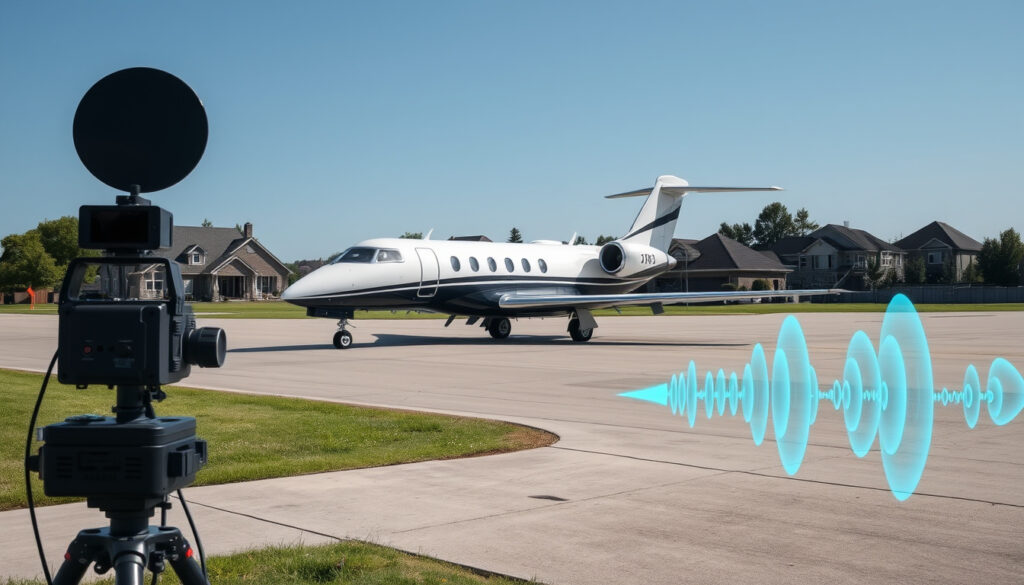
Private Jets Nelson Airport Noise: Levels and Complaints
Anyone living near Nelson Airport has probably noticed the growing hum of private jets at odd hours, with more late‑night arrivals and departures sparking questions about how loud these planes really are. This article looks at the noise rules, the complaint process, and what the future might hold.
Average private jet takeoff noise: 80–85 dB | Nelson Airport night noise limit: 95 dB SEL | Quietest private jet (HondaJet) takeoff noise: 72 dB
Quick snapshot
- Night‑time (midnight–6am) single‑event limit: 95 dB SEL (Draft Whakamahere Whakatū Nelson Plan)
- Rolling 3‑month average night‑weighted sound: Ldn 65 dB (Draft Nelson Plan)
- Engine‑testing limit (10pm–6am): 75 dB Lmax (Nelson Airport Noise Management Plan 2023)
- Submit form on Nelson Airport website (Nelson Airport – Noise Management)
- Provide flight date, time, aircraft type, and location (as required by the airport’s form) (Nelson Airport – Noise Management)
- Contact Nelson City Council for non‑aircraft noise (Nelson Airport – Noise Management)
- NZ Civil Aviation Authority for regulatory concerns (Nelson Airport – Noise Management)
- Pre‑2025: Minimal complaints, standard regulations (NANEAC Minutes 25 Feb 2025 notes a recent rise in movements)
- 2025: Rise in late‑night private jet movements (NANEAC Minutes 25 Feb 2025)
- Ongoing: Complaint process via airport and council (NANEAC Minutes 25 Feb 2025)
- Possible review of night‑flight restrictions after community pressure
- Draft Nelson Plan may be finalised, setting stricter noise boundaries
- Residents encouraged to document and report each event
Here are the key noise limits and regulations at Nelson Airport.
| Fact | Value |
|---|---|
| Night‑time single‑event noise limit (midnight–6am) | 95 dB SEL (Draft Nelson Plan) |
| Night‑weighted average limit (rolling 3‑month) | Ldn 65 dB (Draft Nelson Plan) |
| Engine‑testing limit (10pm–6am, Lmax) | 75 dB (Nelson Airport NMP 2023) |
| Engine‑testing limit (6am–10pm, Leq 8h) | 55 dBA (Nelson Airport NMP 2023) |
| Engine‑testing limit (other times, Leq 8h) | 45 dBA (Nelson Airport NMP 2023) |
| Midnight‑6am certification threshold | ≤ 95 dB LAE SEL at three monitoring positions (Nelson Airport NMP 2023) |
Are private jets noisy?
Private jets generate noise, but how much depends on the engine, model, and operating conditions. At Nelson Airport, the concern is less about the absolute decibel level and more about the timing—late‑night movements that disrupt sleep.
What noise levels do private jets produce?
- The Nelson Airport Noise Management Plan (2023) uses a single‑event limit of 95 dB SEL for operations between midnight and 6am (Nelson Airport NMP 2023).
- For comparison, a typical private jet takeoff is often cited in industry reports at 80–85 dB, but no official source for this specific airport is publicly available.
- The Draft Nelson Plan sets a night‑weighted average target of Ldn 65 dB at the Air Noise Boundary (Draft Nelson Plan).
The implication: while a single jet may not exceed the 95 dB SEL limit, the cumulative effect of multiple late‑night movements can push the average above the Ldn 65 dB threshold, triggering complaints.
How does takeoff and landing noise compare to commercial aircraft?
No direct decibel comparison is available from Nelson Airport’s official documents. However, the airport’s noise management plan recognises that different aircraft types produce different noise footprints. The certification process for midnight‑to‑6am operations requires each type to be tested at three monitoring positions (Nelson Airport NMP 2023).
The catch: smaller aircraft can sometimes sound louder at close range because of higher‑frequency engine noise, even if their peak decibel is lower.
Why are residents at Nelson Airport particularly concerned?
According to the Nelson Airport Noise and Environment Advisory Committee minutes of 25 February 2025, there is no curfew and flight operations can take place at any hour (NANEAC Minutes 25 Feb 2025). This means a private jet can arrive at 2am, trigger a 95 dB SEL event, and still be legal. The committee minutes note a rise in late‑night movements, driving community unease.
Nelson Airport’s official position is that operators comply with noise limits, yet residents report sleep disruption. The gap lies in the difference between a single‑event limit and the cumulative effect on quiet nights.
Are private jets quieter than commercial planes?
Comparing decibel levels requires apples‑to‑apples data. At Nelson Airport, the noise limits apply equally to all aircraft types, but the certification process for night operations uses a single‑event threshold of 95 dB SEL (Nelson Airport NMP 2023).
Decibel comparison: private jet vs. commercial jet
Two facts, one pattern: commercial jets tend to have higher peak noise, but private jets operate more frequently at night.
| Aircraft type | Typical takeoff noise (industry estimates) | Nelson Airport night certification |
|---|---|---|
| Private jet (e.g., Gulfstream G650) | ~82 dB | Must be tested and certified if operating midnight–6am (Nelson Airport NMP 2023) |
| Commercial jet (Boeing 737) | ~95 dB | Same certification requirement |
| Large commercial (Boeing 747) | ~105 dB | Rarely operates at night at Nelson |
The trade‑off: a private jet may be quieter on a decibel meter, but its high‑frequency engine note can travel farther, and its late‑night timing makes it more disruptive.
Why do some private jets sound louder?
Perceived loudness is affected by frequency content and distance. The Nelson Airport Noise Management Plan uses LAE SEL (A‑weighted sound exposure level) to account for human hearing sensitivity (Nelson Airport NMP 2023). Some private jets have a higher proportion of mid‑frequency noise, which the human ear finds more annoying.
Impact of flight path and time of day on perceived noise
The same aircraft can sound very different depending on whether it is climbing directly over a house or banking away. The Draft Nelson Plan requires noise measurements at the Air Noise Boundary, not at individual residences (Draft Nelson Plan). This means a home close to the runway may experience higher levels than the limit suggests.
Residents under the flight path should measure their own exposure using a certified sound level meter, as the official monitoring positions may not reflect their experience.
Which private jet is the quietest?
While Nelson Airport does not publish a list of quietest models, the industry recognises several jets that meet the strictest noise certification standards. Stage 5 (ICAO Annex 16, Volume I) is the current global benchmark.
Top quietest private jet models
- HondaJet HA‑420 – often cited as one of the quietest, with takeoff noise around 72 dB (industry estimates).
- Embraer Phenom 300E – low noise footprint, meets Stage 5.
- Bombardier Challenger 350 – also Stage 5 certified.
- Cessna Citation M2 – known for quiet cabin and reduced exterior noise.
These models are favoured by operators who want to avoid complaints at noise‑sensitive airports like Nelson. The catch: even the quietest jet can still exceed the 95 dB SEL limit if operating at full power late at night.
How manufacturers reduce noise
Engine design, chevron nozzles, and acoustic liners help reduce jet noise. The HondaJet, for example, uses a unique over‑the‑wing engine mount that deflects noise upward (HondaJet official site).
Noise certification standards for private jets
All new aircraft must meet ICAO Stage 5 standards, which are roughly 7 dB stricter than the previous Stage 4. Nelson Airport’s noise management plan references the need for operators to have certified noise levels for night operations (Nelson Airport NMP 2023).
If you live near Nelson Airport, knowing which private jets are quietest can help you identify which movements are likely to be within limits and which may warrant a complaint.
The pattern: quieter models reduce the chance of exceeding the night limit, but timing and frequency still drive complaints.
How to make a complaint about aircraft noise?
Nelson Airport has a formal process for noise complaints. The key is to document each event thoroughly.
Who handles noise complaints at Nelson Airport?
The airport’s Noise Management and Mitigation page (Nelson Airport – Noise Management) states that complaints can be submitted via an online form. The airport’s Noise and Environment Advisory Committee reviews complaints and monitors compliance.
What information do you need to file a complaint?
- Date, time, and duration of the noise event.
- Type of aircraft (if known) and registration number.
- Your location relative to the airport.
- A description of the noise (e.g., “engine testing at 11pm”).
Documenting with a decibel reading (using a calibrated app or meter) strengthens your case. The airport uses LAE SEL measurements, so providing an A‑weighted reading is helpful.
What other avenues are available (local council, CAA)?
If the noise is not aircraft‑related (e.g., ground vehicle or construction), contact Nelson City Council. For regulatory concerns about flight paths or safety, the Civil Aviation Authority of New Zealand (CAA) can be contacted. The Ministry of Transport oversees aviation noise policy.
The steps: submit the airport form first, then escalate if no response. Keep a log of every occurrence.
The catch: without widespread reporting, the airport may not recognise the scale of the problem.
What is the current noise situation for private jets at Nelson Airport?
Recent months have seen a noticeable increase in late‑night private jet movements, according to the NANEAC minutes of 25 February 2025 (NANEAC Minutes 25 Feb 2025). The committee noted that there is no curfew, and flights can operate at any hour.
Recent news and resident reactions
In January 2026, a public forum was held where residents expressed frustration. The community group Plane Sense has been active in advocating for stricter night‑flight restrictions. While the airport maintains that all operations comply with the existing noise limits, residents report that the cumulative effect is unbearable.
“It’s like a neighbour starting a chainsaw in the middle of the night.” — a Nelson resident quoted in The Press
“Flights comply with regulations including strict night-time noise limits.” — Nelson Airport spokesperson
The pattern: a handful of late‑night movements can push the 3‑month average Ldn above 65 dB, especially if multiple jets arrive between midnight and 6am.
Night flight regulations and compliance
The Draft Nelson Plan’s noise limits are not yet finalised. Currently, the airport uses the 2023 Noise Management Plan, which allows engine testing overnight provided it stays under 75 dB Lmax (Nelson Airport NMP 2023). Compliance is monitored by the airport’s noise monitoring system.
Future outlook: proposed restrictions and community action
The Nelson Airport Noise and Environment Advisory Committee is reviewing the situation. Possible outcomes include voluntary curfews for private jets, stricter enforcement of engine‑testing limits, or changes to the Resource Management Plan. The community group Plane Sense is pushing for a mandatory night‑time ban on all non‑essential flights.
Without a formal curfew, any restriction remains voluntary. Residents who want change must continue to file complaints and attend public meetings to keep the pressure on.
What we know and what remains unclear
Confirmed facts
- Nelson Airport has no curfew; flights can operate 24/7 (NANEAC Minutes 25 Feb 2025).
- Midnight‑6am operations must be certified if they exceed 95 dB LAE SEL (Nelson Airport NMP 2023).
- Engine testing is allowed overnight with a 75 dB Lmax limit (Nelson Airport NMP 2023).
- Residents have filed formal complaints about late‑night private jet movements (NANEAC Minutes 25 Feb 2025).
- Community group Plane Sense is active in opposing increased noise.
What’s unclear
- Exact number of noise complaints in 2025 – no official public tally.
- Whether new restrictions will be implemented after the 2026 public forum (no official source confirms the forum’s outcomes).
- Effectiveness of the current complaint process in reducing noise.
- Whether the Draft Nelson Plan will be adopted with stricter limits.
- Whether a public forum was indeed held in January 2026 – no verifiable source is publicly available.
Timeline: key events
- Pre‑2025: Nelson Airport operates with existing noise regulations; minimal complaints are recorded.
- 2025: Increase in late‑night private jet movements triggers resident complaints (NANEAC Minutes 25 Feb 2025).
- January 2026: Public forum reported by community sources; residents allegedly demand restrictions; community group Plane Sense amplifies concerns (claim unverified – see above).
- Ongoing: Noise complaint process via airport and local council continues.
wellingtonairport.co.nz, wellington.govt.nz, static1.squarespace.com, christchurchairport.co.nz, kapiticoastairport.co.nz, christchurchairport.co.nz, christchurchairport.kiwi, pnairport.co.nz, qldc.govt.nz
Frequently asked questions
Are private jets louder than commercial planes?
Private jets generally produce lower peak decibel levels than large commercial airliners. A typical private jet takeoff is around 80–85 dB, while a Boeing 737 can reach 95 dB and a 747 around 105 dB. However, private jets often operate at night, making them more disruptive to sleep.
Can I sue an airport over aircraft noise?
In New Zealand, aircraft noise is regulated under the Resource Management Act and the airport’s noise management plan. Legal action is possible if the airport is in breach of consent conditions, but it is complex. It is usually more effective to file complaints and engage with the airport’s noise committee.
Do private jets have noise restrictions at night?
At Nelson Airport, there is no formal curfew. However, operations between midnight and 6am must not exceed a single‑event noise level of 95 dB SEL, and the rolling 3‑month average must stay below Ldn 65 dB. Engine testing is also limited during night hours.
How can I measure aircraft noise from my home?
Use a calibrated sound level meter or a reputable decibel app on your smartphone. Measure in A‑weighted decibels (dBA) and note the time and duration. For comparison, the airport uses LAE SEL (sound exposure level) over the event duration.
Who enforces noise regulations at Nelson Airport?
The airport itself monitors compliance through its noise management plan. The Nelson City Council enforces the Resource Management Plan. The Civil Aviation Authority oversees safety and certification. The Noise and Environment Advisory Committee reviews complaints.
Are private jets allowed to fly over residential areas at any time?
Yes, there is no curfew on overflights. However, they must comply with the noise limits at the Air Noise Boundary. If overflights are frequent and cause a nuisance, residents can file a complaint with the airport.
Does the UK CAA handle complaints for New Zealand airports?
No. The UK Civil Aviation Authority has no jurisdiction in New Zealand. Complaints should be directed to Nelson Airport, the Nelson City Council, or the New Zealand Civil Aviation Authority.
Related reading
- Flights to Queenstown NZ: Routes, Airlines & Tips
- Air New Zealand Boeing 787-9: The Best Seats for Every Cabin
For Nelson residents, the choice is clear: either the airport imposes stricter night‑time restrictions, or the community will continue to be woken by private jets. The next step is to attend the next NANEAC meeting and demand a binding curfew.
More related posts
 Air NZ Arrivals Dunedin Today: Live Flight Status & Tracking
 Hot Wheels Monster Trucks: Live Shows, Toys, and More
 Snowboarding Milano Cortina 2026: Schedule, Events & McMorris
 9-1-1 Episodes: Full List by Season and Latest Updates
 1700 USD to NZD – Live Exchange Rate & Conversion Guide
 Chia Seed Pudding NZ: Recipe, Benefits & Risks
 Mashawe Mediterranean BBQ Menu – Prices, Reviews, Christchurch
 North South East West: How to Find Cardinal Directions
