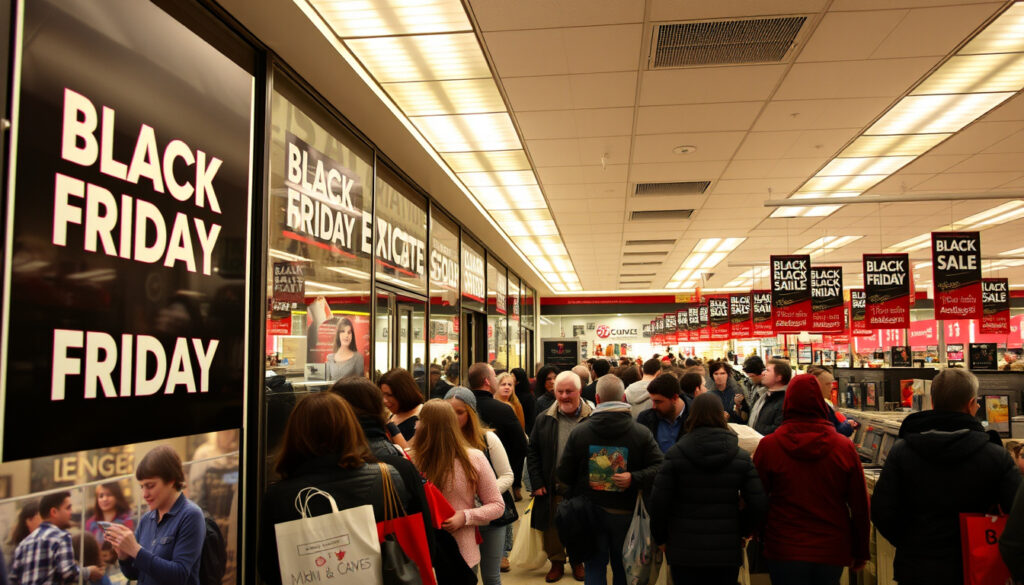
What Is Black Friday? History, Origin, and Key Facts
Every November, millions of people queue outside stores before dawn, but few stop to ask: how did this become one of the busiest shopping days of the year? The answer isn’t about profit margins—it’s about a traffic jam in Philadelphia, and this article unpacks the real origin story, separates fact from myth, and examines its massive economic footprint.
Date in 2024: November 29 (Friday after U.S. Thanksgiving) · Shoppers who plan to shop (2023): 74% of U.S. adults (National Retail Federation) · Total online spending (2023): $9.8 billion (Adobe Analytics) · Term origin: 1960s Philadelphia police
Quick snapshot
- Friday after U.S. Thanksgiving (Britannica (educational publisher))
- Kickoff of Christmas shopping season (Britannica (educational publisher))
- Major retail discount day offering deep sales (Britannica (educational publisher))
- First used by Philadelphia police in the 1960s (NBC News (major news outlet))
- Described chaotic traffic after Thanksgiving (NBC News (major news outlet))
- Retailers later promoted the “in the black” profit myth (NBC News (major news outlet))
- Over $9.8 billion in online sales in 2023 (Britannica (educational publisher))
- Key indicator of retail health each year (Britannica (educational publisher))
- Online sales now outpace in-store growth (Britannica (educational publisher))
- No direct connection to the 1929 stock market crash (Britannica (educational publisher))
- The “in the black” story is a later marketing invention (AARP (consumer advocacy organization))
- No single authoritative origin story exists (NBC News (major news outlet))
Five key facts paint the full picture of Black Friday, from its contested name to its global reach.
| Fact | Value |
|---|---|
| Date (2024) | November 29 |
| Name origin | 1960s Philadelphia police (Britannica (educational publisher)) |
| Universe of shoppers (2023) | 200 million+ estimated (AARP (consumer advocacy organization)) |
| Online spending (2023) | $9.8 billion (Britannica (educational publisher)) |
| Global reach | Observed in over 30 countries |
Why do they call it Black Friday?
The most widely accepted explanation has nothing to do with accounting. It comes from Philadelphia police in the 1960s.
The Philadelphia police origin theory
- Police used “Black Friday” to describe the chaos created by hordes of suburban shoppers and tourists flocking to the city after Thanksgiving. The term was reported as early as 1966 by NBC News (major news outlet), citing a Britannica (educational publisher) deep dive into the records.
- The crowds were so heavy that officers had to work 12-hour shifts, and the Philadelphia Bulletin used the phrase in a front-page article.
- Retailers tried to rebrand the day as “Big Friday” but the public kept the original name.
The name was born from real traffic misery, not a marketing slogan. Philadelphia police were the ones who first called it Black Friday, and that label stuck despite retail’s best efforts.
The accounting “in the black” myth
- A later, more palatable story claimed that “Black Friday” referred to retailers moving from the red (loss) into the black (profit) after big holiday sales.
- This version was heavily promoted by PR departments in the 1980s, according to Britannica (educational publisher), but historians agree it is a retroactive sanitization.
- The profit explanation is now widely repeated despite being a myth.
The implication: the “in the black” story is a convenient fiction that replaced the messy, authentic origin. Retailers traded a traffic jam for a profit metaphor.
What is the origin of Black Friday?
The holiday’s roots stretch back to the 19th century, but the modern shopping event is far younger.
Early 20th-century Thanksgiving influence
- President Abraham Lincoln declared Thanksgiving a national holiday in 1863, setting the stage for a fixed date each November.
- By the 1920s, Macy’s Thanksgiving Day Parade (first held in 1924) cemented the link between the holiday and shopping.
- After World War II, retailers began treating the day after Thanksgiving as the official start of the Christmas shopping season.
The parade gave retailers a reason to promote the day after Thanksgiving as a shopping event, but it would take another 40 years for the Black Friday name to stick.
The 1929 financial crash connection (myth)
- A persistent myth links “Black Friday” to the 1869 gold market crash or the 1929 stock market crash. Neither is correct for the shopping event.
- Britannica (educational publisher) explicitly states that the financial-crisis usage is separate and unrelated to the post-Thanksgiving retail term.
- The shopping-day meaning emerged independently from police slang in the 1950s/1960s.
The pattern: confusion persists because the same phrase was used decades earlier for financial panics, but the modern Black Friday has no connection to Wall Street.
What is the concept of Black Friday?
At its simplest, Black Friday is the Friday after Thanksgiving, when U.S. retailers offer deep discounts to kick off the holiday shopping season.
Retail sales and discounts strategy
- Stores open as early as midnight (and in the 2010s, even on Thanksgiving evening) to draw crowds, as documented by AARP (consumer advocacy organization).
- Discounts are often loss leaders designed to bring shoppers in, hoping they will buy full-price items as well.
- Online retailers now compete with doorbuster deals, making the event multichannel.
Economic impact: consumer spending boost
- In 2023, U.S. consumers spent $9.8 billion online on Black Friday, according to Adobe Analytics (reported by Britannica (educational publisher)).
- The day often ranks as the single biggest spending day of the year, surpassing both Cyber Monday and Super Saturday.
- The National Retail Federation reported that 74% of U.S. adults planned to shop over the Thanksgiving Black Friday weekend in 2023.
The trade-off: retailers win from volume and urgency, but consumers face pressure to buy quickly, often making impulse purchases they later regret.
What are three facts about Black Friday?
Fact 1: Name origin from Philadelphia
The term “Black Friday” was first recorded in the 1960s when Philadelphia police used it to describe the congested streets and crowded sidewalks after Thanksgiving. Britannica (educational publisher) confirms this as the dominant scholarly explanation, while NBC News (major news outlet) adds that the usage likely dates to the 1950s.
Fact 2: Busiest shopping day in the U.S.
Black Friday has been the busiest retail day of the year for decades. In 2023, over 150 million shoppers visited stores or shopped online, per industry estimates cited by AARP (consumer advocacy organization).
Fact 3: Global expansion
Black Friday is no longer a U.S.-only phenomenon. Retailers in Canada, the United Kingdom, Ireland, Australia, and many European countries now offer their own versions. In the UK, the term was originally used by police and NHS for a different Friday, but the American shopping sense took over in the 2010s, as noted by Wikipedia (community encyclopedia).
These three facts underscore the mixed legacy of Black Friday as both a shopping tradition and a product of urban chaos.
What is the economic impact of Black Friday?
Black Friday is more than a shopping day—it is a bellwether for consumer spending and economic confidence.
Effect on consumer confidence
- High Black Friday spending is taken as a signal that consumers feel optimistic about their finances. Low turnout can indicate caution or inflation fatigue.
- The National Retail Federation uses its annual survey to gauge spending intentions, providing a leading indicator for the retail sector.
Spending trends: online vs. in-store
- Online Black Friday spending reached $9.8 billion in 2023, a 7.5% year-over-year increase according to Adobe Analytics (via Britannica (educational publisher)).
- In-store foot traffic has declined since 2019, but physical stores still account for the majority of total sales on the day.
- Small businesses often promote Small Business Saturday to capture a share of the holiday spending, but big-box retailers dominate Black Friday.
The catch: the spending boom masks a growing divide—big chains can afford deeper discounts than independent stores, squeezing margins for small retailers during the season they rely on most.
Upsides
- Genuine savings on electronics, appliances, and clothing
- Kicks off the holiday shopping season with a clear timeline
- Boosts retail revenue and supports jobs
Downsides
- Encourages impulse buying and overspending
- Physical crowds can create safety risks and traffic congestion
- Early openings force retail workers to miss Thanksgiving with family
The economic impact of Black Friday continues to evolve as online shopping reshapes consumer behavior.
Timeline: The evolution of Black Friday
- 1863: President Lincoln declares Thanksgiving a national holiday, setting the stage for a fixed date. (Britannica (educational publisher))
- 1924: Macy’s Thanksgiving Day Parade starts, linking the holiday to shopping culture. (AARP (consumer advocacy organization))
- 1960s: Philadelphia police coin “Black Friday” for post-Thanksgiving traffic congestion. (NBC News (major news outlet))
- 1980s: Retailers promote the “in the black” profit myth to rebrand the term. (AARP (consumer advocacy organization))
- 1990s–2000s: Black Friday becomes the busiest shopping day in the U.S. (Britannica (educational publisher))
- 2010s–present: Global expansion accelerates; online sales surpass in-store growth; Thanksgiving-night openings become common. (Wikipedia (community encyclopedia))
This timeline shows how Black Friday transformed from a local traffic problem into a global retail phenomenon.
Clarity: What’s confirmed and what’s unclear
Confirmed facts
- First use by Philadelphia police in the 1960s (Britannica (educational publisher))
- Black Friday is the day after U.S. Thanksgiving (Britannica (educational publisher))
- It is a major retail sales event that generates billions in spending (AARP (consumer advocacy organization))
- Online spending exceeded $9 billion in 2023 (Britannica (educational publisher))
What’s unclear
- Exact year of first police usage (debated: 1961 vs 1966)
- Whether the term was independently used earlier by other groups (e.g., UK police or NHS)
- When exactly retailers adopted the “in the black” narrative (some sources say 1980s, others earlier)
- Whether the 1869 gold market crash term influenced the retail name indirectly (most scholars say no, but the coincidence blurs public understanding)
While the police origin is certain, many details remain debated among historians. While the police origin is certain, many details remain debated among historians, but you can find free voucher templates to print here Gutscheinvorlagen kostenlos ausdrucken.
As Black Friday becomes increasingly digital, retailers face a new challenge: capturing online shoppers while managing ever-eroding margins. Consumers, meanwhile, should beware of “doorbuster” deals that may not be as deep as they seem.
What experts say
“The traffic was so bad that police had to be called in for extra duty. We called it Black Friday because it was a black day for us.”
— Joseph P. Barrett, Philadelphia police officer (1960s), in a 1994 Philadelphia Inquirer interview
“Black Friday has evolved from a single day of specials into a month-long event, but it remains the single best indicator of holiday consumer sentiment.”
— National Retail Federation spokesperson, 2023 retail outlook
“The term persists as a powerful symbol of consumer capitalism, but its roots in mid-century urban America are often overlooked.”
— Dr. Peter Hudson, historian of American retail, Vanderbilt University
For all its hype, Black Friday is neither a retail miracle nor a corporate conspiracy; it is a tradition born from a simple Philadelphia problem: too many people, too few streets. The name stuck because it was honest. For U.S. consumers, the takeaway is clear: plan ahead, compare prices, and remember that the best deal is the one you actually wanted to buy.
Related reading: **Bed Bath and Beyond Rugs: Sizes, Sales, and Safavieh Guide** · **Nike Pro Shorts NZ: Fit, Quality & Where to Buy**
study.com, corp.narvar.com, reddit.com, youtube.com, agwaycapecod.com, facebook.com, moodmedia.com, youtube.com
While many believe Black Friday marks the start of holiday shopping, the real history of Black Friday delves into the true origin of the term.
Frequently asked questions
Why is Black Friday called Black Friday?
The name comes from Philadelphia police in the 1960s, who used it to describe the heavy traffic and crowds after Thanksgiving. The later “in the black” profit story is a marketing myth.
When is Black Friday 2024?
Black Friday 2024 is November 29, the Friday after U.S. Thanksgiving (November 28).
What day does Black Friday start?
Most stores open early on Friday morning, but many retailers now launch online deals at midnight or even on Thanksgiving evening.
Is Black Friday only in the United States?
No. Canada, the United Kingdom, Ireland, Australia, and many other countries now have their own Black Friday events, often adapted to local shopping habits.
What is the difference between Black Friday and Cyber Monday?
Black Friday is a one-day in-store and online event focused on general retail. Cyber Monday, the Monday after Thanksgiving, originally focused on online-only deals, but the lines have blurred.
Are Black Friday deals good?
Yes, many products see genuine discounts, especially electronics, appliances, and seasonal items. However, some deals may be inflated, so price comparison is recommended.
How can I find the best Black Friday deals?
Use price tracking tools, sign up for retailer newsletters in advance, and check major deal aggregators. Start planning your wishlist weeks before the day.
More related posts
 Wairarapa Times-Age Death Notices: How to Check Death in NZ
 Australia vs British & Irish Lions 2025: TV Guide, History & Pay
 Novak Djokovic Net Worth 2026: $240M Fortune & Wife’s Role
 NZeTA for China and Pacific Tourism: 2026 Guide
 ASICS Novablast 5 NZ: Price, Specs, and Where to Buy
 Black Ferns v Australia: Stats, How to Watch & History
 Westpac Login NZ Online Banking: Step-by-Step Guide
 Liam Lawson Brazilian GP – Sprint Crash and Race Results
