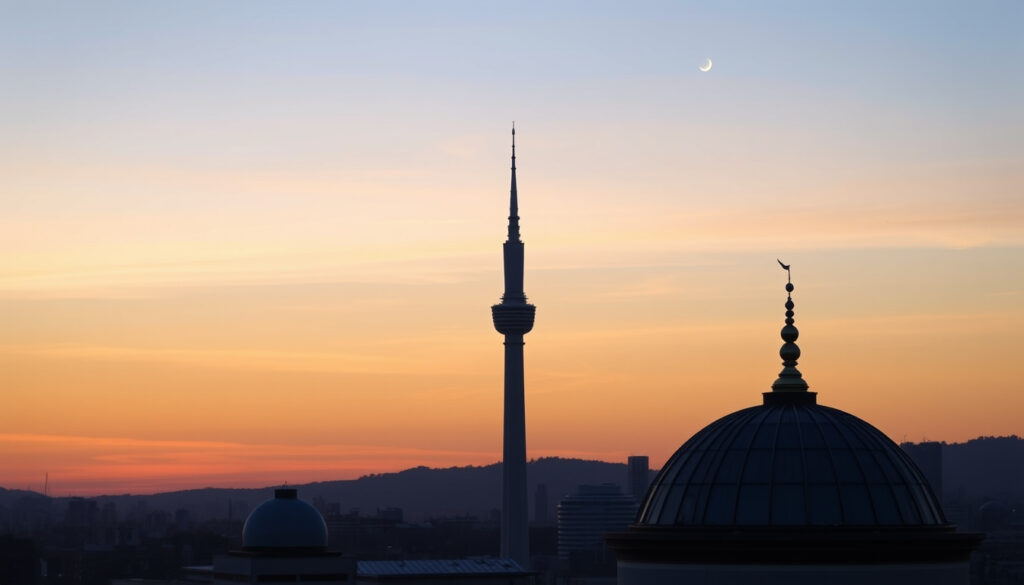
Fajr Time in Auckland: Today’s Schedule & Key Rulings
Anyone who’s ever checked the Fajr time in Auckland knows it’s not as simple as a single number. Mosques in different suburbs, the national Islamic body, and global prayer calculators often show slightly different times — and the differences matter when you’re planning your dawn prayer. This guide breaks down today’s schedules, explains the rulings that determine when Fajr starts and ends, and helps you navigate the variation with clarity.
Auckland Islamic Trust Fajr (Nov 2024): 06:40 AM ·
Masjid e Umar Fajr example: 05:50 AM ·
Yeni Safak ruling: Fajr ends at sunrise
Quick snapshot
- Fajr begins at true dawn (Yeni Safak international news outlet)
- Fajr ends at sunrise (Yeni Safak)
- Calculation angles vary by method (Masjid e Umar Auckland mosque timetable)
- Exact true-dawn moment varies by calculation method (Auckland Islamic Trust local NZ trust shows two different Fajr times on same page)
- Some Auckland mosques follow slightly different schedules (Masjid e Umar timetable differs from other aggregators)
- Fajr time shifts as seasons change – today’s times differ from summer months (Hamariweb prayer aggregator lists 05:02 AM Fajr on 18 Oct 2025)
- Check your local mosque’s timetable or a reliable aggregator before each prayer (Auckland Islamic Trust publishes monthly updates)
Prayer times quoted here come from publicly available sources and reflect the most recent data we could verify. Because true dawn is calculated using different angles, slight variations between sources are normal. Always confirm with your local mosque if you need absolute precision.
The table below confirms the scope of variation across Auckland’s main sources, making it clear why no single number suits every worshipper.
| Fact | Detail |
|---|---|
| Source | Auckland Islamic Trust (ait.org.nz) |
| Fajr time (example, Nov 2024) | 06:40 AM (one listing) and 06:50 AM (another line on same page) |
| Sunrise (same page) | 08:09 AM and 08:22 AM |
| Masjid e Umar timetable | Fajr 05:50 AM (example), Shuruq 07:16 AM |
| Yeni Safak ruling | Fajr ends at sunrise |
| Hanafi Asr start | Shadow twice object’s length (per Abu Hanifa) |
| Shafi Asr start | Shadow equals object’s length (majority of scholars) |
What is the Fajr time in Auckland today?
If you’re looking for a single Fajr time for today in Auckland, the honest answer is that it depends on which source you trust. The Federation of Islamic Associations of New Zealand (FIANZ) uses an 18-degree angle, but the exact times published by local institutions can differ by several minutes.
Fajr time from Auckland Islamic Trust
The Auckland Islamic Trust local NZ Islamic trust publishes a prayer timetable that, as of November 2024, lists Fajr at 06:40 AM with sunrise at 08:09 AM. Interestingly, the same page also shows a second schedule with Fajr at 06:50 AM and sunrise at 08:22 AM. This internal discrepancy highlights how even within one organisation, calculation methods can vary.
Fajr time from Masjid e Umar
The Masjid e Umar Auckland mosque with separate Shafi/Hanafi timings timetable provides a different baseline. A sample entry shows Fajr at 05:50 AM, Shuruq at 07:16 AM, Dhuhr at 12:50 PM, Asr (Shafi) at 03:50 PM, Asr (Hanafi) at 04:50 PM, Maghrib at 05:20 PM, and Isha at 07:00 PM. This table also labels “Shuruq” as the approximate sunrise time.
Fajr time from other aggregators
Global prayer-time sites such as Hamariweb prayer aggregator have listed Auckland Fajr as 05:53 AM on some views and 05:02 AM on 18 October 2025. Meanwhile, prayertim.es web-based prayer-time tool reports Fajr at 06:53 AM. The spread — from about 05:00 AM to 06:53 AM — shows the real-world variation caused by different calculation angles and timezone adjustments.
What time is too late to pray Fajr?
Islamic jurisprudence is clear that the obligatory time for Fajr ends at sunrise. Once the sun’s disc appears above the horizon, the time for the fard prayer has passed.
The end of Fajr time at sunrise
Yeni Safak international news outlet covering prayer times states plainly: “Fajr begins at the time of imsak and ends with sunrise. Sunrise marks the end of the obligatory time for Fajr.” This is the consensus view among Sunni schools.
“Fajr begins at the time of imsak and ends with sunrise. Sunrise marks the end of the obligatory time for Fajr.”
Yeni Safak
Scholarly consensus on Fajr qada
If a person oversleeps or forgets, they must pray Fajr as soon as they remember — even after sunrise. This makeup prayer (qada) is still obligatory, though the preferred time has passed. Some scholars allow a small grace period until the sun is fully above the horizon (approximately 15–20 minutes after the first edge appears), but most hold that the fard window ends precisely at sunrise.
If you see the sun’s disc rising, you’ve missed the Fajr prayer time. Make it up as qada without delay — but do not pray the fard when the sun is actually rising, as that is a forbidden time.
The pattern: a missed Fajr must be made up, but the act of praying during sunrise creates a separate sin.
What is the earliest time to pray Fajr?
Fajr time begins at the moment of true dawn (al-fajr as-sadiq) — the first horizontal light that appears along the horizon, distinct from the false dawn that rises vertically.
Start of Fajr at true dawn
The start is determined astronomically by the sun’s angle below the horizon. The Auckland Islamic Trust local NZ Islamic trust uses an 18-degree angle, while other methods use 15 or 12 degrees. This is why the published Fajr start time can differ by more than 30 minutes on the same day.
As Yeni Safak explains, “Fajr begins at the time of imsak.” Imsak is the moment one stops eating and drinking before the fast, and it coincides with the start of Fajr.
“Fajr begins at the time of imsak and ends with sunrise.”
Yeni Safak
Difference between Fajr and sunrise
The period between true dawn and sunrise is the window for performing the two rak’ahs of Fajr sunnah and the two obligatory rak’ahs. In Auckland, this window can be roughly 1.5 to 2 hours depending on the season and calculation method. Checking your local mosque’s “Shuruq” time (the moment sunrise begins) is an easy way to know when Fajr ends.
Auckland Muslims relying on different calculation angles face up to 30 minutes of difference in Fajr start. The same prayer could be valid for one neighbour and already qada for another — simply because of which degree they follow.
What is the forbidden time of Fajr prayer today?
Islamic tradition identifies three times when performing any salah (including Fajr) is forbidden (karahat): at sunrise, when the sun is at its zenith, and at sunset. These are known as the “forbidden times of salah.”
Forbidden times of salah in general
The Yeni Safak international news outlet covering prayer times reminds readers that “Eid prayer starts after sunrise and after the disliked time (karahat) passes.” The same principle applies to all sunnah and fard prayers: you should not pray the sunnah or fard when the sun is rising.
Why Fajr cannot be prayed at sunrise
If you have not yet prayed Fajr and the sun starts to appear, you must wait until the sun has fully risen above the horizon (typically 15–20 minutes) before making up the prayer. Praying fard during the actual sunrise is considered sinful (makruh tahrimi) because it resembles sun worshippers. However, the obligation to perform the prayer remains; you simply delay the performance to avoid the forbidden window.
Can I pray tahajjud 10 minutes before Fajr?
Yes. The night prayer (tahajjud) is valid until the moment Fajr begins. There is no “forbidden time” in the last part of the night before true dawn.
Tahajjud time ends at Fajr
Yeni Safak confirms that “Tarawih begins after Isha and continues until Fajr.” The same principle applies to tahajjud — it can be offered any time after Isha until the break of true dawn. So praying even 10 minutes before Fajr is perfectly fine, as long as you finish before the adhan of Fajr.
Is there a forbidden time before Fajr?
No. The only disliked time in the night is after the Fajr prayer itself. During the last third of the night, all voluntary prayers are encouraged, and tahajjud is especially virtuous. As long as you are not praying the sunnah of Fajr after the adhan has started, you can stand in prayer until the very last minute before dawn.
What this means for you
- Tahajjud is permissible up to the start of Fajr
- No forbidden window in the last part of the night
- Finish your voluntary prayer before the Fajr adhan
Common confusion
- Some think 10 minutes before Fajr is too close – it is not
- Mixing tahajjud with Fajr sunnah in the same prayer – each is separate
Related reading: What Time Is Evening? Start, End Times & Cultural Guide · Full Moon May 2025: Flower Moon Date, Meaning and Effects
Frequently asked questions
What is the Fajr time for tomorrow in Auckland?
Prayer times shift daily due to Auckland’s changing sunrise. Check Auckland Islamic Trust or Masjid e Umar for the latest. As a guide, times in late 2024 have been around 05:50–06:50 AM.
Do different mosques in Auckland have different Fajr times?
Yes. Masjid e Umar displays a different schedule from the Auckland Islamic Trust. Each organisation may use a different calculation angle (e.g., 18° vs 15°). Always check the mosque you attend.
Can I pray Fajr after sunrise if I overslept?
Yes, as soon as you wake up, but do not pray during the sunrise itself. Wait until the sun is fully above the horizon. The missed prayer must be made up (qada). Yeni Safak notes that the obligatory time ends at sunrise.
How can I find accurate Fajr time for my exact location in Auckland?
Use a reliable local source such as Masjid e Umar or the Auckland Islamic Trust. Global apps like IslamicFinder may differ because they use a default calculation method not calibrated for NZ.
Is there a difference between Hanafi and Shafi Fajr times in Auckland?
Fajr time itself does not differ by school — the ruling on Asr does. But differences in Fajr start time arise from calculation angles, not from madhhab. Masjid e Umar shows separate Asr columns for Shafi and Hanafi, but Fajr is the same across both.
Why does Masjid e Umar show a different Fajr time from FIANZ?
FIANZ publishes an official timetable using 18 degrees, while Masjid e Umar may follow a different local calculation. Both are valid but produce different start times. Check the source you trust most.
For Auckland Muslims, the Fajr time question isn’t about right or wrong — it’s about choosing a calculation method and sticking with it. The implication for your daily practice is clear: verify your prayer times from a source that matches the method followed by your mosque, and remember that the window closes at sunrise. For anyone living in Auckland’s diverse Islamic community, the trade-off is between following a single authoritative timetable or cross-checking multiple sources — but what matters most is that you pray on time.
More related posts
 Best Hand Cream NZ – Top Picks for Dry Cracked Skin
 Ladybug and Cat Noir: Complete Guide to Miraculou Ladybug (2024)
 Easter Sunday Public Holiday – Status Across Australia 2024
 Private Jets Nelson Airport Noise: Levels and Complaints
 First Home Buyers Grant NZ: Status, Eligibility & Alternatives
 Full Moon May 2025: Flower Moon Date, Meaning and Effects
 Travel Insurance Compare NZ – Best Providers and Coverage 2025
 Rainbow’s End Pirate Ship Returns in 2025
