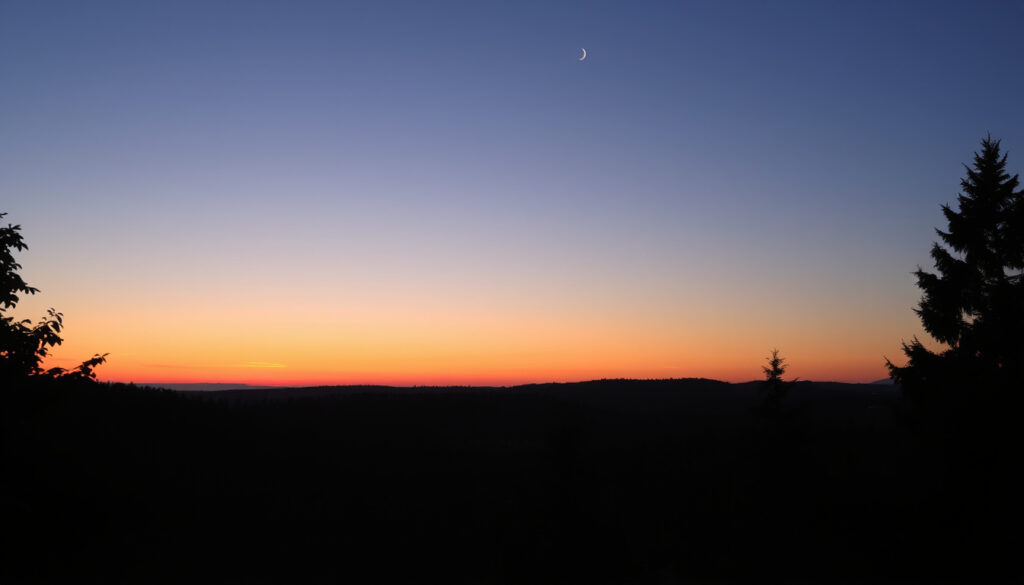
What Time Is Evening? Start, End Times & Cultural Guide
Evening doesn’t have a fixed start time—it varies by culture, season, and language. The answer depends on where you live and even your linguistic background.
Typical start: 5–6 PM (17:00–18:00) ·
Typical end: 11 PM–12 AM (23:00–00:00) ·
Key sources: Wikipedia, QuillBot ·
Cultural variation: Yes – influenced by latitude, season, and custom
Quick snapshot
- Evening typically starts between 5–6 PM (YourDictionary (language reference))
- Evening lasts until around 9–11 PM depending on definition (Amazing Talker (Q&A platform))
- Cultural norms like dinner time influence boundaries (UBC Language Sciences (academic research))
- Exact start and end times are not universally agreed (Vered Shwartz (linguistic survey))
- Distinction between evening and night varies by culture (UBC Language Sciences (academic research))
- Average American evening: 4:27 PM to 7:04 PM (same survey)
- Average European evening: 5:51 PM to 6:50 PM (same survey)
- Evening transitions to night after 9–11 PM in most definitions
- Cultural shifts and global communication may continue to blur boundaries
Here is a quick summary of the typical evening range.
| Attribute | Value |
|---|---|
| Typical start | 5–6 PM (17:00–18:00) |
| Typical end | 11 PM–12 AM (23:00–00:00) |
| Key source | Wikipedia, QuillBot |
| Cultural variation | Varies by region, latitude, season |
Is 5 pm afternoon or evening?
What time does afternoon end?
- A commonly cited schedule places afternoon from 12:00 PM to 5:00 PM, with evening starting at 5 PM (YourDictionary (language reference)).
- Another guide defines afternoon as 1:00 PM to 5:00 PM and evening as 5:00 PM to 7:00 PM (Amazing Talker (Q&A platform)).
Typical afternoon times
In many English-speaking regions, the cultural default treats afternoon as ending around 5 PM. But surveys reveal that the boundary shifts depending on context. One survey found that Americans, on average, consider evening to start at 4:27 PM (same survey as above).
The implication: 5 PM sits right on the fuzzy line. Some call it afternoon, others evening, and neither is wrong.
What is the time of evening?
Evening start time
- Most sources peg the start to the end of the business day, around 5–6 PM (YourDictionary (language reference)).
- In the U.S., the average sunset is 6:30 PM, but evening is perceived as starting earlier (UBC Language Sciences).
Evening end time
- The end of evening is even less fixed. A common standard says evening runs until 9:00 PM (Amazing Talker (Q&A platform)).
- But many people extend it to 11 PM or midnight before calling it night.
Cultural variations
Evening is not a universal concept. Data from an international survey shows stark differences:
| Region | Average start | Average end |
|---|---|---|
| United States | 4:27 PM | 7:04 PM |
| Europe | 5:51 PM | 6:50 PM |
| India | 2:21 PM | 4:56 PM |
| Brazil | 5:28 PM | 5:49 PM |
Data from a linguistic survey.
The pattern: Indian respondents see evening as early afternoon, while Brazilians perceive it as a very narrow window around sunset. Geography and meal times drive these differences.
Is 10 pm considered an evening?
Late evening vs night
- 10 PM is commonly labelled late evening or early night. Most classification guides put the evening‑night boundary between 9 PM and midnight.
- In a survey, U.S. respondents reported that night starts on average at 6:59 PM – well before 10 PM (UBC Language Sciences (academic research)).
When does night start?
Night begins after sunset, and its perceived start varies by culture. In Italy, night starts as early as 6:22 PM (UBC Language Sciences). So 10 PM would be firmly in night time for many.
10 PM is late evening only if your culture draws the boundary after 11 PM. For most English speakers, it’s night.
The implication: Knowing your audience’s cultural frame is essential when scheduling events at 10 PM.
Is 7 pm evening or night?
Twilight and darkness
- 7 PM is after sunset in most latitudes, but twilight lingers. Culturally, it is almost always called evening.
- U.S. data shows that “night” is perceived to begin at 6:59 PM on average (UBC Language Sciences). So 7 PM straddles the line.
Common usage
In everyday language, “evening” is used for 7 PM social events. Dinner invitations at 7 PM are called “evening dinners”. The term “night” only takes over after 9 or 10 PM.
“In my opinion, 5pm is evening time, night time is from 8pm-12am.”
— Reddit user (personal classification)
The trade-off: 7 PM is safe to call evening, but if you’re speaking with someone from a culture where night starts early, you might get a puzzled look.
Is 6 pm in the evening?
Is 6 PM evening or afternoon?
- Many standard tables mark 6 PM as the beginning of evening (YourDictionary).
- But a sizeable minority still call it late afternoon, especially in regions where sunset is after 7 PM.
Time divisions
A frequently cited division: afternoon 12–5 PM, evening 5–9 PM, night 9 PM–6 AM. By that logic, 6 PM is squarely in evening. For a deeper dive into how different cultures define evening, you can explore free text to speech Google ChatGPT.
For anyone scheduling meetings or planning social events, calling 6 PM “evening” is the safest bet — but know that your audience’s local norms may push it into afternoon.
The catch: Even within the same country, perceptions can differ, so when in doubt, ask.
What’s known and what’s unclear
Confirmed facts
- Afternoon ends and evening begins in the late afternoon (5–6 PM) according to most English‑language references (YourDictionary (language reference)).
- Evening is a subjective time period influenced by sunset, work schedules, and language structure (UBC Language Sciences).
- Languages like Spanish and Portuguese lack a direct word for “evening” (UBC Language Sciences (academic research)).
What’s unclear
- Exact start and end times are not universally agreed; surveys show wide variance.
- Distinction between evening and night varies by culture — and even within the same country.
- Biblical definitions (e.g., Hebrew ereb) differ from modern secular usage (The Simple Answers (religious analysis)).
Quotes from the research
“Cultural norms like dinner time influence afternoon‑evening boundaries.”
— Researcher, UBC Language Sciences
The pattern: These differences underscore that time-of-day labels are not universal.
Summary
Evening isn’t a fixed hour — it’s a fluid concept shaped by sunset, cultural traditions, and language. For anyone puzzled by the evening clock, the takeaway is that there’s no single correct answer, but the pattern is clear: sunset and culture rule the hour. Whether you’re in Ireland or India, your evening starts when your society says it does. For a traveller or global worker, the safest guideline is to treat 5–6 PM as evening’s start and to ask locals when they feel the shift.
Related reading: Afternoon vs. Evening: Key Differences · Good Night at 4 PM: Time Expressions Across Cultures
Frequently asked questions
What time is evening shift?
Evening shift typically runs from 3 PM to 11 PM or 4 PM to midnight, depending on the employer. It’s the span between day shift and night shift.
What time is evening in Ireland?
In Ireland, evening is generally considered to begin around 5 PM or 6 PM, but the long summer daylight can push perceived evening later. No official definition exists.
Is 8 PM evening?
Yes, 8 PM is almost universally considered evening, though some might call it night after 9 PM. It falls within the typical 6–9 PM evening window.
When does evening start in winter?
In winter, earlier sunsets (4–5 PM in high latitudes) can cause evening to be perceived as starting earlier. The cultural start may shift to 4 PM in some regions.
Is afternoon 12–5?
That’s a common definition, but some extend afternoon to 6 PM. The boundary between afternoon and evening is the most debated transition of the day.
What time is twilight?
Twilight is the period between sunset and full night, lasting roughly 20–60 minutes depending on latitude. It overlaps with the early part of evening.
More related posts
 Snowboarding Milano Cortina 2026: Schedule, Events & McMorris
 Car Rental New Zealand: Best Companies, Costs & Tips
 ANZ Home Loan Rates 2025: Current Rates & Comparison
 NZ vs West Indies Cricket 2025/26: Schedule & Streaming
 How to Use Command Prompt: Step-by-Step Guide for Beginners
 Spark Mobile Top Up: How to Top Up Your Prepaid Phone (2025)
 Ms Rachel Toys NZ: Buy Speak & Sing Doll, Farmers & More
 Harold and the Purple Crayon 2024: Flop, Age Rating, Meaning
