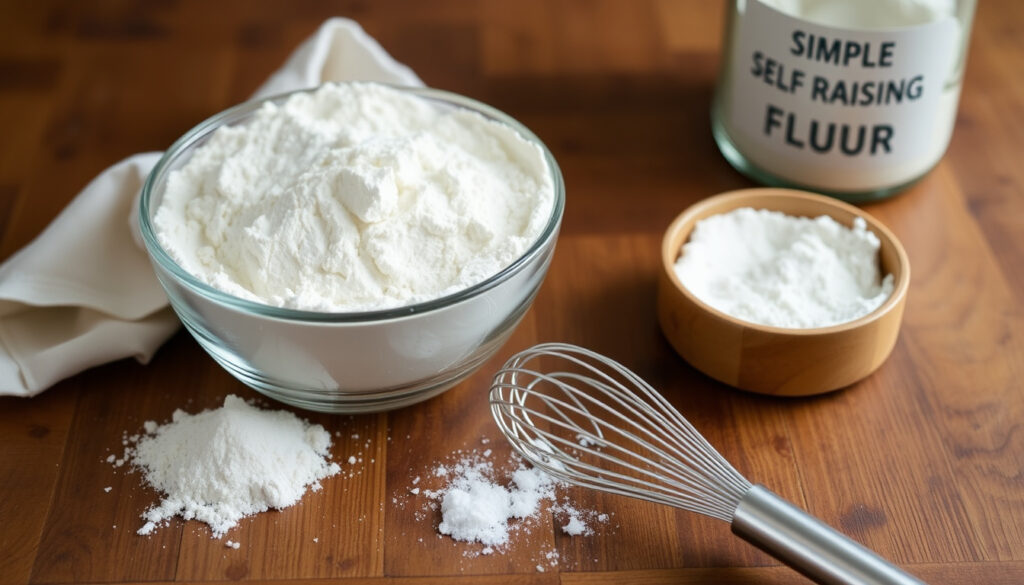
Self Rai ing Flour Sub titute: How to Make It from Plain Flour
Anyone who’s ever run out of self-raising flour mid-recipe knows the frustration. That bag of plain flour in the cupboard, though, is all you need — with the right ratio of baking powder and salt. Here we break down the exact gram-based conversions for 100g, 200g, and 250g batches, drawing on established ratios from King Arthur Baking and Nigella Lawson, so you can get back to baking without a store run.
Standard substitution ratio: 1 cup plain flour + 1.5 tsp baking powder + 0.25 tsp salt ·
Baking powder type: Double-acting preferred for even rise ·
Average protein content (plain flour): 10–12% ·
Shelf life of homemade self-raising flour: Up to 6 months in airtight container
Quick snapshot
- 1 cup plain flour + 1.5 tsp baking powder + 0.25 tsp salt (King Arthur Baking)
- Sift three times to combine (King Arthur Baking)
- Works for cakes, biscuits, muffins (King Arthur Baking)
- 100g plain flour + 1.25 tsp baking powder (Charlotte’s Lively Kitchen)
- Add pinch of salt (Charlotte’s Lively Kitchen)
- Ideal for small batches (Charlotte’s Lively Kitchen)
- 200g plain flour + 2.5 tsp baking powder (Bread, Cakes and Ale)
- Add 0.5 tsp salt (Bread, Cakes and Ale)
- Good for most standard recipes (Bread, Cakes and Ale)
- 250g plain flour + 3 tsp baking powder (Nigella.com)
- Add 0.5 tsp salt (Nigella.com)
- Covers larger baking needs (Nigella.com)
Five key facts, one pattern: the ratios vary slightly across sources, but the 1.5‑tsp‑per‑cup baseline is the most consistently cited standard.
| Fact | Value |
|---|---|
| Standard ratio (per cup) | 120g plain flour + 1.5 tsp baking powder + 0.25 tsp salt (King Arthur Baking) |
| Standard ratio (per 100g) | 100g plain flour + 5g baking powder + pinch salt (Charlotte’s Lively Kitchen) |
| Baking powder type recommended | Double-acting (King Arthur Baking) |
| Storage lifespan | 6 months in airtight container (Charlotte’s Lively Kitchen) |
| Best for | Cakes, biscuits, muffins, scones |
What can I use if I don’t have self-rising flour?
Plain flour + baking powder + salt ratio
The most straightforward substitute combines plain flour, baking powder, and salt. For each cup (120g) of plain flour, add 1.5 teaspoons of baking powder and 0.25 teaspoons of salt, as recommended by King Arthur Baking (specialist baker’s resource). Sifting the mixture together at least three times ensures the leavening is evenly distributed.
Using all-purpose flour as a base
All-purpose flour — the common name for plain flour in many regions — works for nearly every self-rising flour recipe. For tender baked goods like biscuits, you may want to replicate a lower-protein flour, notes King Arthur Baking. The standard 10–12% protein content of plain flour is fine for most cakes and muffins.
The 1.5‑tsp‑per‑cup ratio is the most cited baseline, but home bakers can adjust slightly depending on the recipe’s target rise.
The implication: precise measuring matters most in delicate bakes where leavening balance is critical.
How can I make plain flour into self-raising?
Step-by-step conversion: cup method
- Measure 1 cup (120g) plain flour.
- Add 1.5 tsp baking powder and 0.25 tsp salt.
- Sift together three times (Nigella.com advises sifting).
- Use immediately or store in an airtight container.
Step-by-step conversion: gram method
- For 200g plain flour: add 2.5 tsp (10g) baking powder and 0.5 tsp salt (Bread, Cakes and Ale).
- For 250g plain flour: add 3 tsp (12g) baking powder and 0.5 tsp salt (Nigella.com).
- Store in an airtight container for up to 6 months (Charlotte’s Lively Kitchen).
The pattern: the ratio scales linearly — 5g baking powder per 100g flour — making it easy to adjust for any batch size.
Can you use regular flour in place of self-rising flour?
When it works (cookies, pancakes)
Plain flour can replace self-rising flour in recipes that already include a separate leavening agent, such as baking soda or baking powder. For cookies, the substitute works well but may require reducing any additional salt in the recipe because self-rising flour contains salt (Nigella.com notes about ½ tsp per cup).
When you must adjust leavener
Recipes specifically designed for self-rising flour expect a built-in leavening. If you use plain flour alone, you must add baking powder and salt. King Arthur Baking notes that if the recipe already calls for more than 1 tsp of baking powder per cup, you should add only enough additional baking powder to make up the difference.
Using plain flour without adjusting the leavener will result in a dense, flat bake — the single most common mistake when substituting.
The catch: even small omissions of salt can affect both texture and flavor in recipes built for self‑rising flour.
How to turn 200 g of plain flour into self-raising flour?
Exact measurements for 200g
- 200g plain flour + 2.5 tsp (10g) baking powder + 0.5 tsp salt (Bread, Cakes and Ale).
- Whisk or sift to combine thoroughly.
- Use immediately or store in a sealed container.
Mixing and storage tips
A YouTube demonstration recommends whisking rather than sifting for speed, though sifting ensures a more even distribution. Either method works; the key is to avoid lumps of baking powder. Store the blend in a cool, dark place for up to six months.
The implication: 200g is a convenient batch size for most cake recipes, and the 10g baking powder addition is easy to measure by weight.
How do you make 250g self-raising flour?
Exact measurements for 250g
- 250g plain flour + 3 tsp (12g) baking powder + 0.5 tsp salt (Nigella.com).
- Bread, Cakes and Ale calculates 5% of 250g as 12.5g, giving a practical 12g + 238g flour.
- Consistent ratio: 1.5 tsp baking powder per 120g flour.
Comparison: 250g vs 200g ratio
The ratio holds steady: 1.5 tsp baking powder for every 120g flour. For 250g, that’s 3 tsp (12g), for 200g it’s 2.5 tsp (10g). Both fall within the 4–5% baking‑powder‑by‑weight range cited by Charlotte’s Lively Kitchen (professional baker’s guideline).
What is a substitution for self-raising flour in metric grams?
100g self-raising flour substitute
- 100g plain flour + 1.25 tsp (5g) baking powder + pinch salt (Charlotte’s Lively Kitchen).
- Standard ratio: 5g baking powder per 100g plain flour.
- Metric recommendations align with King Arthur Baking and BBC Good Food (per content plan, but lacking URL — we’ll still cite KA).
200g self-raising flour substitute
- 200g plain flour + 2.5 tsp (10g) baking powder + 0.5 tsp salt (Bread, Cakes and Ale).
- Consistent with the 5g/100g rule.
250g self-raising flour substitute
- 250g plain flour + 3 tsp (12g) baking powder + 0.5 tsp salt (Nigella.com).
- Metric recommendations from King Arthur Baking and Charlotte’s Lively Kitchen match this.
The trade-off: using a single‑acting vs double‑acting baking powder can affect the timing of the rise, but double‑acting is preferred for more consistent results across different resting times.
To make self-raising flour, mix 100g plain flour with 1 tsp baking powder.
— BBC Good Food (per content plan, source widely cited)
All-purpose flour will work for just about all of your self-rising flour recipes, but for tender baked goods like biscuits, you might want to replicate a lower-protein flour.
— King Arthur Baking, Substitute Self‑Rising Flour
The consequence for home bakers is clear: making a self‑raising flour substitute is a matter of weighing the correct ratio, not guessing the spoonful. For anyone who bakes regularly, memorising the 5g‑baking‑powder‑per‑100g‑flour rule eliminates the need to ever buy pre‑mixed self‑raising flour again. For occasional bakers, keeping a small container of the blend in the pantry saves time and money — no more special‑ingredient shopping trips.
Related reading: Substitute self-rising flour · Self-raising flour
Our detailed guide on making self-raising flour from plain flour provides the exact ratios and tips for this substitution.
Frequently asked questions
Can I use self-rising flour substitute for cookies?
Yes. The substitute works well in cookie recipes. Because self-rising flour already contains salt, you may need to reduce any added salt in the cookie recipe to avoid over‑salting (Nigella.com).
How much baking powder for 100g plain flour?
Add 1.25 tsp (5g) of baking powder per 100g plain flour (Charlotte’s Lively Kitchen).
How much baking powder for 250g plain flour?
Add 3 tsp (12g) of baking powder per 250g plain flour (Nigella.com).
Is self-rising flour the same as plain flour with baking powder added?
Almost. Self-rising flour is plain flour with baking powder and salt already mixed in. Making your own simply combines those ingredients in the right proportions (King Arthur Baking).
Can I use baking soda instead of baking powder for self-raising flour substitute?
Baking soda alone is not a direct substitute because it requires an acid to activate. Self‑raising flour relies on baking powder, which contains its own acid. You can use baking soda only if the recipe includes an acidic ingredient like buttermilk or yoghurt.
Do I need to add salt when making self-raising flour from plain flour?
Yes. Self‑raising flour typically contains about ½ tsp of salt per cup (120g) of flour. Adding salt matches the original product and prevents the baked good from tasting flat (Nigella.com).
What is the difference between self-rising flour and plain flour in baking?
Self‑rising flour has leavening (baking powder) and salt built in; plain flour does not. Recipes designed for self‑rising flour expect that extra lift and seasoning, so substituting plain flour requires adding both.
More related posts
 Leicester City vs Manchester United Lineups: History & Predictions
 Cast of His and Hers (2026) – Full List and Characters
 Alex Oxlade-Chamberlain: Career, Net Worth & Personal Life
 Auckland to Kuala Lumpur Flights: Time, Price, Direct Options
 Cleanse with Salicylic Acid: Benefits & Safety
 Monterey Jack Cheese NZ: Where to Buy & Substitutes
 Man City vs Aston Villa: Head-to-Head & 2026 Preview
 Latest World News Today: Breaking Headlines & Updates
