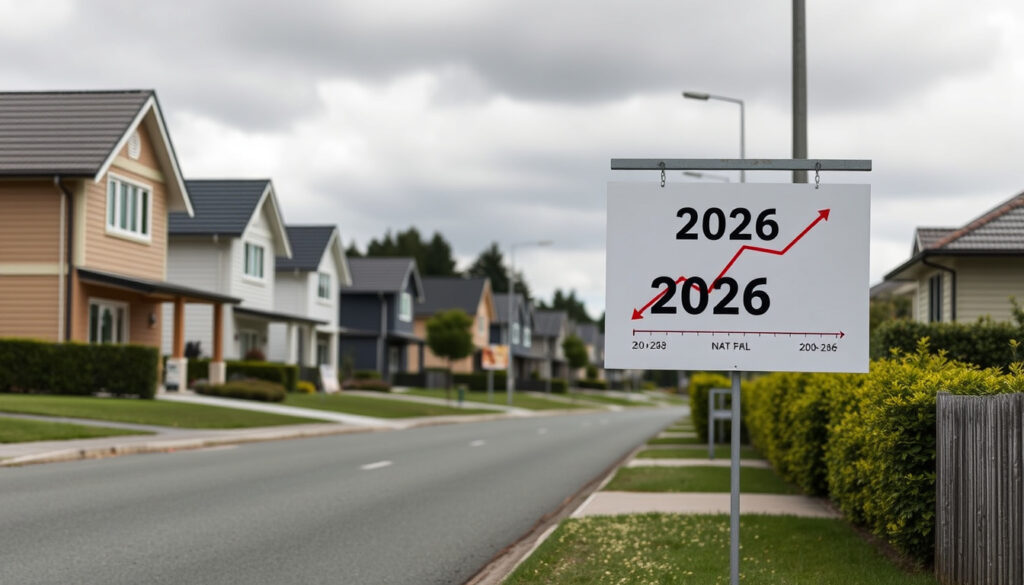
ASB House Price Forecast Revised Down: Flat 2026 NZ Outlook
New Zealand’s major banks have spent the past few years learning a humbling lesson: predicting house prices is harder than it looks. After earlier forecasts of 3–6% growth proved too optimistic, ASB has now joined ANZ and BNZ in sharply revising its outlook for 2026. The result is a housing market consensus that barely moves at all — and a growing gap between what economists hope will happen and what the data keeps showing.
ANZ 2026 Forecast: −2% (down from 5%) ·
BNZ 2026 Forecast: 0% (revised from +2%) ·
ASB Latest Action: Revised down to flat ·
NZ Market Trend: Three years of flat prices
Quick snapshot
- ANZ now expects −2% house price change to December 2026, reversing an earlier 2% increase projection (MacroBusiness)
- ASB’s March 2026 Quarterly Economic Forecast predicts 0% house price growth for 2026 (Opes Partners)
- BNZ Markets Outlook projects flat house prices for 2026, revised down from +2% (Opes Partners)
- Whether mortgage rates will return to the 3% levels seen before the tightening cycle
- The precise depth of any further downside if global uncertainty deepens
- How quickly supply overhang in listings will absorb into demand
- ANZ revised its 2026 forecast from 5% down to 2% in December 2026 (ANZ Property Focus)
- RBNZ December 2026 Monetary Policy Statement projected just 0.03% house price growth to December 2026 (Opes Partners)
- Westpac now forecasts a −1% decline for 2026, down from a prior +4% increase estimate (MacroBusiness)
- BNZ expects the OCR to rise in September and September 2026, pushing floating mortgage rates to 6.0–6.5% by year-end (MacroBusiness)
- ANZ anticipates the first OCR hike in December 2026 (ANZ Property Focus)
- Median bank forecast for December 2026–December 2026 sits at 0.00% (Opes Partners)
The table below consolidates the key figures across the major banks and the Reserve Bank.
| Label | Value |
|---|---|
| Latest Revision | ASB downward adjustment (December 2026) |
| 2026 ANZ Projection | −2% house price change |
| BNZ 2026 Estimate | 0% (from +2%) |
| RBNZ Feb 2026 Forecast | 0.03% growth |
| Westpac 2026 Revision | −1% from +4% |
| Prior ASB Note | Small falls H2 2022 |
| Flat Price Duration | Three years as of early 2026 |
| Wellington Decline | 20%+ from peak |
Will NZ house prices go up in 2026?
The short answer from New Zealand’s biggest banks is a definitive “not by much.” ASB’s March 2026 Quarterly Economic Forecast predicts flat house prices (0% growth) to March 2026, a stark contrast to earlier optimism from multiple institutions that had penciled in 3–6% growth for the year (OneRoof property market analysis). ANZ’s revised Property Focus now expects a −2% decline, reversing an earlier 2% increase projection, citing rising mortgage rates and global uncertainty as headwinds (MacroBusiness economic reporting).
ASB’s revised forecast details
ASB chief economist Nick Tuffley expects a slight pickup in 2026 but has been clear this will not resemble a dramatic boom. The bank attributes its cautious stance to elevated listings and an inventory overhang that continues to suppress price momentum (OneRoof property market analysis). Past forecasts from multiple banks — including ASB’s own earlier projections — have consistently overstated growth, with predictions of 5–6% for 2023 resulting in actual declines, and 3–5% growth predicted for 2024 landing flat (MoneyHub NZ forecast tracker).
Comparisons with ANZ and BNZ
The three major banks now share a remarkably similar outlook: flat or near-flat for 2026. BNZ’s Markets Outlook, released in September 2026, projects 0% growth — down from a prior +2% forecast — with real prices potentially falling to 2016 levels by mid-2027 if current conditions persist (MacroBusiness economic reporting). Westpac has gone further, predicting a −1% decline for 2026 after previously expecting 4% growth. Reserve Bank NZ’s February 2026 Monetary Policy Statement sits at the extreme end of caution, projecting just 0.03% house price growth to December 2026 (Opes Partners forecast compilation).
Will mortgage rates drop to 3% again?
For borrowers who remember the sub-3% era of 2020–2021, the answer from economists is an uncomfortable “not soon.” BNZ expects floating mortgage rates to reach 6.0–6.5% by the end of 2026, a significant increase from current levels (MacroBusiness economic reporting). Both ANZ and BNZ expect the Reserve Bank to lift the Official Cash Rate (OCR) in late 2026 — ANZ anticipates the first hike in December 2026, while BNZ projects increases in both September and December 2026 (ANZ Property Focus report).
ASB home loan rate trends
ASB’s own rate guidance aligns with the broader industry consensus: mortgage rates will remain elevated through 2026, with fixed-term options offering some relief for those willing to lock in. However, the era of sub-3% rates appears to have closed for the foreseeable future, with economists pointing to persistent inflationary pressures and global energy shocks as factors that could keep rates higher for longer (MacroBusiness economic reporting).
2026 outlook from experts
The consensus among bank economists is that mortgage rates will remain a headwind for housing activity through 2026. ANZ’s Property Focus notes that rising mortgage rates have shifted from a tailwind to a headwind for house prices, a reversal from the low-rate environment that powered the market’s 2020–2021 boom (ANZ Property Focus December 2026). CPI inflation is reportedly expected to remain above 4% in 2026 due to global energy pressures, which limits the RBNZ’s ability to cut rates (MacroBusiness economic reporting).
Borrowers choosing fixed rates above 5% gain budget certainty but pay a premium; those on floating rates retain flexibility but face growing risk as OCR hikes approach.
Should I fix my mortgage in 2026?
The decision to fix a mortgage in 2026 involves weighing certainty against potential future rate cuts. With the RBNZ expected to hike the OCR twice in late 2026, and BNZ forecasting floating rates at 6.0–6.5% by year-end, locking in a fixed rate now offers protection against further increases (MacroBusiness economic reporting). However, historical bank forecasting accuracy suggests caution: past predictions of rate cuts have frequently proven premature.
Pros and cons of fixing now
On the pro side, fixing at current rates protects against OCR hikes that ANZ and BNZ both anticipate in the final quarter of 2026. With house prices expected to remain flat to negative, locking in a predictable mortgage cost could provide useful stability for household budgets. On the con side, if inflation moderates faster than expected, borrowers who fix now may find themselves paying above-market rates once the RBNZ eventually pivots to cuts.
UK borrower insights adapted to NZ
UK mortgage fixing patterns offer a loose parallel for NZ borrowers considering term length. In the UK market, borrowers choosing 2-year fixes have historically benefited when rates subsequently dropped, while those on 5-year terms avoided mid-cycle volatility. In the NZ context, with OCR hikes anticipated but uncertain in timing, a mid-term fix (3 years) may offer a reasonable balance between certainty and flexibility.
Will mortgage rates go down to 3% in 2026?
The data suggests this is unlikely to happen within the 2026 calendar year. ANZ’s Property Focus downgraded its 2026 inflation forecast to 2% from an earlier 5%, but this still reflects a persistent inflation environment that limits the RBNZ’s room to cut rates (ANZ Property Focus). BNZ’s expectation of floating mortgage rates at 6.0–6.5% by end-2026 further reinforces that sub-3% fixed rates are not a realistic 2026 expectation (MacroBusiness economic reporting).
ASB interest rate forecast
ASB’s economists, while acknowledging the potential for economic improvement, see mortgage rates remaining elevated through 2026. The bank’s forecast reflects a market where the RBNZ is actively hiking rather than cutting, creating an environment where rate relief for borrowers is not on the immediate horizon.
Broader NZ trends
House prices have now been flat for approximately three years as of early 2026, according to ANZ’s Property Focus analysis (ANZ Property Focus December 2026). This extended period of stagnation suggests that rate normalization alone may not be sufficient to reignite price growth, with structural factors like housing supply, regional population shifts, and global economic conditions playing increasingly important roles.
Should I fix for 3 or 5 years?
The choice between a 3-year and 5-year fixed mortgage term in 2026 hinges on two competing pressures: the immediate threat of OCR hikes through late 2026, and the possibility that inflation moderates enough to allow rate cuts in 2027–2028. BNZ and ANZ both expect the OCR to rise through the end of 2026, which argues for locking in current fixed rates to avoid the higher floating rates that would follow hikes.
Term comparison factors
A 5-year fixed rate typically carries a premium above 2–3 year rates, reflecting the lender’s commitment to hold rates stable over a longer horizon. However, borrowers who fixed for 5 years in early 2021, at rates below 3%, have benefited significantly as floating and short-term fixed rates have climbed. Conversely, those who chose shorter terms have faced refinancing at progressively higher rates. The lesson from recent history is that certainty has value when rate trajectories are upward, but locking in for 5 years carries the risk of being overcharged if rates eventually fall.
NZ-specific advice
For NZ borrowers in 2026, a 3-year term may offer the best balance: it provides protection against the anticipated 2026 OCR hikes, while retaining flexibility to benefit from potential rate cuts in 2028 or 2029. ASB chief economist Nick Tuffley’s expectation of a “slight pickup” in 2026 — but not a dramatic boom — suggests the bank does not see a major rate-cutting cycle on the immediate horizon that would make a 5-year fix unnecessarily expensive.
The RBNZ’s September 2026 Monetary Policy Statement projected just 0.03% house price growth — the most cautious official forecast in the current cycle. Any signal of a shift toward earlier or more aggressive OCR cuts would be a key input for borrowers reconsidering their fixing strategy.
Upsides
- Fixed rates offer predictability for household budgeting amid OCR uncertainty
- Flat house prices may create buying opportunities for well-funded purchasers
- Southland and select regions expected to outperform national average
- Economy improving could support demand longer-term
Downsides
- OCR hikes expected in late 2026 will push floating rates to 6.0–6.5%
- Bank forecasts have historically been too optimistic on growth
- Wellington down 20%+ from peak; other regions may follow
- Global uncertainty (Middle East conflict cited by BNZ) could worsen outlook
- Three years of flat prices suggests structural headwinds beyond rate cycles
Timeline
Three major institutions have published their 2026 house price forecasts within a four-month window, with each revision moving in a more cautious direction than the last.
| Date | Event |
|---|---|
| December 2026 | ANZ revises 2026 forecast from 5% to 2% in Property Focus report |
| December 2026 | RBNZ Monetary Policy Statement projects 0.03% house price growth to September 2026 |
| September 2026 | ASB Quarterly Economic Forecast: 0% house price growth for 2026 |
| December 2026 | BNZ Markets Outlook revises to flat from +2% |
| Late 2026 | BNZ expects OCR hikes in September and December; ANZ expects first hike in December |
Confirmed vs Unclear
Several aspects of the NZ housing outlook are well-supported by multiple institutional sources, while others remain genuinely uncertain.
Confirmed facts
- ANZ revised to −2% for 2026
- ASB forecasts 0% for 2026
- BNZ revised to 0% from +2%
- RBNZ projects 0.03% growth
- Westpac revised to −1% from +4%
- House prices flat for three years
- OCR hikes expected in late 2026
What’s unclear
- Whether rates will return to 3% levels
- Exact ASB 2026 figure published date
- Depth of Wellington’s continued decline
- Impact of global uncertainty on NZ prices
- Quantitative housing supply/demand balance
What economists are saying
The human element behind these forecasts provides context that spreadsheet projections cannot. Multiple economists have offered candid assessments of the current market.
“Overall, despite an improving economic backdrop, 2026 looks set to be another year of little movement in house prices.”
— ANZ NZ Economists, Interest.co.nz market report
“Our best guess is house prices will rise by 5 to 7% over 2026. Call it 6% to sound precise.”
— Jarrod Kerr, Kiwibank chief economist, OneRoof property analysis
New Zealand’s housing outlook has weakened sharply as the Middle East conflict reshapes the macro environment.
— Mike Jones, BNZ Chief Economist, MacroBusiness economic reporting
expects a slight pickup in 2026 “but not a dramatic boom”
— Nick Tuffley, ASB chief economist, OneRoof property analysis
The divergence between Kiwibank’s optimistic 5–7% call and the near-zero consensus at the other major banks reflects genuine disagreement about whether improving economic conditions will translate into housing market momentum. BNZ and ANZ lean cautious; Kiwibank leans hopeful. ASB sits in the middle, acknowledging improvement while resisting optimism.
Related reading: Home Loan Rates Forecast 2026
This flat 2026 outlook unfolds alongside NZ consumer finance law changes that are reshaping lending at major NZ banks like ASB and ANZ.
Frequently asked questions
What is ASB’s current house price outlook?
ASB’s March 2026 Quarterly Economic Forecast projects 0% house price growth to March 2026, meaning flat prices for the full year. The bank attributes this cautious outlook to elevated listings and an inventory overhang that continues to suppress price momentum.
How does ANZ’s forecast compare to ASB?
ANZ’s outlook is slightly more pessimistic than ASB’s. ANZ expects a −2% decline for 2026, representing a reversal from an earlier 2% increase projection. ASB forecasts flat (0%), making it marginally more bullish than ANZ but aligned in direction.
What factors led to the ASB revision?
ASB revised its forecast based on elevated housing inventory, persistent supply overhang, and the expectation that mortgage rates will remain a headwind. The bank also cited historical inaccuracy in past predictions as a reason for adopting a more conservative stance.
Is now a good time to buy in NZ?
With flat-to-negative price growth expected for 2026 and mortgage rates elevated, buyers who can secure stable financing may find limited price competition. Wellington, down more than 20% from its peak, represents the sharpest correction and may offer relative value for long-term buyers. However, rising floating rates and OCR hikes in late 2026 mean financing costs should be carefully modeled.
What are Wellington house price predictions?
Wellington has experienced the sharpest decline of any major NZ city, down more than 20% from its peak as of early 2026. ANZ and OneRoof reports suggest Wellington will lag the national average in any recovery, with regional variations favoring Southland over Wellington in 2026 forecasts.
How do interest rates impact forecasts?
Interest rates are the primary transmission mechanism between RBNZ policy and house prices. ANZ’s Property Focus specifically cited rising mortgage rates as shifting from a tailwind to a headwind. BNZ expects floating rates to reach 6.0–6.5% by end-2026, which would represent a significant increase from current levels and further suppress borrowing capacity.
What risks does ASB highlight?
ASB highlights supply overhang, elevated mortgage rates, and global economic uncertainty as key risks to its outlook. The bank notes that past optimistic forecasts have been repeatedly revised downward, suggesting that downside risks remain material if any of these factors deteriorate further.
For NZ property buyers and investors weighing their next move, the picture from ASB, ANZ, and BNZ is consistent in one respect: 2026 is unlikely to deliver the price growth that earlier forecasts suggested. Borrowers weighing whether to fix their mortgage face a familiar calculus — pay a premium for certainty now, or gamble on a rate-cutting cycle that economists cannot agree on. The three banks most directly involved in NZ mortgage lending have collectively abandoned optimism, and that signal alone carries weight.
More related posts
 Roaring Meg Pinot Noir: Reviews, Price & Ownership
 AA Car Insurance Login: How to Access Your Account Online
 Cast of Night at the Museum – Complete Actors List
 When Is Summer NZ – Official Dates, Months, Seasons Guide
 Rinnai Hot Water Cylinder: Cost, Lifespan & Problems
 How to Check Motherboard Model: Windows, BIOS & Physical
 Best Places to Watch Sunset in Ireland & Top Global Spots
 Brad Pitt Fight Club: Age, Workout & Transformation
