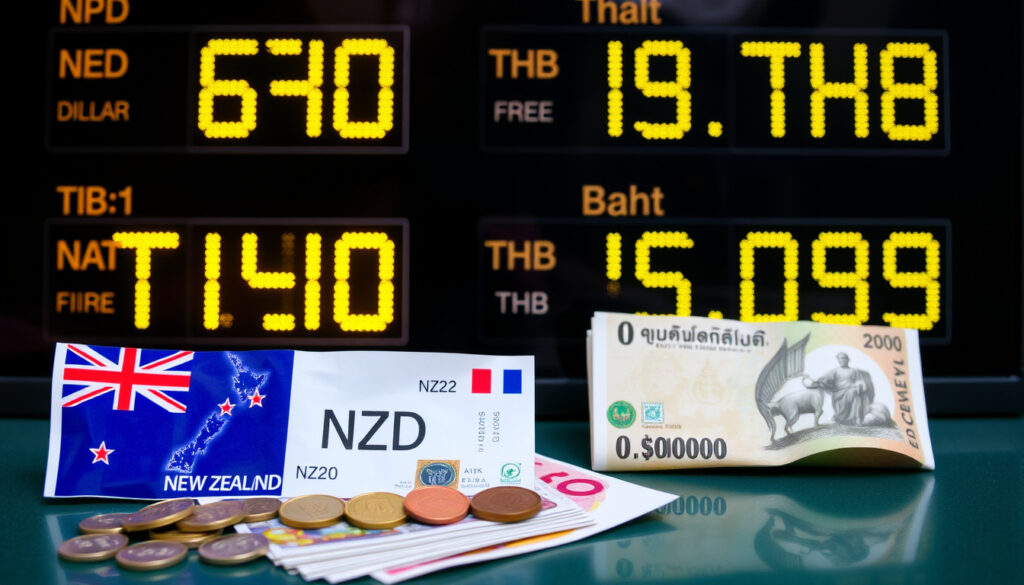
NZD to Thai Baht Exchange Rate Today: Latest Rates & Conversion
Planning a trip from New Zealand to Thailand? Right now, 1 NZD buys around 19.31 THB at the mid-market rate, but the rate you actually get can vary by 10% or more depending on who you exchange with. This guide compares live rates from banks, airport booths, and money-transfer apps to help you plan your budget and avoid losing value.
1 NZD to THB (mid-market rate): ฿19.31 ·
30-day high (NZD/THB): ฿19.4743 ·
30-day low (NZD/THB): ฿19.0541 ·
1,000 NZD to THB at mid-market: ฿19,310
Quick snapshot
- 1 NZD = ฿19.31 at mid-market (Revolut (currency data provider))
- 30-day range: ฿19.05–฿19.47 (Revolut) (Revolut (currency data provider))
- Most NZ banks no longer sell FX cash; Westpac is the only bank option (MoneyHub NZ (travel-money guide))
- Whether the Thai baht will strengthen or weaken in the next month
- Exact fees and markups for every provider — some are disclosed, others hidden in the rate
- Whether the current exchange rate will remain favorable in the coming days
- Since 2020, 1 NZD has traded between roughly 20 and 23 THB (MoneyHub NZ)
- Current levels (around 19.3) are near the low end of that range (MoneyHub NZ)
- Compare at least three providers before exchanging
- Consider using a rate alert tool to lock in when the NZD strengthens
Here’s how different amounts convert at the mid-market rate.
| Amount (NZD) | Thai baht at mid-market |
|---|---|
| 1 | ฿19.31 |
| 100 | ฿1,931 |
| 500 | ฿9,655 |
| 1,000 | ฿19,310 |
| 10,000 | ฿193,100 |
What is the current exchange rate for NZD to THB?
Mid-market rate vs. bank rate
- The true mid-market rate is the one you see on Google or XE — 1 NZD = ฿19.31 as of this writing (Revolut (currency data provider)).
- Banks and physical exchange booths add a markup of 2–5% on top of that. For example, Travelex NZ (retail currency exchange) currently lists 1 NZD = 17.3605 THB for cash — a 10% gap from the mid-market rate.
- Money-transfer services like Wise and Revolut use the mid-market rate and charge a transparent fee (Revolut).
How to check the live rate
- Use a trusted converter like Revolut’s live converter or check MoneyHub NZ’s travel-money page for updated rates.
- Rates move in real time during market hours (Monday to Friday).
The implication: the rate you see on a screen is almost never the rate you’ll get at a counter — the gap is where the costs hide.
How much is $1,000 New Zealand in Thai baht?
Conversion calculation
- At mid-market rate: NZ$1,000 × 19.31 = ฿19,310 (Revolut).
- Using a provider like RemitFinder’s (money-transfer comparison) best rate of 19.3600 THB, NZ$1,000 would give ฿19,360.
- At Travelex’s current cash rate of 17.3605, the same NZ$1,000 yields only ฿17,361 — a loss of almost 2,000 baht.
Fees that reduce the amount received
- Bank transfer fees: typically NZ$15–30 plus a markup on the rate.
- ATM withdrawal fees in Thailand: ฿220 per transaction from local ATMs (not included in the exchange rate).
- Airport exchange kiosks often offer the worst rates, sometimes 5–8% below mid-market.
What this means: the same NZ$1,000 can be worth anywhere from ฿17,361 to ฿19,360 depending on the channel — a difference of nearly 2,000 baht, which is a full day’s budget for many travellers.
What is a good exchange rate for NZD to THB?
Historical average rate
- Over the last five years, 1 NZD has typically bought between 20 and 23 THB (MoneyHub NZ).
- The current 30-day high is ฿19.4743, which is 1% above the mid-market — a relatively favorable level compared to the 19.05 low (Revolut).
When to lock in a rate
- If you find a rate within 1% of the mid-market (i.e., above 19.10 THB per NZD), it’s a good time to exchange.
- Compare at least three providers before committing. RemitFinder’s comparison of 15 providers showed rates ranging from 18.2010 to 19.3600 THB (RemitFinder).
- Use a rate alert tool (many apps offer this) to get notified when the NZD strengthens.
The catch: a “good” rate today might look worse tomorrow — so if you’re close to your target, locking in is better than waiting for perfection.
Is it a good time to buy Thai baht?
Factors affecting the Thai baht
- The Thai baht has weakened against the NZD partly due to Thailand’s slower post-pandemic tourism recovery and differing central bank policies (MoneyHub NZ).
- Seasonal travel demand from New Zealand (peaking around November–February) can also push the rate less favorably because more people are buying baht.
Why use a rate alert
- Apps like Revolut allow you to set a target rate and trade when it hits.
- If you have time before your trip, monitor the rate for a week or two and exchange when the NZD is strong.
The trade-off: timing the market is hard, but with the current range at the lower end of the 5-year average, locking in now may be better than waiting.
How much cash should I bring to Thailand?
Daily spending estimates
- Budget travellers spend about ฿1,204 per day; mid-range around ฿3,288; high-end around ฿9,863 per day, according to The Currency Shop (travel cost guide).
- Entertainment and attractions average ฿618 per day.
Cash vs card acceptance
- Thailand is still largely cash-based for street food, local markets, and small shops.
- Visa and Mastercard are accepted at hotels and larger restaurants, but you’ll still want cash for daily incidentals.
- ATMs charge a flat fee of ฿220 per withdrawal — so withdrawing larger amounts less often reduces the impact.
Why this matters: for a two-week trip, a mid-range budget of ฿46,032 (about NZ$2,384 at mid-market) means you could save NZ$100–200 just by choosing the right exchange method.
The biggest savings don’t come from finding a slightly better rate — they come from avoiding fees. A travel money card like Wise or Revolut can save you 5–10% compared to an airport booth.
Provider comparison
Four channels, one pattern: the markup increases with convenience.
| Provider | Rate (1 NZD to THB) | Fee structure | Best for |
|---|---|---|---|
| Mid-market (reference) | ฿19.31 | No fees (hypothetical) | Baseline for comparison |
| Revolut (digital banking app) | ฿19.51 (displayed) | 0.5%–1% fee per trade | Frequent travellers, app users |
| Travelex NZ (airport booth) | ฿17.36 | 10%+ markup | Last-minute cash needs |
| Panda Remit via RemitFinder (money transfer) | ฿19.36 | Transparent fee often <1% | Large transfers (sending money to Thailand) |
The gap between the worst and best rate on NZ$1,000 is more than 2,000 baht — enough to cover three days of budget travel.
Upsides
- Using an app like Wise gives near mid-market rates with no hidden markup.
- Travel money cards are safer than carrying large amounts of cash.
- Online ordering from TravelMoney NZ guarantees stock and locks in a rate (TravelMoney NZ (currency retailer)).
Downsides
- ATMs in Thailand charge a flat fee of ฿220 per withdrawal regardless of amount.
- Most NZ banks no longer offer FX cash services; Westpac is an exception for existing customers (MoneyHub NZ).
- Airport booths offer the worst rates, sometimes 8–10% below market.
Steps to exchange NZD to Thai baht
- Step 1: Check the live mid-market rate
- Use Revolut or XE to get the real rate. Bookmark Revolut’s converter for quick reference.
- Step 2: Compare at least three providers
- Check a comparison tool like RemitFinder for money transfers, and see if your bank offers a travel card.
- Step 3: Choose your method
- For cash: buy online from TravelMoney NZ and pick up at the airport — you lock the rate before you fly.
- For a card: sign up for Revolut or Wise, load NZD, and convert to THB in-app.
- Step 4: Execute the exchange
- If using an app, the process is simple: start your exchange, select NZD to THB, and confirm (Revolut).
- If exchanging cash, bring your passport and be prepared for a markup.
The pattern: the more steps you take before you buy, the more you save. Skipping the research directly costs you baht.
A New Zealand traveller who uses a digital app over an airport booth on a NZ$2,000 trip could save enough for a night’s accommodation in Bangkok.
What we know — and what’s uncertain
Confirmed facts
- 1 NZD = ฿19.31 at mid-market as of today (Revolut).
- The 30-day range is ฿19.05–19.47 (Revolut).
- Most NZ banks don’t sell FX cash; Westpac is the only bank option (MoneyHub NZ).
What’s unclear
- Whether the baht will strengthen or weaken in the coming weeks.
- Exact fees for every provider — some are hidden in the rate spread.
- Whether the current exchange rate will remain favorable in the coming days.
“We use the real mid-market exchange rate and add a small, transparent fee — no hidden markups.”
Revolut (digital banking platform)
“Our cash exchange rates are updated in real time and reflect the cost of handling physical currency.”
Travelex NZ (currency exchange provider)
The bottom line for Kiwis heading to Thailand: the same NZ$1,000 can be worth ฿19,310 if you use a digital provider — or as little as ฿17,361 if you grab cash at the airport. For a mid-range two-week trip, that’s a difference of NZ$200 or more. Use a rate alert, compare three providers, and avoid the airport booth unless it’s an emergency.
Related reading: 1700 USD to NZD – Live Exchange Rate & Conversion Guide and 25 AUD to NZD: Live Rates from 28.35-30.27 NZD Today.
For a detailed look at the current NZD to THB rate, including how it affects your holiday budget, check the latest figures from a New Zealand perspective.
Frequently asked questions
How do I convert NZD to THB on the go?
Use a travel money app like Revolut or Wise. They offer live rates and instant conversion from your phone.
Do I need to exchange currency before flying to Thailand?
Not necessarily. You can withdraw cash from ATMs in Thailand, but be aware of the ฿220 fee per transaction. Ordering cash online from TravelMoney NZ and picking it up at the airport locks in a better rate than walk-up counters.
What fees do banks charge for NZD to THB conversion?
Most NZ banks no longer offer FX cash. For money transfers, banks typically add a 2–3% markup plus a flat fee. Check with your bank before sending.
Can I use New Zealand dollars in Thailand?
No — only Thai baht is accepted. You must exchange before you spend.
Is it better to exchange in New Zealand or Thailand?
Exchange in New Zealand if you can get a rate close to mid-market (e.g., using a travel card). In Thailand, airport booths are expensive, but city exchange counters can offer decent rates — though you’ll need cash on arrival.
How much Thai baht should I get for a two-week trip?
For a mid-range budget of ฿3,288 per day, aim for about ฿46,000 (approximately NZ$2,380 at mid-market). Bring a mix of cash and a travel card.
More related posts
 First Home Buyers Grant NZ: Status, Eligibility & Alternatives
 How Many ml in a Pint: UK 568ml vs US 473ml Beer Guide
 Atmosphere Taylor Jenkins Reid – Synopsis, Characters, Reviews
 Nancy Guthrie Breaking News Today: Updates on Her Disappearance
 Westpac Login NZ Online Banking: Step-by-Step Guide
 Best Hand Cream NZ – Top Picks for Dry Cracked Skin
 Arsenal W.F.C. Standings: WSL & UCL Tables
 Easy Workout at Home: 10-Minute Routines for Beginners
