Home Loan Rates Forecast – 2026 Outlook and Trends
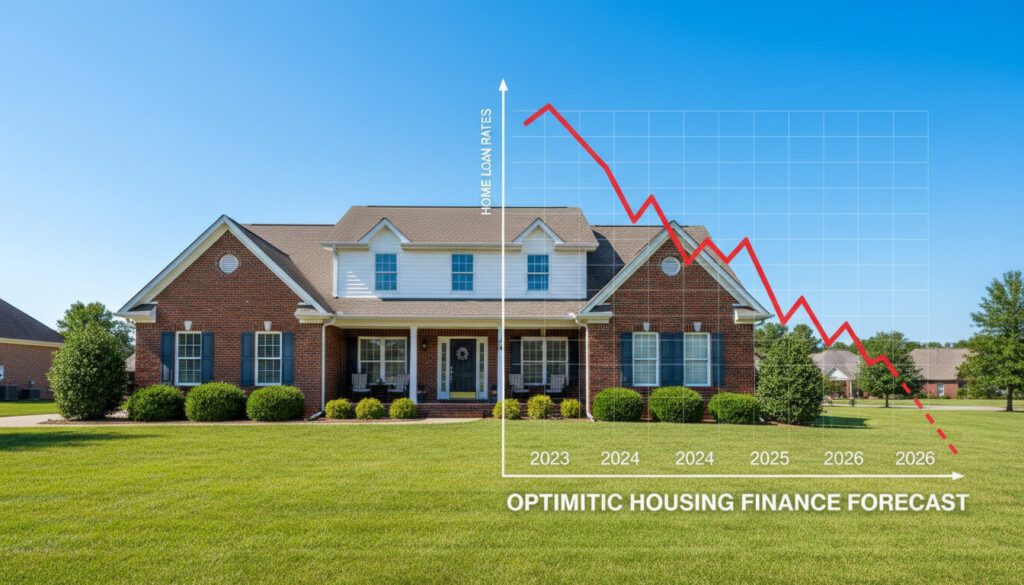
Analysts now project that 2026 will bring further moderation, with forecasts converging around the 6.0 to 6.2 percent range for the year-end average. Some optimistic scenarios suggest rates could briefly dip below 6 percent by mid-2026, potentially reaching 5.5 percent under favorable economic conditions, though such declines remain contingent upon sustained inflation control and stable employment data.
Borrowers currently face a complex decision environment. While rates have improved from the 7-percent-plus levels seen at the start of 2025, the window for dramatic further reductions appears narrow, with most economists anticipating stabilization rather than a return to the sub-3-percent era of 2020-2021.
What is the Home Loan Rates Forecast for 2025?
~6.3%
Above 7%
6.25%
6.2%
- Quarterly data confirms a steady decline from 6.83 percent in Q1 2025 to 6.24 percent by Q4 2025.
- Fannie Mae’s prediction of a 6.8 percent annual average and 6.3 percent year-end rate aligned closely with actual market performance.
- The Mortgage Bankers Association forecasted a slide from 6.9 percent to approximately 6.4 percent, slightly higher than the realized figures. MBA research tracks these quarterly trends.
- Fifteen-year fixed rates maintained a consistent spread below 30-year products, closing the year at 5.5 percent versus 6.24 percent.
- Bankrate’s analysis proved particularly prescient, anticipating rates would occupy the 6-percent range throughout most of 2025 without breaching the 6-percent floor.
- Forward projections for 2026 suggest the first sustained period below 6 percent since mid-2022 remains possible but not guaranteed.
| Metric | Q1 2025 Actual | Q4 2025 Actual | 2026 Consensus |
|---|---|---|---|
| 30-Year Fixed | 6.83% | 6.24% | 6.0%–6.2% |
| 15-Year Fixed | — | 5.5% | Below 30-year |
| Fannie Mae Forecast | 6.8% avg | 6.3% end | 6.2% end |
| MBA Forecast | 6.9% start | 6.4% end | — |
| Bankrate Prediction | 6% range | 6.3% | 6.1% avg, 5.7% low |
| Morgan Stanley Outlook | — | — | 5.5%–5.75% mid-2026 |
Will Home Loan Rates Go Down in 2025?
The question of whether rates would decline during 2025 has largely been resolved by market data showing a 59-basis-point reduction from the first quarter to the fourth. The descent began slowly, with rates stubbornly holding above 6.5 percent for the majority of the year until a pivotal shift occurred in early September.
When Did the 2025 Decline Accelerate?
September 2025 marked the inflection point when emerging weakness in U.S. labor markets convinced bond investors that Federal Reserve policy would tilt dovish, driving 30-year rates decisively below the 6.5-percent threshold. This momentum carried through to late October, when rates touched 6.25 percent—the lowest level recorded that year.
When Will Mortgage Rates Drop Further?
Looking ahead to 2026, Morgan Stanley strategists anticipate that a contraction in the 10-year Treasury yield to approximately 3.75 percent by mid-2026 could compress 30-year mortgage rates to the 5.50-percent to 5.75-percent band. Their analysis suggests this reprieve may prove temporary, with rates likely ascending again in the latter half of 2026 and continuing into 2027.
Bankrate industry analyst Ted Rossman notes that while 5.5 percent remains achievable under optimal conditions, borrowers should prepare for volatility. Stubbornly high inflation readings and rumblings of a less independent Fed could apply upward pressure at unpredictable intervals throughout 2026.
What Factors Affect Home Loan Rates?
Mortgage rates do not move in isolation. Their trajectory reflects a complex interplay between central bank policy, price stability metrics, and international economic turbulence.
Federal Reserve Policy and Employment Data
The Federal Reserve’s cautious approach to rate reductions remains the primary determinant of mortgage pricing. Economic stability indicators, particularly employment figures, heavily influence whether the Fed implements additional cuts. The late-2025 rate decline directly correlated with softening labor market reports, demonstrating this relationship.
Inflation Persistence
Consumer price metrics continue exerting asymmetric pressure on rates. While successful inflation containment supports lower borrowing costs, stubbornly elevated readings maintain upward tension. The aggressive tightening cycle implemented between 2022 and 2024—driven explicitly by inflation concerns—previously drove mortgage rates above 7 percent, illustrating the potency of this factor.
Global Economic Conditions
International uncertainty and market volatility frequently drive capital toward U.S. Treasury securities, indirectly affecting mortgage-backed securities. Concerns regarding global growth forecasts and sovereign debt levels can sustain elevated risk premiums in American home lending markets.
What Are Current Home Loan Rates?
As of late 2025, the 30-year fixed-rate mortgage averages approximately 6.3 percent, while 15-year fixed products hover near 5.5 percent. These figures represent a material improvement from the 7-percent-plus environment dominating early 2025, yet they remain historically elevated compared to the pandemic era. Quarterly tracking data confirms the downward momentum accelerated significantly in the final three months of the year.
Shorter-term mortgages consistently price below their 30-year counterparts. During Q4 2025, this spread amounted to approximately 74 basis points, with 15-year rates at 5.5 percent versus 6.24 percent for 30-year fixed loans, offering significant interest savings for borrowers capable of higher monthly payments.
While current levels show stability, global economic shocks or abrupt shifts in Federal Reserve guidance could reverse recent gains rapidly. The 2023-2024 period demonstrated rates can exceed 7 percent when inflationary pressures resurface.
What is the Historical Trend in Mortgage Rates?
- Pre-Pandemic Baseline (2019-early 2020): 30-year mortgages averaged approximately 3 percent, representing historically affordable borrowing conditions. Freddie Mac historical data confirms these levels.
- Inflation Response Era (2022-2024): Federal Reserve rate hikes to combat inflation pushed mortgage rates above 7 percent, with 2023-2024 marking the peak pain period for homebuyers.
- 2025 Opening: Rates began the year above 7 percent but immediately started drifting lower as inflation moderated.
- September 2025 Inflection: Labor market weakness triggered a decisive break below 6.5 percent.
- October 2025 Trough: Rates reached 6.25 percent, the annual nadir.
- Year-End 2025: Stabilization at approximately 6.3 percent, down significantly from 2024 peaks but triple pre-pandemic levels.
How Reliable Are the Forecasts?
Established Consensus
- Rates have definitively descended from 2024 peaks into the mid-6-percent range.
- Federal Reserve officials remain committed to cautious, data-dependent policy adjustments.
- The 5.5-percent to 6.5-percent range appears likely to contain rate movements through 2026-2027.
- Additional rate cuts require sustained proof of economic cooling and inflation control.
Uncertain Variables
- Precise timing of potential drops below 6 percent remains speculative.
- Whether inflation will resurge or remain contained is an open question.
- Federal Reserve independence and potential political interference create forecast instability.
- Global economic shocks could rapidly alter Treasury yield trajectories.
What Context Shapes Current Rate Levels?
Contemporary mortgage rates exist in a transitional phase between the extraordinary monetary accommodation of 2020-2021 and the restrictive policies implemented to quell post-pandemic inflation. Current levels—approximately 6.2 to 6.3 percent—represent neither the emergency lows of the pandemic nor the punitive highs of 2023-2024.
This positioning reflects a market coming to terms with “higher for longer” interest rate environments. The sub-3-percent era required extraordinary federal intervention and zero-bound Fed policy unlikely to repeat absent severe economic crisis. Conversely, the 7-percent-plus peaks of 2023-2024 required specific inflationary pressures that have partially, though not completely, abated.
Borrowers must calibrate expectations accordingly. The emerging baseline may settle significantly above historical averages of the past decade, potentially normalizing in the 5.5-to-6.5-percent corridor rather than reverting to pandemic-era bargains. Borrowers must calibrate expectations accordingly, and you can explore Asuntojen toteutuneet hinnat Suomessa to understand current market conditions. Asuntojen toteutuneet hinnat Suomessa
What Do Leading Economists Say?
“Stubbornly high inflation readings and rumblings of a less independent Fed could apply upward pressure at other times of the year.”
Ted Rossman, Bankrate Industry Analyst
Rates are expected to move lower in 2025 and 2026, with the 30-year fixed rate anticipated to end 2026 at approximately 6.2 percent.
Fannie Mae Economic Forecast
Is Now a Good Time to Get a Home Loan?
Financial planners generally advise prospective buyers to focus on personal readiness rather than attempting to time market minima. With mortgage rates expected move lower 2025 and 2026 but volatility persisting, borrowers should prioritize credit score optimization, multi-lender comparison shopping, and realistic budget assessment over waiting for theoretical rate floors that may prove elusive or brief. According to the latest mortgage rates forecast, preparing now offers more value than delaying indefinitely.
Frequently Asked Questions
What is the difference between 15-year and 30-year home loan rates?
Fifteen-year fixed rates typically run 70-80 basis points below 30-year rates. In Q4 2025, 15-year rates averaged 5.5 percent compared to 6.24 percent for 30-year fixed mortgages, offering substantial interest savings for borrowers who can afford higher monthly payments.
How does the Federal Reserve directly impact mortgage rates?
The Fed does not set mortgage rates directly, but its federal funds rate influences Treasury yields and bank borrowing costs. The Fed’s 2022-2024 hikes pushed rates above 7%, while its cautious 2025 stance contributed to the gradual decline to 6.3%.
Should I wait for rates to reach 5.5% before buying a home?
Analysts consider 5.5% achievable only under favorable conditions by mid-2026, with Morgan Stanley projecting a subsequent rise. Waiting risks missing current inventory or facing renewed competition if rates drop, plus potential price appreciation.
What credit score qualifies for the best current rates?
While specific thresholds vary by lender, borrowers should maximize credit scores and compare multiple lenders to secure optimal pricing. Current market conditions reward strong credit profiles more than during the ultra-low rate era.
Are refinancing opportunities improving in 2026?
Refinance activity may increase if rates dip below 6% as projected by some analysts, particularly benefiting homeowners who purchased during the 7-percent-plus periods of 2023-2024. However, prepayment penalties and closing costs require careful calculation.
Can international events push US mortgage rates higher?
Yes. Global economic uncertainty drives capital to US Treasuries, affecting mortgage-backed securities. Geopolitical instability or sovereign debt crises can maintain elevated risk premiums, keeping rates higher than domestic conditions alone would suggest.
Is 6.3% considered a high mortgage rate historically?
While triple pre-pandemic levels of ~3%, current rates align roughly with historical averages from the 1990s and 2000s. The 6.3% figure represents moderation from recent peaks but remains expensive compared to the 2010-2021 decade.
More related posts
 Speight’s Ale House Hamilton: Menu, Reviews & Quiz Night
 Easy Workout at Home: Beginner Routines That Work (No Equipment)
 Ancestry Login Already a Member? Fix Sign-In and Recover Accounts
 Air New Zealand Boeing 787-9: The Best Seats for Every Cabin
 Free AI Image Generator from Image: Best Tools & How to Use
 Fijian Drua vs Chiefs: H2H Results, History and Drua Meaning
 Man City vs Aston Villa: Head-to-Head & 2026 Preview
 1400 USD to NZD: Exchange Rate & Conversion Guide (2026)
