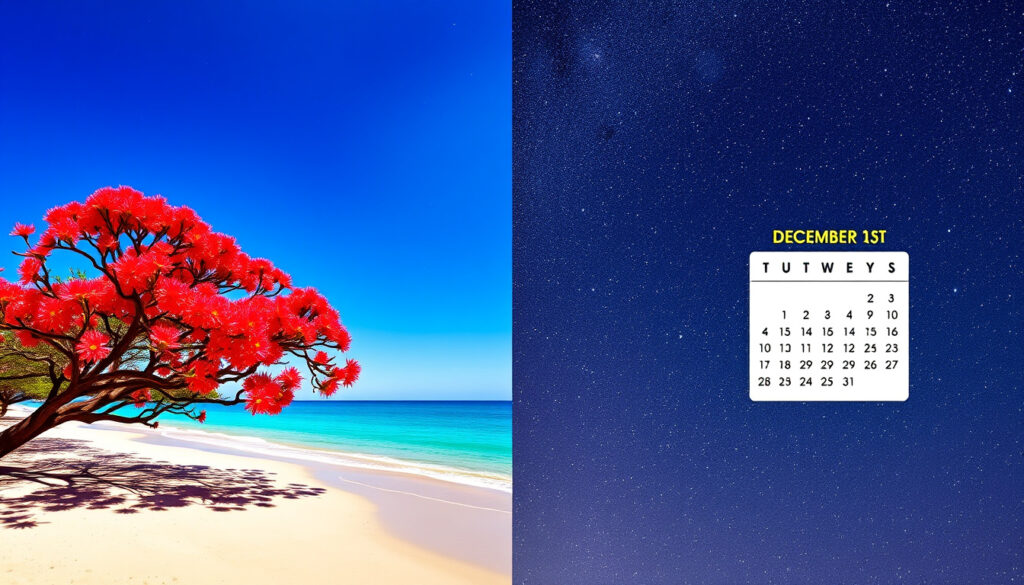
When Does Summer Start in NZ? Meteorological vs Astronomical
New Zealand’s summer start has three competing definitions — meteorological, astronomical, and weather-pattern-based — and they disagree by up to five weeks. Meteorologists point to December 1, astronomers wait for the solstice around December 21–22, and NIWA’s data shows summer can start as early as November 22 or as late as January 5.
Meteorological summer start: December 1 ·
Astronomical summer start (average): December 14 ·
Earliest recorded summer start (NIWA): November 22, 2017 ·
Latest recorded summer start (NIWA): January 5, 1976 ·
Hottest month: February ·
Coldest month: July
Quick snapshot
- Meteorological summer runs December–February (NIWA)
- Summer solstice occurs around December 21–22 (Britannica)
- February is the hottest month (NIWA)
- Exact solstice date varies year to year (Dec 21 or 22)
- NIWA’s “warmest 90-day” start can shift by weeks
- Earliest NIWA start: Nov 22, 2017 (NIWA)
- Latest NIWA start: Jan 5, 1976 (NIWA)
- Autumnal equinox ~March 20–21 ends astronomical summer
- Meteorological summer ends February 28/29
Five key facts that summarise New Zealand’s summer start definitions at a glance.
| Label | Value |
|---|---|
| Meteorological summer months | December, January, February |
| Astronomical summer start date | December 21 or 22 (summer solstice) |
| Average summer start (NIWA) | December 14 |
| Hottest month | February |
| Coldest month | July |
What months is summer in NZ?
Meteorological summer: December, January, February
The simplest answer comes from meteorologists. NIWA (New Zealand’s National Institute of Water and Atmospheric Research) defines summer as the three calendar months December, January and February. This “meteorological summer” is fixed and used for consistent climate statistics. As NIWA explains, meteorological seasons are three-month blocks that make record-keeping straightforward.
For planning holidays or comparing year-on-year temperatures, the meteorological definition gives you a stable calendar. No guessing—summer always starts December 1.
Astronomical summer: from summer solstice to autumnal equinox
Astronomers use Earth’s orbit. The Royal Observatory Greenwich notes that summer begins at the solstice—when a hemisphere is tilted most toward the Sun. In the Southern Hemisphere that happens around December 21 or 22. Britannica confirms astronomical summer lasts from the summer solstice until the autumnal equinox (around March 20–21). So by this count, summer in NZ starts on the solstice, not a fixed date.
The implication: if you celebrate the solstice as summer’s true beginning, the date shifts by a day each year. For 2025, the December solstice falls on December 21.
Is December 1st the first day of summer?
Meteorological definition: yes, December 1
If you follow the meteorological convention, December 1 is the first day of summer. NIWA’s forecasters use this calendar-based start for daily weather reporting and long-range outlooks.
Astronomical definition: no, summer solstice is the start
Astronomically, the first day of summer is the solstice. NIWA explains that astronomical seasons are based on Earth’s position relative to the Sun. The solstice marks the moment the Sun reaches its highest point in the sky—the longest day of the year in the Southern Hemisphere. The National Weather Service (US) adds that on the summer solstice the Sun is directly over the Tropic of Cancer (Northern Hemisphere) or Capricorn (Southern). So for New Zealand, December 1 is not astronomically summer until the solstice about three weeks later.
NIWA’s data reveals a third layer. When the institute defines summer as the warmest 90-day period of the year, the average start is December 14—right between the two official calendars. That “weather-pattern start” has arrived as early as November 22, 2017, and as late as January 5, 1976.
Choosing one definition over the other can delay your summer plans by up to three weeks—or, if you use NIWA’s actual temperature data, start them in November.
The pattern: no single calendar satisfies all purposes — one definition can push your summer plans back by weeks or start them before December.
What is the hottest month in New Zealand?
February is typically the hottest month
Across most of New Zealand, February edges out January as the hottest month. NIWA records show average highs between 20–25°C in February, depending on location. The delay—summer starts in December but peaks in February—is due to thermal lag: the ocean and land take time to warm up after the summer solstice.
Regional variations: Northland vs. Southland
In Northland (e.g., Kaitaia), February averages around 24°C, while in Southland (e.g., Invercargill) it’s closer to 18°C. The official tourism site 100% Pure New Zealand lists December–February as the warmest months, with February typically the peak.
What is NZ’s coldest month?
July is the coldest month
July is New Zealand’s coldest month, with average lows ranging from 5–10°C. Winter runs from June to August, and July consistently records the lowest nationwide temperatures. The NIWA climate data confirms July as the chilliest month.
Winter temperatures by region
In the North Island, July lows hover around 8°C in Auckland; in the South Island, Queenstown can drop to 1°C. The pattern reinforces that July is the core of winter.
When does summer end in NZ?
Meteorological end: end of February
Meteorological summer ends on February 28 (or 29 in a leap year). NIWA then marks autumn as March, April, May.
Astronomical end: autumnal equinox (around March 20)
Astronomically, summer ends at the autumnal equinox when day and night are nearly equal. Britannica states the Southern Hemisphere autumnal equinox occurs on March 20 or 21. After that, the Sun moves north and days grow shorter.
What this means: if you plan a summer holiday, the meteorological end gives you a hard deadline, while the astronomical end gives you a few extra weeks of daylight.
Timeline signal
- – Meteorological summer begins (NIWA)
- – Summer solstice (astronomical summer start) (Britannica)
- – Hottest month of the year (NIWA)
- – Meteorological summer ends
- – Autumnal equinox (astronomical summer ends) (Britannica)
Confirmed facts
- Meteorological summer in NZ is December to February (NIWA)
- February is the hottest month (NIWA)
- July is the coldest month (NIWA)
- Summer solstice occurs around December 21–22 (Britannica)
What’s unclear
- Exact date of astronomical summer start varies by year (solstice date)
- NIWA’s “warmest 90-day” start can shift by weeks
Quotes
“There’s a great debate about when summer actually begins—meteorologists, astronomers, and even New Zealanders themselves don’t always agree.”
— NIWA (National Institute of Water and Atmospheric Research), discussing the three competing definitions
“New Zealand’s summer months are December, January and February—the warmest time of the year.”
— 100% Pure New Zealand (official tourism site)
For anyone planning a summer trip or tracking seasonal changes, the choice between calendars matters. Meteorological summer gives you a fixed anchor; astronomical summer ties you to ancient celestial markers; NIWA’s data-driven start tells you what the weather actually does. For the average New Zealander, December 1 is the practical start—but if you’re after the longest day, the solstice is your real signal.
What are the four seasons in New Zealand?
Spring (September–November), summer (December–February), autumn (March–May), winter (June–August), per meteorological convention.
Does New Zealand have a summer solstice?
Yes, around December 21–22 each year.
What is the weather like in New Zealand during summer?
Generally warm, with average highs 20–25°C; February is often the hottest month.
When is the best time to visit New Zealand for summer?
December to February offers the warmest weather and long daylight hours.
How long does summer last in New Zealand?
Meteorologically 3 months (Dec–Feb); astronomically from solstice to equinox (about 3 months too, but dates shift).
Is summer in New Zealand the same as in the Northern Hemisphere?
No—NZ summer is December–February, while the Northern Hemisphere summer is June–August.
What activities are popular in New Zealand during summer?
Beach holidays, hiking, sailing, and festivals.
For more on how we define other parts of the day, see our piece on when evening officially starts. And for astronomical events like the summer solstice, we’ve covered the dates.
Understanding summer’s start in New Zealand depends on whether you follow astronomical and meteorological definitions of the season, much like the Northern Hemisphere approaches.
More related posts
 How to Make Butter Chicken – Easy Authentic Recipe
 Anna Guy and Simon Dallow: Relationship, Career, and Family Updates
 Rinnai Hot Water Cylinder: Cost, Lifespan & Problems
 Free AI Image Generator from Image: Best Tools & How to Use
 Wairarapa Times-Age Death Notices: How to Check Death in NZ
 Enquiry or Inquiry NZ: Which Spelling Is Correct
 FC Barcelona vs PSG Lineups: Historic Starting XIs & Stats
 Today’s Wordle Answer: Hints & Solution for June 10
