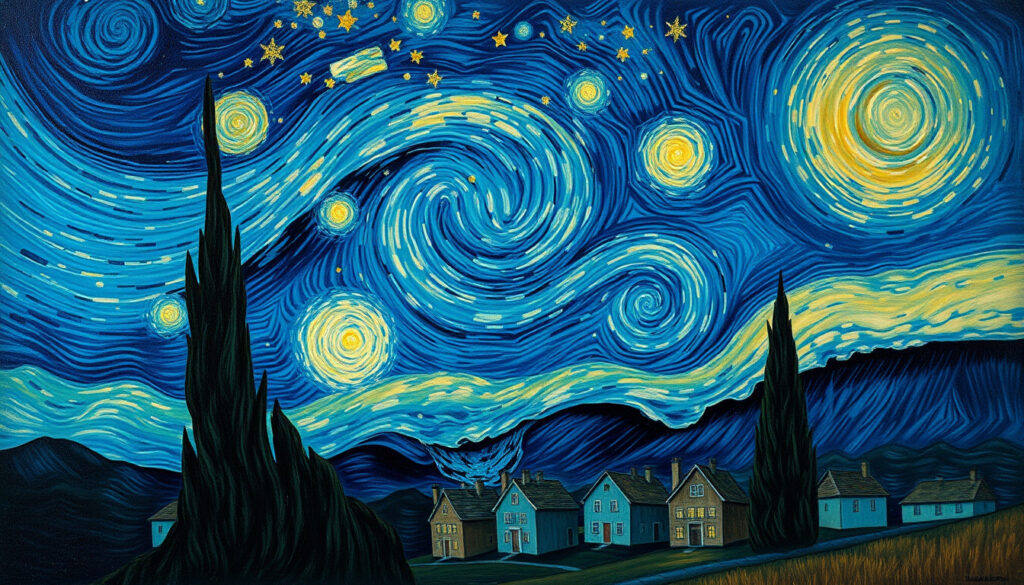
Van Gogh’s Starry Night: Location, Meaning, and Controversy
Few paintings have sparked as much debate as Van Gogh’s Starry Night, painted in June 1889 while the artist was confined to an asylum and dismissed by its creator as a “failure” — yet it has become one of the most recognized images in art history. Its location, meaning, and controversial history are explored below.
Year painted: 1889 ·
Location: Museum of Modern Art, New York ·
Dimensions: 73.7 cm × 92.1 cm ·
Medium: Oil on canvas ·
Artist: Vincent van Gogh ·
Current owner: Museum of Modern Art (MoMA)
Quick snapshot
- Exact meaning of symbols like the cypress tree and number of stars remains debated (Wikipedia)
- Whether Van Gogh genuinely believed the painting was a failure or was being self-deprecating is uncertain (Smarthistory)
- Whether the village in the painting is a literal view from the asylum window or an imagined composition is debated (Wikipedia) (Wikipedia)
- Painted June 1889 at Saint-Paul-de-Mausole asylum (MoMA)
- Acquired by MoMA in 1941 (MoMA)
- On permanent display at MoMA, Floor 2, 2 South (NewYorkTickets)
- Occasionally loaned for special exhibitions (MoMA) (NewYorkTickets)
Six essential details define the painting: artist, year, medium, dimensions, location, and museum. Each is backed by the museum’s own records.
| Artist | Vincent van Gogh |
| Year | 1889 |
| Medium | Oil on canvas |
| Dimensions | 73.7 cm × 92.1 cm |
| Location | Museum of Modern Art, New York |
| Museum | MoMA |
The pattern: the painting’s home is an ocean away from where it was created — and that fact shapes much of its story.
Where is Van Gogh’s Starry Night?
The Starry Night lives at the Museum of Modern Art (MoMA) in New York. It arrived in 1941 through the Lillie P. Bliss Bequest, a gift that brought the work to American shores (MoMA). The canvas hangs in the Paul J. Sachs Galleries on Floor 2, 2 South — a spot that draws crowds daily (NewYorkTickets).
Why isn’t Starry Night in Amsterdam?
Many assume a Van Gogh masterpiece would reside at the Van Gogh Museum in Amsterdam. But Starry Night never traveled there. The Van Gogh Museum confirms that the work’s home is MoMA, not Amsterdam (Van Gogh Museum). Why? The painting was never acquired by the Dutch institution — it passed through private hands and galleries before MoMA secured it in the 1940s (Wikipedia). Budget priorities and acquisition timing meant the Van Gogh Museum missed its chance.
Does the original Starry Night still exist?
The original oil-on-canvas is intact and on display at MoMA. Conservation treatments have kept it stable, but it retains its 1889 character (MoMA). Visitors can see it in person most days, except when it travels for special loans.
“It was acquired in 1941 through the Lillie P. Bliss Bequest, and it has become one of the most beloved works in our collection.”
— Ann Temkin, MoMA curator (MoMA audio)
What this means: the painting you see today is the same canvas Van Gogh handled — a direct link to his studio in Saint-Rémy.
What’s so special about Van Gogh’s Starry Night?
The painting is famous for its emotional intensity and original technique. MoMA notes that the sky is “much more an expression of turmoil in the artist’s imagination than a portrait of the literal night sky” (MoMA audio). It was painted from memory, not from observation — a method that gave Van Gogh freedom to exaggerate.
What makes the painting’s style unique?
Bold, swirling brushstrokes and vivid colors break from naturalism. Smarthistory quotes Van Gogh describing the forms as “exaggerations” and their lines as “contorted like those of ancient woodcuts” (Smarthistory). The sky churns above a peaceful village, creating a tension that keeps viewers looking.
How does the composition reflect Van Gogh’s mental state?
The contrast between a tormented sky and a tranquil town mirrors the artist’s own struggle. He was a patient at Saint-Paul-de-Mausole asylum when he painted it (MoMA). Ann Temkin describes the sky as an “expression of turmoil” — a window into Van Gogh’s mind (MoMA audio).
The artist who made this iconic night scene couldn’t see its future fame. For Van Gogh, the painting was a failed study; for the world, it’s a masterpiece of emotional honesty.
The implication: Starry Night works because it feels raw — and that rawness is exactly what made Van Gogh doubt it.
What did Starry Night symbolize?
Interpretations vary widely. The cypress tree, the stars, and the moon each carry possible meanings — but the artist never spelled them out definitively.
What do the stars and moon represent?
Many see the bright orbs as signals of hope or a connection to the divine. Some link the imagery to Van Gogh’s religious upbringing (Wikipedia). Astrophysicists have even connected the positions of the moon and stars to specific astronomical events visible from Saint-Rémy on May 25, 1889 (Artsper Magazine).
Does the cypress tree have a symbolic meaning?
The cypress is a traditional symbol of death and eternity, says Artsper Magazine (Artsper Magazine). It reaches upward like a flame, tying the earth to the sky — a bridge between mortal life and the infinite.
The catch: no single reading is “official.” The painting invites viewers to project their own meaning, which is part of its staying power.
Why was Starry Night controversial?
Controversy swirls around two points: Van Gogh’s own harsh review and the early reception by critics.
Why did Van Gogh call it a failure?
In a letter to his brother Theo in July 1889, Van Gogh wrote: “I have a new study of the starry sky, but it is a failure” (Smarthistory). He felt the composition didn’t capture what he intended — a quiet night scene. Scholars debate whether he genuinely thought it was poor or was being modest.
How was the painting received by contemporaries?
When it first appeared in public at an exhibition in 1901, critics dismissed its exaggerated style (Wikipedia). It took decades for the art world to embrace its emotional power. Today, it’s one of the most reproduced images in history — a reversal Van Gogh never saw.
Van Gogh’s “failure” label is often used to romanticize the artist. But it may simply reflect his perfectionism — not a genuine belief that the work had no worth.
The trade-off: the very intensity that early critics hated is what later audiences adored. Controversy didn’t kill the painting; it fueled its legend.
Does the original Starry Night still exist?
Yes, and it’s in remarkable condition. The canvas has undergone careful conservation but remains Van Gogh’s original work (MoMA). It is on permanent display — a rare privilege for such a famous piece.
Has the painting ever been damaged or restored?
MoMA has performed routine conservation treatments, including cleaning and stabilization. No major damage has been reported. The painting is monitored in a climate-controlled environment (MoMA).
Where can the public see it?
Visit MoMA in Midtown Manhattan. The painting is in the Paul J. Sachs Galleries. Tickets are required; photography without flash is permitted (NewYorkTickets).
Timeline of The Starry Night
- June 1889 — Van Gogh paints The Starry Night while a patient at Saint-Paul-de-Mausole asylum (MoMA).
- 1890 — After Van Gogh’s death, the painting stays with his brother Theo (Wikipedia).
- 1901 — First public exhibition in Paris (Wikipedia).
- 1941 — Acquired by MoMA through the Lillie P. Bliss Bequest (MoMA).
- Present — On permanent display at MoMA, occasionally loaned for special exhibitions (MoMA).
Confirmed Facts vs. What’s Unclear
Confirmed facts
- Van Gogh painted Starry Night in June 1889 (MoMA).
- The painting is currently at MoMA in New York (MoMA).
- It is an oil-on-canvas work measuring 73.7 × 92.1 cm (MoMA).
- The view was inspired by the asylum window in Saint-Rémy (MoMA).
What’s unclear
- Whether Van Gogh truly believed the painting was a failure or was being self-deprecating (Smarthistory).
- The exact meaning of symbolic elements (e.g., the cypress tree, the number of stars) remains debated (Wikipedia).
- Some suggest the swirls relate to astronomical phenomena like spiral galaxies or comets, but this is speculative (Wikipedia).
Voices on The Starry Night
“In the meantime, I have a new study of the starry sky, but it is a failure.”
— Vincent van Gogh, letter to his brother Theo, July 1889 (Smarthistory)
“It was acquired in 1941 through the Lillie P. Bliss Bequest, and it has become one of the most beloved works in our collection.”
— Ann Temkin, MoMA curator (MoMA audio)
For art lovers and museum visitors, the choice is clear: see the original in New York while you can, or risk missing the one canvas Van Gogh himself doubted — but the world chose to treasure.
britannica.com, icanvas.com, youtube.com, moma.org, instagram.com, reddit.com
For a deeper look into the painting’s history and its location at the Museum of Modern Art, see Van Gogh Starry Night.
Frequently asked questions
How thick is the paint on Starry Night?
The impasto technique means some brushstrokes are several millimeters thick, creating a textured surface visible in person.
What does the cypress tree in Starry Night symbolize?
It is often interpreted as a symbol of death and eternity, connecting earth to the heavens.
Is Starry Night realistic?
No — it is an imagined composition exaggerated for emotional effect, not a literal view from the asylum window.
How long did Van Gogh take to paint Starry Night?
He completed it in a single session in June 1889, working from memory and imagination.
Has Starry Night ever been stolen?
No. It has remained in secure collections since 1941 and has never been reported stolen.
Can I take a photo of Starry Night at MoMA?
Yes, photography without flash is permitted for personal use.
What other paintings did Van Gogh make during his time at the asylum?
He produced over 150 works during his stay, including Irises and The Bedroom versions.
More related posts
 How Many ml in a Pint: UK 568ml vs US 473ml Beer Guide
 Pacers vs Knicks Player Stats: Box Scores & Game Analysis
 What Are Prime Numbers? Definition, List 1-100, & Why They Matter
 Ben Roberts-Smith: Australia’s VC Hero Accused of War Crimes
 Mt Richmond Special School Guide for Parents
 Car Rental New Zealand: Best Companies, Costs & Tips
 USB A to USB C Adapter – Compatibility Limits and Best Picks
 Best Books for Emotional Intelligence: Expert Picks to Build EQ
