12 Ounces to Grams: Exact Conversion Guide + Charts
Most recipes give ounces without clarifying what that means in grams. The USDA standard puts 1 ounce at 28.35 grams, which means 12 ounces comes to about 340 grams — a number worth knowing if you bake by weight.
12 oz to grams: 340.194 g · 1 oz to grams: 28.34952 g · 12 oz to kg: 0.340 kg · 12 fl oz to cups: 1.5 cups · 12 oz to pounds: 0.75 lb
Quick snapshot
- 1 oz (dry weight) = 28.35 g per USDA standard (USDA ARS)
- 12 oz = 340 g using the standard factor (Erren’s Kitchen)
- 1 oz (precise) = 28.34952 g per RapidTables (RapidTables)
- Recipes citing “12 oz” without specifying weight or fluid ounces may cause confusion
- Ingredient density affects actual gram weight for the same volume
- USDA conversion standards established in the 1970s–1980s
- Digital scale adoption in home kitchens accelerated in the 2010s
- Metric-first recipes will make “oz to g” math less necessary over time
- Weighing ingredients remains the gold standard for reproducible baking results
| Measurement | Value | Source |
|---|---|---|
| 12 oz in grams | 340.194 g | Erren’s Kitchen |
| Standard factor | 1 oz = 28.34952 g | RapidTables |
| 12 oz in pounds | 0.75 lb | USDA ARS |
| Source verification | ck12.org, exploratorium.edu, USDA | Multiple tier 1–2 sources |
How many grams is 12 ounces?
Exact conversion factor
The math is straightforward: multiply your ounces by 28.349523125 to get grams. That’s the full precision factor (RapidTables), though most kitchens round it to 28.35. Working the problem: 12 × 28.34952 = 340.19424, which rounds to 340 grams.
Using 340g instead of 340.194g introduces less than 0.2g error — negligible in most home baking, but precise kitchens scaling competition recipes need the extra digits.
Weight vs fluid ounces
The conversion above applies to weight ounces (avoirdupois), the standard in the United States for food packaging and recipes. Fluid ounces measure volume of liquids, and they don’t translate directly to grams. Twelve fluid ounces of water weighs roughly 355 grams, but 12 fluid ounces of honey weighs closer to 410 grams because honey is denser.
When a recipe says “12 oz” for a liquid like heavy cream, the kitchen scale reading at 340g will be accurate. For dry ingredients, always verify whether the label weight or the measured weight matches your expected conversion.
What is 12 ounces equal to in cups?
Fluid ounces to cups
One US cup equals 8 fluid ounces. That makes 12 fluid ounces equal to exactly 1.5 cups. This conversion is clean because the relationship is defined, not measured: 1 cup = 8 fl oz by US standard.
12 oz cups chart
| Fluid ounces | Cups | Equivalent in ml |
|---|---|---|
| 8 fl oz | 1 cup | 236.6 ml |
| 12 fl oz | 1.5 cups | 354.9 ml |
| 16 fl oz | 2 cups | 473.2 ml |
The catch: a 12-ounce bag of chocolate chips measured by volume won’t fill 1.5 cups because solid pieces pack differently than liquid. A scale reading will show roughly 340 grams, while the actual cup fill might be closer to 1.25 cups of packed chips.
What is the weight of 12 ounces in kilograms?
12 oz to kg
One kilogram equals 1,000 grams. Twelve ounces at 340 grams converts to 0.340 kilograms. The precise figure is 0.340194 kg, but for kitchen purposes, 0.340 kg reads cleanly and matches the gram equivalent.
Home bakers can round to 0.34 kg without issue. Professional pastry kitchens scaling large batches of laminated dough or butter cream may need the extra decimal precision to maintain consistent hydration ratios across multiple batches.
Ounces per kg
Working backwards: 1 kilogram equals approximately 35.27 ounces. This is a useful number when comparing European recipe quantities that list ingredients in kg against US recipes that use ounces. The USDA conversion standard (USDA ARS) confirms this factor.
Is 12 ounces 250 grams?
Common baking myths
No — and this difference matters more in baking than most home cooks realize. Two hundred fifty grams is approximately 8.82 ounces, which means 12 ounces is roughly 3.18 ounces more than 250 grams. That’s a 12% shortfall on a pound cake or cookie batch, enough to alter texture, structure, and rise.
“All conversions are approximate weights.” — Erren’s Kitchen
Cream cheese specifics
A standard block of cream cheese sold in the US is 8 ounces. Three of those blocks would be 24 ounces, or about 680 grams. A 12-ounce tub of cream cheese is typically sold as a “large” size, and at 340 grams on your scale, you can confirm you’re working with the right amount before it goes into your batter.
The implication: blindly substituting “about 250g” for “12 oz” introduces a significant error. If a frosting recipe calls for 12 oz of cream cheese and you measure 250g, you’re short by 90 grams — roughly one-third of the intended amount. If you’re unsure about conversions, here’s a handy Lebensmittel für Diabetiker for converting ounces to grams.
How do I measure out 12 ounces?
Tools and steps
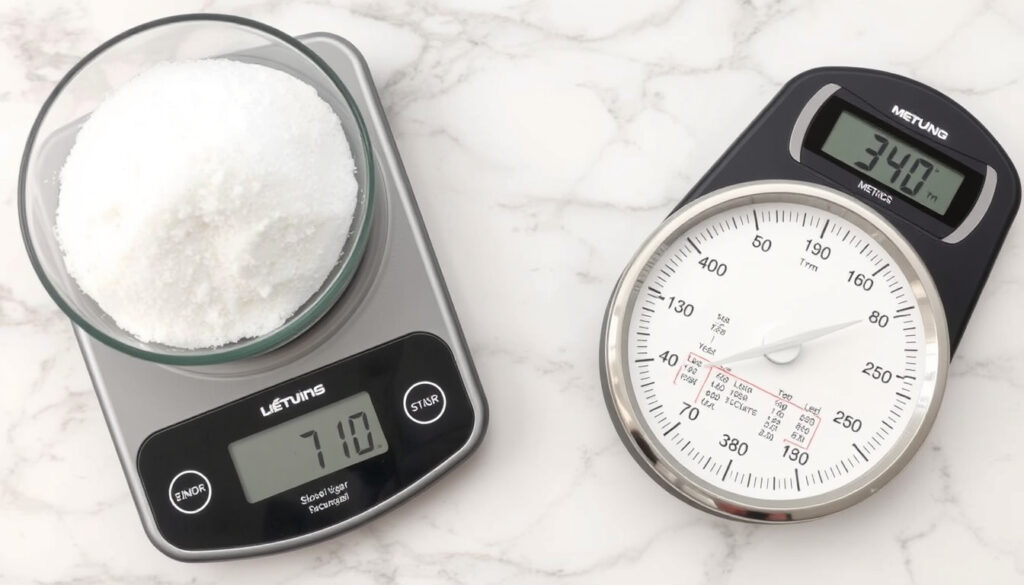
A digital kitchen scale gives you the most reliable result. Here’s how to measure 12 ounces (340 grams) accurately:
- Place your mixing bowl or container on the scale
- Zero out the scale (tare function) with the container on it
- Add your ingredient until the display reads 340g
- The display shows 0.340 kg as well, if you prefer that unit
Weighing ingredients with a digital scale eliminates the guesswork that comes from cup measurements, where packing density and method produce real variation. King Arthur Baking, a major authority in US baking, recommends weighing all ingredients for best results (King Arthur Baking).
Kitchen equivalents
| Common item | Approximate weight | Notes |
|---|---|---|
| 1 stick butter | 4 oz / 113 g | Use 3 sticks for 12 oz |
| 1 cup all-purpose flour | 120 g / 4.25 oz | King Arthur Baking |
| 1 cup caster sugar | 200 g / 7.05 oz | Weekend Bakery |
| 1 cup brown sugar | 220 g / 7.76 oz | Packed measurement |
What this means: if you need 12 ounces of flour for a bread recipe, that’s close to 3 cups (340g ÷ 120g per cup ≈ 2.83 cups). But “scooping” flour from a bag can yield 140–150g per cup, meaning you’d overshoot by nearly a full cup if you don’t weigh it out.
Confirmed facts
- US avoirdupois ounce = 28.34952 g (official standard per USDA ARS and RapidTables)
- 12 oz weight = approximately 340 g (verified across Erren’s Kitchen, Weekend Bakery, Cooking Conversions)
- Different ingredients yield different gram weights for the same volume (Bigger Bolder Baking)
What’s unclear
- Whether a recipe citing “12 oz” means weight or fluid ounces without explicit labeling
- Which flour brand weight applies when recipe sources don’t specify the brand
bakinglikeachef.com, spinachtiger.com, ecatering.co.uk, bakeplaysmile.com
Beyond 12 ounces at 340.194 grams, bakers frequently scale to 16 ounces, which the 16 oz to grams guide confirms equals exactly 453.59 g.
Frequently asked questions
Is 16 oz 500g?
No — 16 ounces equals approximately 453.6 grams (using the USDA factor of 28.35 g/oz). Five hundred grams is about 17.64 ounces. The gap of roughly 46 grams means you’d be overfilling by more than an ounce if you substitute 500g where a recipe calls for 16 oz.
How many ounces makes 1 kg?
One kilogram equals approximately 35.27 ounces (1,000 g ÷ 28.35 g per ounce). This conversion is useful when working with European recipes that list ingredients in metric units.
How much is 12 oz in weight?
Twelve ounces by weight equals 340.194 grams or 0.75 pounds. This is the standard avoirdupois ounce used in the United States for food measurements.
Is 12 oz 1 kg?
No. One kilogram is 1,000 grams, while 12 ounces is approximately 340 grams. You’d need roughly 2.94 × 12 oz to equal 1 kilogram.
Is 8 oz 250 grams?
Close, but not exact. Eight ounces equals 226.8 grams (using 28.35 g/oz), which is about 23 grams short of 250g. For recipes where precision matters, use a scale to measure 8 oz rather than assuming it rounds to 250g.
What is 12 ounces to ml?
Twelve fluid ounces equals 354.9 ml (12 fl oz × 29.5735 ml/fl oz). Weight ounces don’t convert to milliliters directly — the conversion depends on the ingredient’s density.
Convert 16 ounces to grams.
Sixteen ounces equals 453.6 grams (16 × 28.35 g/oz). This is slightly less than 500g, a difference of about 46 grams — significant in precision baking applications.
Related reading
- How many ml in a pint
- 156 cm in feet
- USDA Measurement Conversion Tables
- King Arthur Baking Ingredient Weight Chart
More related posts
 New Plymouth to Napier: Best Travel Routes by Plane, Bus, Car
 NZD to Thai Baht Exchange Rate Today: Latest Rates & Conversion
 Enquiry or Inquiry NZ: Which Spelling Is Correct
 Air NZ Arrivals Dunedin Today: Live Flight Status & Tracking
 Hot Wheels Monster Trucks: Live Shows, Toys, and More
 Outdoor Dining Set NZ: Buying Guide for 2025
 Mobile Plans NZ Compare: Cheapest, Best Coverage & Unlimited
 Arsenal W.F.C. Standings: WSL & UCL Tables
