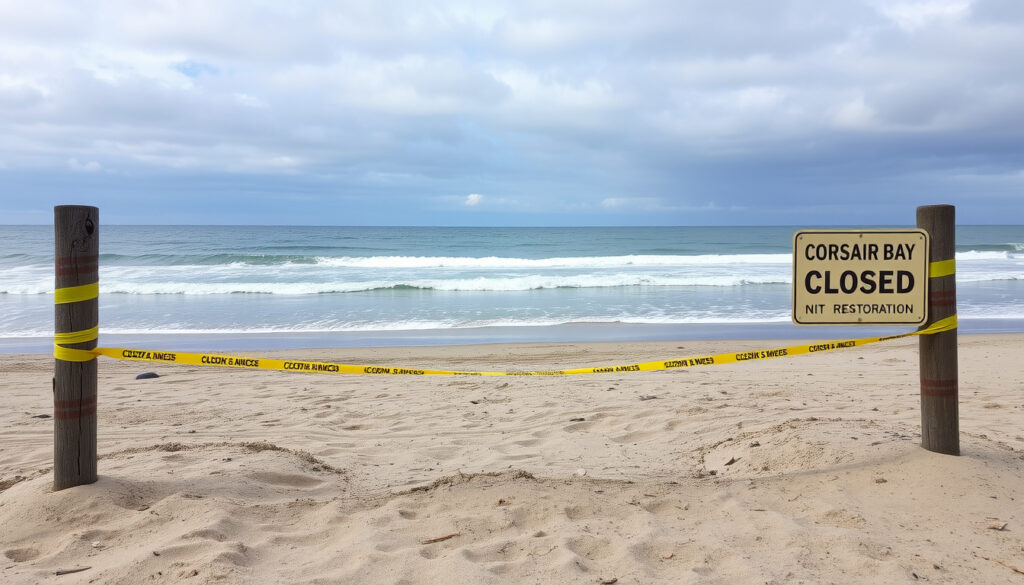
Corsair Bay Beach Closure: What Happened and Next Steps
On 17 February 2024, Christchurch City Council closed Corsair Bay after visitors encountered a foul sewage odour—and a health warning followed within hours. The cause: bottles flushed down public toilets, overwhelming a local septic tank.
Closure Date: 17 Feb 2024 ·
Cause: Bottles in toilets ·
Warning Covered: 3 bays ·
Warning Status: Lifted
Quick snapshot
- Christchurch City Council closed Corsair Bay on 17 Feb 2024 after visitors reported a strong sewage-like smell (Newstalk ZB)
- Bottles flushed down public toilets caused the septic system to overflow (Newstalk ZB)
- Health New Zealand issued a public health warning covering Corsair Bay, Cass Bay, and Rāpaki Bay (ODT Star News)
- Specific date when water testing confirmed safety levels were reached
- Whether long-term monitoring will be implemented at Corsair Bay
- Details on any penalties for items flushed into public facilities
- 17 Feb 2024: Beach closed, health warning issued (ODT Star News)
- Post-Feb 2024: Investigations confirmed bottles as cause (ODT Star News)
- Following testing: Warning lifted after bacteria levels dropped below guidelines (Newstalk ZB)
- Ongoing water quality monitoring planned by Environment Canterbury
- Council repairs to septic system with contractors ongoing
- Beaches remain open but subject to future testing if conditions arise
Key details about the incident are consolidated in the table below.
| Detail | Information |
|---|---|
| Location | Lyttelton Harbour, Christchurch |
| Closure Trigger | Sewage-like smell reported by beachgoers |
| Incident Date | 17 February 2024 (Saturday) |
| Primary Cause | Bottles flushed down public toilets |
| Secondary Factor | Malfunctioning outdoor shower (clean water) |
| Warning Scope | Corsair Bay, Cass Bay jetty/beach, Rāpaki Bay beach |
| Affected Areas Count | 3 |
| Health Warning Status | Lifted after water testing |
Is Corsair Bay open?
Yes—Corsair Bay has reopened to swimmers and recreational water users. Christchurch City Council closed the beach on Saturday, 17 February 2024, after visitors reported a pervasive sewage-like odour upon arrival. A beachgoer described noticing an “ungodly, heavy smell” as soon as they opened their car door, prompting immediate concern among the small crowd gathered at the popular swimming spot near Lyttelton.
Health New Zealand issued a public health warning after detecting untreated sewage discharge at Motu-kauati-iti Corsair Bay. The warning applied to Corsair Bay itself, the jetty and beach at Cass Bay, and the beach at Rāpaki Bay—three adjacent bodies of water within Lyttelton Harbour that shared potential contamination from the overflow.
Current status
The health warning has been lifted. Water testing conducted by Environment Canterbury (ECan) showed faecal bacteria levels had dropped below guideline values, prompting Dr Cheryl Brunton, Medical Officer of Health with the National Public Health Service, to confirm the all-clear for swimmers. “This is great news for swimmers and other recreational water users who would have been avoiding the water following the high levels of contamination,” she said.
Reopening expectations
Council contractors have been repairing the septic system since the incident, working to prevent a recurrence. Christchurch City Council has indicated ongoing water quality testing will continue over the coming days to ensure levels remain safe. The broader sewer network showed no fault—investigations confirmed the issue was confined to the local septic tank serving the public toilet facilities.
The pattern here is straightforward: a preventable infrastructure failure triggered a predictable public health response, followed by resolution once the blockage was cleared and testing confirmed safety. What remains less clear is whether any long-term monitoring or infrastructure upgrades will result from this incident.
Corsair Bay water quality
The incident raised immediate questions about what exactly was flowing into the bay. Video footage captured a small stream of discoloured water bubbling out from near the Corsair Bay toilet block, with a visible puddle forming on the ground nearby. The smell was unmistakable to anyone at the beach that Saturday.
Recent testing
ECan testing revealed that faecal bacteria levels—elevated during the initial incident—had fallen below guideline values after the overflow was contained and the system cleared. Christchurch City Council coordinated with ECan throughout the testing process, with results confirming the water was safe for recreational use. The combined effect of the septic overflow and a malfunctioning outdoor shower discharging clean water down a nearby pathway made the initial water quality inconclusive, but follow-up testing resolved any ambiguity.
Health risks
Public health officials were blunt about the risks during the warning period. Dr Imogen Evans, a public health medicine specialist with the National Public Health Service, stated that water quality at the affected site was “not considered suitable for recreational uses, including swimming because of the risk to health from the bacteria and other pathogens.” Water contaminated by human waste can harbour viruses, bacteria, and protozoa capable of causing gastrointestinal illness, skin infections, and other conditions.
During any future health warning at Corsair Bay or nearby beaches, authorities advise against swimming and against eating fish or shellfish from the affected area. If shellfish are consumed, remove the gut and liver and wash thoroughly before cooking.
Corsair Bay sewage leak
Investigations traced the source to an unlikely culprit: bottles. Christchurch City Council’s public toilets at Corsair Bay experienced a septic tank blockage caused when visitors flushed items—specifically bottles—down the toilets rather than disposing of them in bins. The blockage prevented the system from functioning normally, leading to an overflow of untreated sewage into a small holding tank and subsequently into the surrounding environment.
Reported incident
Raw sewage was visible overflowing near the Corsair Bay toilet block. The blockage in the septic system, caused by bottles and similar items flushed down toilets, led to an overflow into a small holding tank that could not contain the excess volume. This was not a failure of the broader municipal sewer system—the wider infrastructure showed no issues. The problem was isolated to the local septic tank serving the public conveniences.
Blamed factors
Beyond the primary cause of bottles in the toilets, a secondary factor complicated the picture: a malfunctioning outdoor shower was discharging clean water down a nearby pathway, adding to the runoff entering the bay. While this clean water did not pose a contamination risk itself, the combined effect of multiple water sources running into the bay made initial water quality assessments inconclusive until testing could be completed separately.
Christchurch ratepayers fund public toilet infrastructure at scenic spots like Corsair Bay, and this incident underscores that careless disposal choices impose real costs on the community.
Corsair Bay news
The incident generated significant local news coverage, with multiple outlets reporting on the closure, investigation, and subsequent reopening. The timeline moved quickly: beach closed Saturday, health warning issued the same day, investigations confirming the cause within days, and the warning lifted once water testing confirmed safety.
Recent events
The closure and reopening at Corsair Bay played out across several days in mid-February 2024. Christchurch City Council closed facilities at the beach and engaged contractors to repair the septic system. Officials confirmed no evidence of a broader sewer leak affecting the wider Lyttelton Harbour area—the issue was contained to the Corsair Bay septic tank.
Council response
Christchurch City Council acted as both the facility manager and first responder in this incident, closing public amenities and initiating the repair process. The council has not announced any changes to its public toilet maintenance schedule as a result of this incident, though contractors remain on-site completing repairs. Environment Canterbury’s role in water quality monitoring provides an independent check on conditions.
The implication: unless the council changes its approach to public education about what should never be flushed, the same preventable blockage could recur.
Cass Bay water quality
Cass Bay, located adjacent to Corsair Bay within Lyttelton Harbour, fell under the same health warning. The jetty and beach at Cass Bay were included in the advisory issued by Health New Zealand after untreated sewage was detected flowing into the shared harbour waters.
Comparison to Corsair Bay
Both beaches experienced the same contamination event and the same warning lift after testing showed bacteria levels below guidelines. They share a common water source and face similar conditions whenever runoff enters Lyttelton Harbour—making them effectively a single recreational zone during any future pollution event.
Current safety
Like Corsair Bay, Cass Bay has been deemed safe for recreational use following the successful remediation of the septic system and confirmatory water testing. There have been no reports of illness among visitors who used the beaches before the warning was issued, though health officials note that symptoms from sewage exposure can take several days to appear. For more information on the Warriors game, check out this Warriors game weekend guide.
Timeline
Three beaches in Lyttelton Harbour affected, one preventable cause: the Corsair Bay incident moved through distinct phases from discovery to resolution.
Key events in chronological order are summarised in the table below.
| Date | Event |
|---|---|
| 17 Feb 2024 (Saturday) | Beachgoers report strong smell at Corsair Bay; Christchurch City Council closes beach and facilities |
| 17 Feb 2024 (Saturday) | Health New Zealand issues public health warning covering Corsair Bay, Cass Bay, and Rāpaki Bay |
| Post-17 Feb 2024 | Investigations identify bottles flushed down public toilets as cause of septic tank overflow |
| Following testing | Environment Canterbury water testing shows bacteria levels below guideline values |
| After testing confirmed | Health New Zealand lifts warning; beaches reopen to recreational use |
The catch: no permanent infrastructure upgrade has been announced, leaving the septic system vulnerable to the same failure mode.
Lyttelton Harbour’s three beaches reopened within days—but only because testing confirmed the water had flushed clean. No permanent fix to the septic system has been announced.
Confirmed vs. unclear
Confirmed facts
- Closure due to sewage-like smell on 17 Feb 2024
- Bottles flushed down toilets caused septic overflow
- Health warning covered three harbour beaches
- Warning lifted after bacteria levels dropped
- Issue limited to local septic tank, not broader sewer
- Water testing showed faecal bacteria below guidelines
What’s still unclear
- Exact date water testing confirmed safety thresholds
- Whether council plans permanent septic upgrades
- If any enforcement action will follow against those who flushed improper items
- Long-term monitoring schedule from Environment Canterbury
What officials said
“This is great news for swimmers and other recreational water users who would have been avoiding the water following the high levels of contamination.”
— Dr Cheryl Brunton, Medical Officer of Health, National Public Health Service
“Water quality at the affected site is not considered suitable for recreational uses, including swimming because of the risk to health from the bacteria and other pathogens.”
— Dr Imogen Evans, Public Health Medicine Specialist, National Public Health Service
The contrast between these two statements captures the arc of the incident: urgent caution from public health officials during the contamination period, followed by clear relief once testing confirmed the water had returned to safe levels. Neither statement addresses what caused the overflow or whether similar incidents can be prevented—gaps that remain unanswered in the public record.
What this means for visitors
Corsair Bay is back open, but the incident exposes a fragility in the infrastructure that serves one of Christchurch’s most popular summer swimming spots. The council maintains public toilets at the beach; those toilets connect to a septic system that failed when treated as a waste bin. Until infrastructure upgrades are announced or a public awareness campaign makes clear what should never be flushed, the risk of a repeat closure remains.
For swimmers planning a day at Lyttelton Harbour, the practical question is whether to check for active health warnings before heading down—a step most visitors probably never considered before February 2024. Health New Zealand maintains a public register of beach water quality advisories that can be consulted before departure.
Related reading: Raglan Things to Do · Stuff The Press Death Notices Christchurch
Frequently asked questions
Why did Corsair Bay beach close?
Corsair Bay beach closed on 17 February 2024 after visitors reported a strong sewage-like smell. Christchurch City Council closed the beach and facilities the same day, and Health New Zealand issued a public health warning covering three local bays.
What caused the smell at Corsair Bay?
Investigations confirmed that bottles and other items flushed down public toilets caused a blockage in the Corsair Bay septic system. This led to an overflow of untreated sewage from a holding tank. A malfunctioning outdoor shower also discharged water down a nearby pathway, adding to surface runoff.
Is swimming safe at Corsair Bay now?
Yes, swimming has been deemed safe following water testing that showed faecal bacteria levels below guideline values. Health New Zealand lifted the public health warning once results confirmed the water had returned to safe recreational standards.
What is the current status of the Corsair Bay septic system?
Christchurch City Council contractors have been repairing the septic system since the incident. The wider municipal sewer network showed no issues—the problem was confined to the local tank serving public toilets. Long-term upgrade plans have not been publicly announced.
How long will the closure last?
The beach closure lasted from Saturday, 17 February 2024, until water testing confirmed safety and the health warning was lifted. This was a matter of days rather than weeks. Ongoing monitoring continues, but the beaches have fully reopened.
What should visitors do instead if beaches have warnings?
During a health warning, visitors should avoid swimming at the affected beaches and should not eat fish or shellfish from those areas. Other beaches in the Christchurch area—including those outside Lyttelton Harbour—are unaffected by local incidents and can be considered as alternatives.
Who issued the health warning for Corsair Bay?
Health New Zealand, through the National Public Health Service, issued the public health warning on 17 February 2024 after detecting untreated sewage discharge at Corsair Bay.
More related posts
 Signs of a Heart Attack: Symptoms & Early Warnings
 Homes for Rent in Gisborne: Private, Long Term & Cheap
 Man United vs Bournemouth – Preview, Predictions and Lineups
 Nelson Suspicious House Fire: Latest Updates
 Cast of Night at the Museum – Complete Actors List
 Is Coffee Good for You? Benefits, Risks & Research
 Full Moon May 2025: Flower Moon Date, Meaning and Effects
 Mad Butcher Lower Hutt – New Location, Hours & Prices
