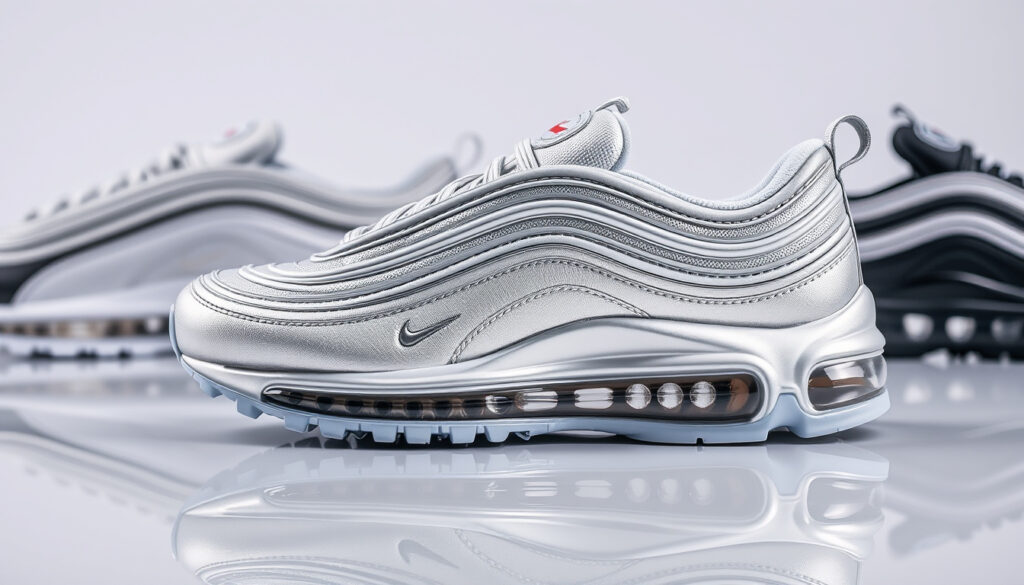
Nike Air Max 97: History, Features and Comparisons
Spot a pair of wavy, reflective sneakers gliding past and you’re looking at the Nike Air Max 97. Debuting in 1997 as a performance running shoe, it shed its athletic origins to become one of the most recognizable silhouettes in streetwear—turning heads in Seoul, London, and Dublin alike.
Original Release Year: 1997 · Designer Inspiration: Japanese bullet train · Price Range: €100 – €150 · Key Feature: Full-length visible Air unit · Top Colorways: Black, White
Quick snapshot
- Released in 1997, designed by Christian Tresser (Sneaker Freaker)
- Full-length Air cushion visible through the outsole (Extrabux)
- Wave-like reflective upper inspired by Japanese bullet train (Sneaker Freaker)
- Air Max 95/97 hybrid dropped March 21, 2025 for Air Max Day (GOAT Editorial)
- Which specific Air Max model holds the #1 global sales crown long-term
- Rarity rankings vary by market and resale data source
- Exact production volumes for limited colorways
- 1997: Original release as running shoe (Sneaker Freaker)
- Late 1990s: Adoption into streetwear culture (Sneaker Freaker)
- 2010s: Retro re-releases and high-profile collaborations (Sneaker Freaker)
- 2025: Air Max 95/97 hybrid launch (GOAT Editorial)
- Air Liquid Max projected for 2026, extending the lineage beyond 40 years
- Ongoing collab-driven retro drops keep the 97 relevant
- Hybrid 95/97 variants likely to expand colorway range
| Specification | Detail |
|---|---|
| Release Year | 1997 |
| Designer | Christian Tresser |
| Key Technology | Full-length Nike Air |
| Typical Price | €100 – €150 |
| Weight (Men’s) | Approx 400g |
| Height Boost | 2-2.5 inches |
| Outsole Material | BRS 1000 Regrind carbon rubber |
| Fit Recommendation | True to size (regular), half size up (wide) |
Why are Air Max 97 so popular?
The Air Max 97 carved out a devoted following by marrying cutting-edge cushioning with a design that looked unlike anything else on the market. Its wave-like upper wasn’t just for show—those reflective panels and layered panels borrowed from the Japanese bullet train gave the shoe an aerodynamic feel that translated both on the track and on the pavement.
Design influences
Christian Tresser drew inspiration from mountain bikes, crash helmets, and the silver STREAMLINER bullet train that zips between Tokyo and Osaka. The result was a shoe with concentric ridges that mimic the train’s exterior and a full-length Air unit that mirrored its smooth, cushioned ride. No other sneaker at the time offered this level of visible cushioning with such a cohesive visual language.
Cultural impact
By the late 1990s, the Air Max 97 had crossed over from track to street. Its bold silhouette photographed well, and the reflective silver accents caught light in a way that made it irresistible for night-time city wear. The model became a canvas for limited releases—metallic colorways, country-specific drops, and eventually collaborations with off-duty designers and music artists.
Celebrity endorsements
While Nike never relied on a single celebrity to sell the 97, the sneaker accumulated fans across musicians, skaters, and fashion figures organically. When figures in hip-hop and streetwear culture were spotted wearing OG colorways, resale prices climbed and the shoe’s underground credibility solidified.
Unlike sneakers that trend for a season and fade, the 97’s design is distinctive enough to remain recognizable three decades later. That staying power is rare in footwear.
When did the Air Max 97 come out?
The Nike Air Max 97 officially dropped in 1997, positioning itself as the flagship of Nike’s Air Max line for that year. It followed the Air Max 95 (1995), which had introduced dual forefoot and heel air windows, and it leapfrogged both predecessors by extending visible Air technology the entire length of the sole.
Development background
Nike’s design team, led by Tresser, experimented with full-length Air as early prototypes in the mid-1990s. The engineering challenge was sealing the unit without puncturing it during manufacturing while keeping the shoe lightweight enough for performance use. The solution involved a redesigned tooling process that became a template for future Max models.
Launch details
The original colorway—silver and deep navy—arrived at a retail price that put it in the premium segment for a running shoe. Early adopters in the US, UK, and Japan were the first to experience the full-length cushioning, though the shoe’s visual impact made it a collector’s item almost immediately.
Initial reception
Critics praised the cushioning and the bold aesthetic, though some traditional runners found the stiff toe box a departure from conventional performance footwear. The shoe’s popularity among non-athletes who cared more about style than stride mechanics surprised Nike, setting a precedent for sneakers designed to transcend their original category.
The Air Max 97 arrived at the right moment: 1997 was peak era for performance footwear innovation, and the shoe’s design language felt genuinely new. That timing gave it legs—literally—that few sneakers maintain across decades.
What is the Nike Air Max 97 for?
Originally engineered as a running shoe with serious cushioning for long-distance trainers, the Air Max 97 serves a broader purpose today. Its durable construction and distinctive look make it a versatile option for everyday wear, from commutes to casual outings.
Original running purpose
The full-length Air unit was designed to absorb impact efficiently during runs, particularly on harder surfaces like pavement. The BRS 1000 Regrind carbon rubber outsole provided grip and durability on wet roads, while the hidden lacing system kept the foot secure without pressure points developing during extended sessions.
Modern uses
Today, most buyers wear the 97 as a lifestyle shoe. The expansive toe box protects against bunions and foot fatigue during standing, which makes it surprisingly practical for office or retail environments. Its springy cushioning holds up well for all-day wear, a fact confirmed by wear tests and user reviews.
Versatility
The Air Max 97 pairs equally well with joggers, jeans, or casual chinos. Available colorways range from classic black and white to bold neons, allowing wearers to match their personal style without compromising on the iconic silhouette.
Do people still wear Air Max 97s?
Absolutely. The Air Max 97 has proven remarkably durable—both in physical construction and cultural relevance. Each retro release generates renewed interest, and the 95/97 hybrid introduced for Air Max Day 2025 shows Nike hasn’t exhausted the model’s potential.
Current trends
Search interest and social media mentions of the Air Max 97 remain consistent year-over-year. Reddit discussions frequently highlight the model’s comfort for all-day wear, though some users note it requires a break-in period before the stiff upper softens. The black and white colorways are perennially popular in Ireland and across Europe.
User experiences
Wearers consistently praise the full-length Air cushion for its standing comfort and the shoe’s ability to absorb impact on hard floors. The trade-off is flexibility: the 97 feels less pliable during extended walking compared to the Air Max 90, which molds to the foot over time. For those prioritizing height boost and cushioning over all-day flexibility, the 97 delivers.
Resale market
Limited colorways and collaboration pairs command significant premiums on resale platforms. The Air Max 95/97 Thunder, which launched March 21, 2025, sold out quickly across European retailers including GOAT, reflecting the model’s continued collector appeal.
The 97’s stiff upper means it doesn’t flex as naturally as the 90 or 95 during long walks. Wide-footed wearers should consider sizing up half a size, as the toe box runs narrower than the 95’s.
Nike Air Max 90 vs 95 vs 97: Key Differences
Three titans of the Air Max family—each with its own character. Choosing between them depends on priorities: cushioning technology, height boost, fit, and intended use all factor into the decision.
Design comparisons
The Air Max 90 features a simpler layered upper with a padded collar, larger heel unit, and deep outsole ridges. The Air Max 95 introduced the layered mesh upper with leather overlays and a curved outsole for stability. The Air Max 97 stands apart with its wavy, reflective upper and full-length visible Air—a design that remains unmatched in the line.
The comparison table below breaks down the key specs side-by-side across the three models.
| Feature | Air Max 90 | Air Max 95 | Air Max 97 |
|---|---|---|---|
| Height Boost | 1.5-2 inches | 1-1.5 inches | 2-2.5 inches |
| User Score | 8.94/10 | 7.95/10 | Not individually rated |
| Fit | True to size, narrow toe box | True to size, rigid narrow fit | True to size, stiffer for wide feet |
| Air Technology | Full-length PU midsole, Max Air heel | Dual forefoot and heel air windows | Full-length air cushion |
| Best For | Versatile wear, break-in comfort | Flat feet, varied surfaces | Height boost, sporty activities |
| Durability | Up to 7 years with care | Up to 7 years with care | Up to 7 years with care |
For users prioritizing stature, the 97 wins decisively. For flat-footed wearers or those needing stability on uneven terrain, the 95’s dual air windows and curved outsole provide superior arch support.
Performance specs
The Air Max 97 delivers the highest height boost of the three models—2 to 2.5 inches—thanks to its full-length air unit. The 90 follows at 1.5 to 2 inches, while the 95 offers the most modest elevation at 1 to 1.5 inches. User ratings from JD Sports indicate the Air Max 90 leads with an average score of 8.94 out of 10, followed by the Air Max 95 at 7.95.
The Nike Air Max 90 seems to be a runaway leader, with an average score of 8.94 out of 10.
— JD Sports Blog (Retail Analyst)
If you’re looking for a serious height boost, the Nike Air Max 97 is your best bet.
— Snkrdunk Magazine (Sneaker Expert)
Popularity factors
The 90’s popularity likely stems from its comfort post-break-in and versatility across occasions. The 97 hasn’t been individually rated in the same JD Sports dataset, but its sustained popularity and collector interest suggest comparable standing.
Upsides
- Highest height boost of the trio (2-2.5 inches)
- Full-length Air cushion for maximum standing comfort
- Distinctive wavy design remains visually striking
- Expansive toe box protects against bunions and foot fatigue
- Durable BRS 1000 Regrind outsole handles varied conditions
- Hidden lacing system provides secure, pressure-free fit
Downsides
- Stiffer upper requires break-in period
- Narrower toe box than 95; wide feet should size up
- Less flexible during extended walking than 90 or 95
- Heavier than lifestyle-focused competitors
- Premium price for a lifestyle shoe
The Air Max 97 in Ireland
Irish sneaker fans have access to the Air Max 97 through major retailers, online platforms, and the resale market. The Air Max 95/97 Thunder dropped across Europe on March 21, 2025, confirming continued availability in the Irish market through GOAT and other EMEA retailers.
Price points in Ireland typically fall between €100 and €150 for standard colorways, with limited editions commanding higher resale premiums. The black and white variants remain the most accessible and versatile for everyday wear, while specialty colorways sell out quickly.
Those seeking specific Ireland-based pricing or stock data should check directly with retailers, as regional inventory fluctuates seasonally.
For Irish buyers, the 95/97 hybrid launches represent the best opportunity to pick up the 97’s design DNA in a fresh silhouette. Monitoring GOAT and regional drops in spring 2025 will likely yield the most availability.
Related reading: Nike Air Force 1 Black Guide
snkrdunk.com, blog.jdsports.co.uk, youtube.com, youtube.com, kickswrap.com
The Nike Air Max 97’s iconic full-length Air unit from 1997 finds deeper context in this history, colorways and buying guide, enriching comparisons with earlier models like the 90 and 95.
Frequently asked questions
What is Nike’s #1 selling shoe?
Based on user ratings from JD Sports, the Air Max 90 currently holds the highest average user score at 8.94 out of 10 among Air Max models. Long-term global sales data varies by market and retailer.
Why are Air Max 95 so popular?
The Air Max 95 introduced dual air windows and a curved outsole that provides excellent arch support, making it ideal for flat-footed wearers and tourists walking on varied surfaces. Its layered upper design also made it a standout visually.
How much do Nike Air Max 90s cost?
Standard Air Max 90 colorways typically retail between €90 and €140, depending on materials and colorway. Limited releases can exceed €200 on resale platforms.
What are the rarest Air Max models?
Exact rarity rankings vary by market and data source. Collaboration pairs, country-specific drops, and early production runs from the 1990s command the highest premiums in collector circles.
Is the Nike Air Max 97 comfortable?
Yes for standing and casual wear—the full-length Air cushion provides excellent impact absorption. Extended walking may feel less flexible compared to the Air Max 90, which molds to the foot over time. The stiff upper requires a break-in period.
Where to buy Nike Air Max 97 in Ireland?
Standard colorways are available through major athletic retailers and online platforms. The Air Max 95/97 Thunder dropped March 21, 2025, via GOAT and other European retailers. Check regional stockists for current availability.
What colors are available for Nike Air Max 97?
Black and white remain the most popular and widely available. Nike releases seasonal colorways including neons, earth tones, and limited collaboration palettes. The Air Max 95/97 Lightning launched March 24, 2025, adding three new hybrid colorways.
The Air Max 97 occupies a unique position in sneaker history: a performance shoe that transcended its category to become a cultural icon. Its wavy design and full-length Air cushioning set it apart in 1997, and neither has aged poorly. For Irish buyers weighing the trio of Air Max 90, 95, and 97, the choice depends on priorities. The 90 wins for comfort and versatility after break-in. The 95 excels for flat-footed stability and all-day walking. The 97 delivers the tallest stance, the boldest silhouette, and a springy ride that still feels modern.
For someone in Dublin looking for a shoe that photographs well, holds its value, and won’t quit after years of wear, the Air Max 97 remains a sensible investment—provided they size up if they have wider feet. Those who do will get a shoe that still turns heads three decades on.
More related posts
 Inland Revenue Student Loan Arrests – Latest Stats and Enforcement
 Free AI Image Generator from Image: Best Tools & How to Use
 Animals Starting With X: Complete List and Fun Facts
 Rokeby Protein Smoothie NZ: 30g Whole Protein, No Added Powder
 Liam Lawson Brazilian GP – Sprint Crash and Race Results
 Nancy Guthrie Breaking News Today: Updates on Her Disappearance
 NZD to Thai Baht Exchange Rate Today: Latest Rates & Conversion
 Call Me by Your Name – Plot Cast Ending Explained
